[Asia Economy Reporter Seo So-jeong] As the won-dollar exchange rate has rapidly risen in a short period, debates surrounding the conclusion of the 'Korea-US currency swap' are heating up. Since the effects of the Korea-US currency swap were felt during the 2008 global financial crisis and the March 2020 COVID-19 pandemic, demands for a swift agreement are growing. However, there are also many opposing views that its effectiveness will be limited.
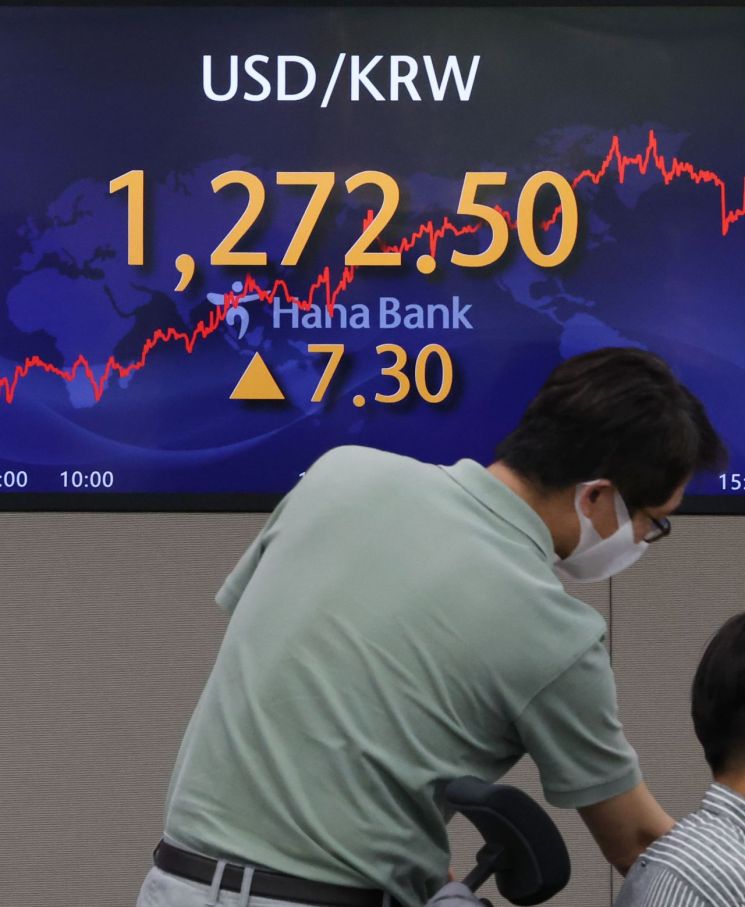
In the Seoul foreign exchange market, the won-dollar exchange rate soared to 1,272.5 won per dollar at the close on the 28th of last month, marking the highest level in 2 years and 1 month. On the following day, the 29th, it reversed to a downward trend after 6 trading days, falling to 1,255.9 won. As the recent rapid rise in the exchange rate continued, authorities strengthened market monitoring and took market stabilization measures. Deputy Prime Minister and Minister of Economy and Finance Hong Nam-ki verbally intervened on the 28th of last month, stating, "We will make efforts to stabilize the market if necessary."
Despite the authorities' verbal intervention, as the won-dollar exchange rate surged to nearly 1,270 won during the day, the highest level in almost two years, First Vice Minister of Economy and Finance Lee Ok-won raised the tone of his remarks on the 29th. Vice Minister Lee said, "If a sudden market imbalance occurs, we will adhere to the principle of implementing market stabilization measures," adding, "We will maintain close cooperation with related agencies and promptly activate market stabilization measures if necessary."
At the end of last month, as concerns about government intervention increased and expectations grew that the Federal Reserve's tightening pace might slow due to weak US first-quarter growth, the exchange rate closed around the 1,250 level. However, the market expects the strong dollar phenomenon to be inevitable for the time being. In the political sphere, as domestic and international uncertainties expand and exchange rate volatility increases, the necessity of concluding a currency swap as an 'exchange rate safety net' is being emphasized.
At the National Assembly's Planning and Finance Committee hearing on the 19th of last month, Governor Lee Chang-yong of the Bank of Korea faced repeated demands to establish a permanent Korea-US currency swap, which ended at the end of last year. Given Korea's high dependence on export industries such as semiconductors, the need for a Korea-US currency swap is inevitably significant. In response, Governor Lee said, "It would be good to establish a permanent currency swap, but meeting the conditions is not easy," adding, "A policy evaluation is needed to assess how it would affect the stability of our economy."
Kim Jung-sik, Emeritus Professor of Economics at Yonsei University, emphasized the necessity, saying, "With global adversities such as US interest rate hikes, China's economic slowdown, and the prolonged Ukraine crisis, we must respond to the crisis by re-pursuing a currency swap with the US," and added, "Our foreign exchange reserves, at $457.8 billion as of March, are not at a reassuring level."
On the other hand, there is also a view that the effect of the Korea-US currency swap on the recent exchange rate rise will be limited. A market official said, "The US currently maintains permanent currency swaps only with five countries: the European Union (EU), Japan, Switzerland, the United Kingdom, and Canada, but many of these currencies, such as the euro and yen, are weak," questioning, "If the argument is for exchange rate stability, how can this phenomenon be explained?"
Amid growing voices for the Korea-US currency swap, a Bank of Korea official said, "After concluding the currency swap contract, we judged that the domestic and international financial and economic situations have stabilized and maintained stability, so the temporary currency swap contract was terminated as scheduled on December 31 of last year," adding, "We are closely examining the effects and impacts of the currency swap."
© The Asia Business Daily(www.asiae.co.kr). All rights reserved.