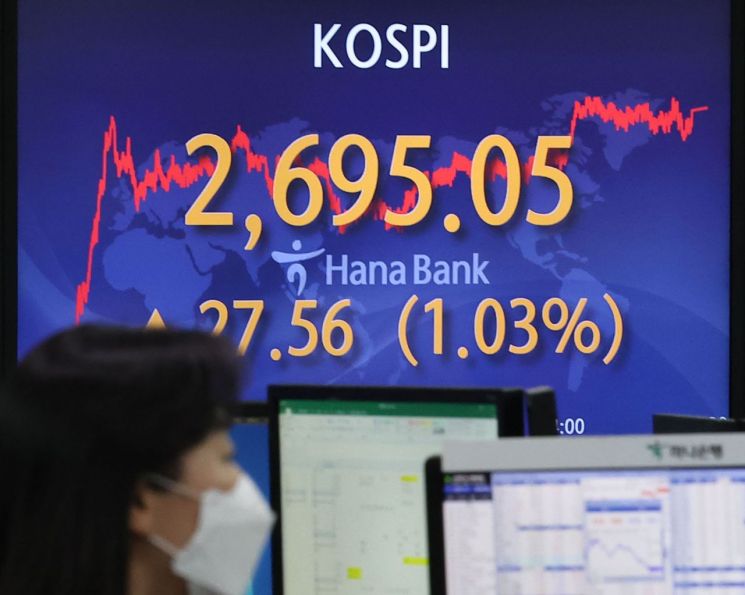
[Asia Economy Reporter Lee Seon-ae] The bottom of the KOSPI in May, as anticipated by the securities industry, is generally around 2600. However, some have also considered the possibility of a breakdown below 2600.
On the 1st, the expected KOSPI ranges for May projected by securities firms were ▲Korea Investment & Securities 2640?2840 ▲Samsung Securities 2600?2850 ▲Kiwoom Securities and Kyobo Securities 2600?2800 ▲Daol Investment & Securities 2560?2780. Overall, the KOSPI 2600 level was seen as the bottom.
Kim Dae-jun, a researcher at Korea Investment & Securities, stated, "Growth slowdown and rapid inflation continue to hamper the stock market, and changes in monetary policies and liquidity environments across countries are also burdensome," adding, "More time is needed for a trend recovery of the KOSPI."
Han Ji-young, a researcher at Kiwoom Securities, said, "The stock market will remain under the influence of macro uncertainties this month as well, so it will take time for a trend rebound. However, China's stimulus policy, earnings expectations, limited exchange rate volatility, and the possibility of calming foreign selling pressure will support the downside and create a box range movement."
However, some also forecast the possibility of a market rebound if the impact of negative factors weakens. Kim Yong-gu, a researcher at Samsung Securities, predicted, "This month, we expect a stock price movement above neutral, surpassing empirical pessimism," and added, "The index path is likely to take a 'low-high' shape around the Federal Open Market Committee (FOMC) meeting of the U.S. Federal Reserve (Fed)." He emphasized, "If a global recession does not materialize, the downside support at the KOSPI 2600 level will be solid," and "Post-Fed policy changes, a retrospective relief could bring the index back up to the 2800 level."
Lee Kyung-min, a researcher at Daishin Securities, also explained, "After the U.S. FOMC, the release of the U.S. April Consumer Price Index and China's inflation data, if concerns about monetary policy ease and the possibility of inflation peaking is confirmed, a completely opposite investment environment could be created."
A researcher at Kiwoom Securities said, "Since the recent stock market crash cannot be explained by fundamental conditions, there is also a possibility of a technical rebound in major countries' stock markets in May."
Meanwhile, experts advised that from an investment strategy perspective, the Wall Street adage 'Sell in May' may not hold this year, and attention should be paid to inflation and the economy. The researcher from Daishin Securities said, "If inflation passes its peak, anxiety about the economy will also ease," adding, "Once expectations for the economy have sufficiently lowered, the market will focus on economic cycle recovery." He recommended, "If short-term price adjustments occur quickly and strongly, it should be used as an opportunity for active weight expansion," and advised a split buying strategy utilizing volatility around the KOSPI 2600 level.
There is also considerable caution regarding investment. Korea Investment & Securities emphasized that the Fed's tightening stance may continue until inflation reaches its peak, warning to be cautious of industries vulnerable to rising interest rates. Kyobo Securities advised that if inflation slows and uncertainties around monetary policy disappear, a preference for safe assets due to recession concerns may deepen, recommending investment priorities in the order of safe currencies, high-quality bonds, and stocks with strong momentum response. They also cautioned that as inflation is controlled, price declines may accompany, making it difficult to find financial asset investment opportunities in the first half of the year, urging a focus on risk management.
© The Asia Business Daily(www.asiae.co.kr). All rights reserved.
![Clutching a Stolen Dior Bag, Saying "I Hate Being Poor but Real"... The Grotesque Con of a "Human Knockoff" [Slate]](https://cwcontent.asiae.co.kr/asiaresize/183/2026021902243444107_1771435474.jpg)















