[Asia Economy Reporter Ki-min Lee] The Presidential Transition Committee announced on the 28th that it plans to strengthen the cost-based principle in electricity rate determination and increase the proportion of nuclear power generation to reduce the burden of factors causing electricity rate hikes.
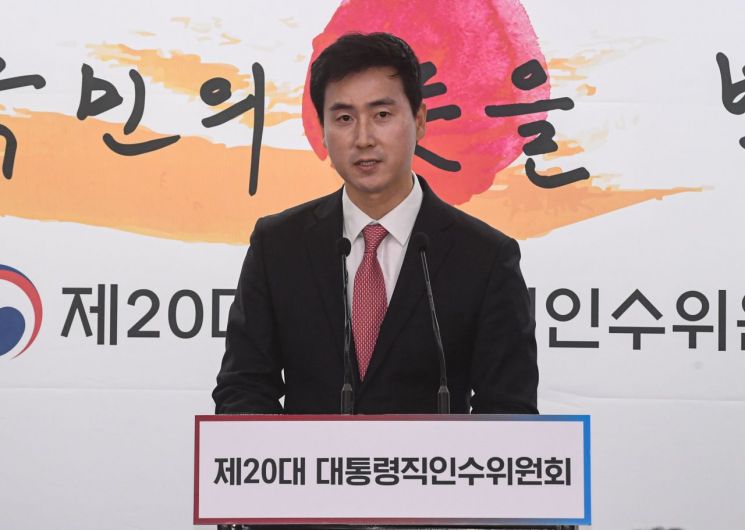
Kim Ki-heung, deputy spokesperson of the Transition Committee, held a briefing on the "Five Key Tasks for Normalizing Energy Policy" at a press conference in Tongui-dong, Jongno-gu, Seoul on the 28th, revealing these plans.
The five key tasks announced by the Transition Committee on the day are ▲achievable carbon neutrality and energy mix ▲market-based demand efficiency ▲energy industry as a new growth engine ▲robust resource security ▲and a warm energy transition.
The Committee plans to first promote achievable carbon neutrality and an energy mix (composition ratio by power source). While respecting the internationally pledged carbon neutrality goals, it plans to reduce carbon emissions through the utilization of nuclear power. Accordingly, it intends to resume construction of Shin Hanul Units 3 and 4, continue operation and adjust utilization rates of nuclear power plants, and not revise the 2030 Nationally Determined Contribution (NDC) for greenhouse gas reduction.
Renewable energy development and dissemination will be continuously promoted considering local acceptance, economic feasibility, and the domestic renewable energy industry ecosystem, while reducing coal and liquefied natural gas (LNG) power generation, which have high carbon emissions.
The Committee also plans to strengthen the cost-based principle of electricity rates, which reflects fuel cost fluctuations necessary for electricity production in the rates, and enhance the independence and expertise of the Electricity Commission.
In particular, the Committee will establish an energy market structure based on competition and market principles. By expanding the scope of Power Purchase Agreements (PPA), it aims to ease Korea Electric Power Corporation’s (KEPCO) monopoly sales structure and foster various demand management service companies.
Park Joo-heon, senior expert of the Economic Division 2 and professor of economics at Dongduk Women’s University, said, "Last year, KEPCO’s deficit reached 5.9 trillion won, and a similar level of deficit is expected in the first quarter of this year," adding, "If the wrong policy practices in electricity price determination continue, the deficit problem will worsen." He expressed expectations that "the expansion of the nuclear power proportion, known as the cheapest generation cost, in the next government will significantly ease the factors causing electricity rate hikes."
However, the Committee views that internal self-help measures are also necessary to improve KEPCO’s deficit. Professor Park added, "Before discussing investment in KEPCO, KEPCO itself must come up with self-help measures."
To restore the nuclear power ecosystem, the Committee plans to resume construction of Shin Hanul Units 3 and 4 as early as possible through inter-ministerial cooperation and introduce a demand forecasting system for nuclear power equipment. It will also strengthen the Korea-US nuclear alliance and establish a nuclear power export promotion team to pursue orders for 10 nuclear reactors.
Although there has been a rapid transition to renewable energy for carbon neutrality, reflecting the fact that the technology has not yet met expectations, the Committee will also strengthen competitiveness in the renewable energy industry. It plans to build domestic and overseas clean hydrogen supply chains through diversification of hydrogen production methods and securing overseas hydrogen production bases, and enhance competitiveness through hydrogen-related R&D.
The Committee plans to expand the scope of resource security to include key minerals as well as energy. To this end, it will promote the establishment of a resource security system and legal framework through public-private cooperation. It will set up a national resource security control tower and establish early warning and crisis response systems. Cooperation among public enterprises, private sector, and government will be strengthened to reduce resource acquisition risks for the private sector.
Meanwhile, the target recipients of the "Energy Voucher," an energy welfare policy for low-income households, will also be expanded.
© The Asia Business Daily(www.asiae.co.kr). All rights reserved.
![Clutching a Stolen Dior Bag, Saying "I Hate Being Poor but Real"... The Grotesque Con of a "Human Knockoff" [Slate]](https://cwcontent.asiae.co.kr/asiaresize/183/2026021902243444107_1771435474.jpg)















