Concerns Over Economic Slowdown Highlighted, US Stock Market Crash Impact
KOSPI and KOSDAQ Indices Close Down Over 1%
Individuals Net Buy of 1.1 Trillion Won in Both Markets
Pearl Abyss Plummets 25% Due to Poor Performance of China-Launched Game
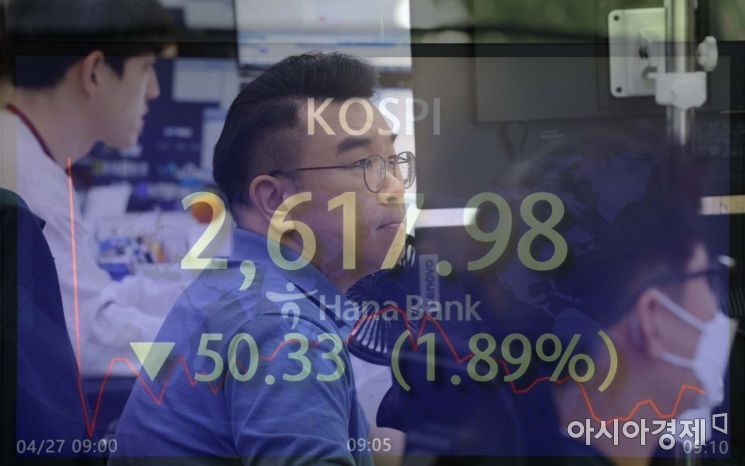 On the 27th, when the KOSPI and KOSDAQ indices plunged by over 2%, dealers were working in the dealing room of Hana Bank in Euljiro, Seoul. The U.S. stock market sharply declined due to concerns over a slowdown in the economic recession and earnings uncertainty among big tech companies, which appears to have caused a chain reaction. Photo by Moon Honam munonam@
[Asia Economy Reporter Minji Lee] The KOSPI closed the session down over 1%. Despite the decline, individual investors are estimated to have bought stocks worth around 1 trillion won, helping to cushion the sharp drop in the index.
On the 27th, the KOSPI closed at 2,639.06, down 1.10% (29.25 points) from the previous trading day. The index opened at 2,630.58, down 1.41% (37.73 points) from the previous day, and fell nearly 2% at one point, but the net buying by individual investors helped reduce the losses. According to investment trends, individuals alone purchased stocks worth 904.5 billion won, while foreigners and institutions sold stocks worth 677.2 billion won and 237.8 billion won, respectively.
The domestic stock market was dragged down by concerns over economic slowdown due to prolonged lockdowns in China. As global companies mentioned the possibility of poor earnings, fears of economic downturn increased.
Lee Kyung-min, a researcher at Daishin Securities, said, "The sharp decline in large tech stocks led the US stock market crash, with factors such as Federal Reserve tightening burdens and economic slowdown concerns cited as reasons for deteriorating investor sentiment. Currently, the financial market is interpreting all changes by amplifying the tightening burden and recession fears to the worst-case scenario. During the process of confirming economic indicators and US inflation data released from late April to early May, additional volatility expansion may occur."
By sector, the largest declines were seen in telecommunications (-3.54%), paper and wood (-2.34%), banking (-2.17%), insurance (-1.62%), and securities (-1.71%). Among the top market capitalization stocks, Samsung Biologics (0.75%) and Samsung SDI (1.55%) showed gains, while Samsung Electronics (-1.66%), LG Energy Solution (-1.3%), SK Hynix (-2.25%), NAVER (-2.26%), Kakao (-2%), and Kia (-0.24%) declined.
At the same time, the KOSDAQ index closed at 896.18, down 1.64% (14.98 points) from the previous trading day. The index opened at 898.02, down 1.44% (13.14 points), and at one point fell more than 2%. In the stock market that day, individual investors alone bought stocks worth 194.5 billion won, while foreigners and institutions sold 11.6 billion won and 182.1 billion won, respectively.
By sector, notable declines were seen in digital content (-7.85%), food and tobacco (-6.31%), and IT software (-4.82%). The digital content sector's decline was mainly due to the fall in gaming stocks, with Pearl Abyss (-25%) having a significant impact. The day before, this game ranked first in popularity on China's Apple App Store and Tencent's app market 'TapTap' within an hour of release but quickly dropped to 29th place. Meanwhile, other gaming stocks also closed sharply lower, including JoyCity (-6.4%), Longtu Korea (-5%), Wemade Max (-4.4%), Com2uS (-4.1%), and Mgame (-4.1%).
Among the top market capitalization stocks, all closed lower except Celltrion Healthcare (0.33%) and Celltrion Pharm (1.71%). EcoPro BM fell 0.22%, and L&F (-1.07%), Kakao Games (-4.04%), LignoTech (-2.53%), Chunbo (-2.35%), and CJ ENM (-1.99%) also declined.
© The Asia Business Daily(www.asiae.co.kr). All rights reserved.
![Clutching a Stolen Dior Bag, Saying "I Hate Being Poor but Real"... The Grotesque Con of a "Human Knockoff" [Slate]](https://cwcontent.asiae.co.kr/asiaresize/183/2026021902243444107_1771435474.jpg)
















