Corporate Asset Ranking Rises One Step After 16 Years
From Refining and Telecommunications to Semiconductors, Batteries, and Bio
Continuously Discovering Future Growth Engines... Expanding Investment Areas
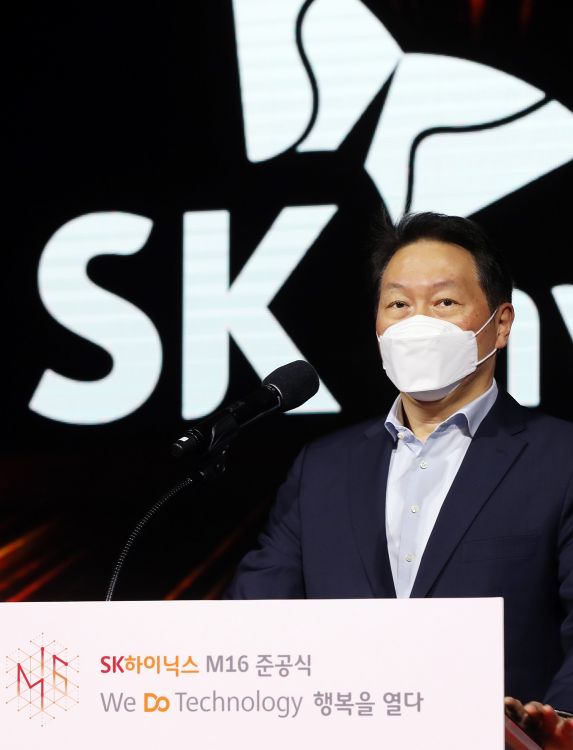
[Asia Economy Reporter Oh Hyung-gil] Behind SK Group's rise to the 2nd place in the asset rankings among large corporations lies its continuous pursuit of future growth engines.
After ventures in refining and telecommunications, SK Group challenged the semiconductor sector and has continuously shifted its activities to batteries, bio, and carbon-neutral industries to drive growth.
Additionally, the group has reorganized key affiliates to align with new business models and pursued initial public offerings (IPOs) to enhance corporate value, supporting quantitative expansion.
According to the '2022 Publicly Disclosed Corporate Groups (Large Corporate Groups)' data released by the Fair Trade Commission on the 27th, SK's total assets amounted to 291.969 trillion KRW, ranking 2nd after Samsung's 483.919 trillion KRW. The number of affiliates increased by 38 from the previous year to 186.
It rose one step again after 16 years since surpassing LG Group to take 3rd place in 2006.
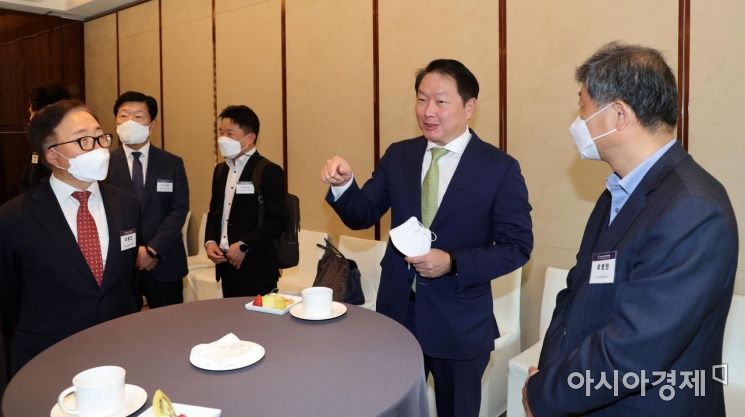 Choi Tae-won, Chairman of the Korea Chamber of Commerce and Industry, and Woo Byung-hyun, CEO of Asia Economy, along with other guests, are having a conversation on the 27th at the Western Chosun Hotel in Jung-gu, Seoul, ahead of the '2022 Asia Future Business Forum' hosted by Asia Economy. Photo by Kim Hyun-min kimhyun81@
SK Group added semiconductors to its growth engines, which were centered on energy, chemicals, and information and communications technology (ICT), by acquiring SK Hynix in 2012, and has since expanded its assets by adding batteries and bio sectors.
The semiconductor sector has supported growth over the past decade. Of the 52.5 trillion KRW increase in assets last year, 20.9 trillion KRW came from the semiconductor field.
After boldly acquiring Hynix, SK made aggressive investments in facilities and research and development, strengthening the semiconductor ecosystem.
It expanded factories in Cheongju and Icheon and strategically built infrastructure capable of producing related products by consecutively acquiring semiconductor specialty gas company SK Materials and wafer company SK Siltron.
Mergers and acquisitions (M&A) are still ongoing. Following the acquisition of Toshiba Memory in 2017 and Intel's NAND business last year, SK plans to acquire the UK semiconductor design specialist ARM.
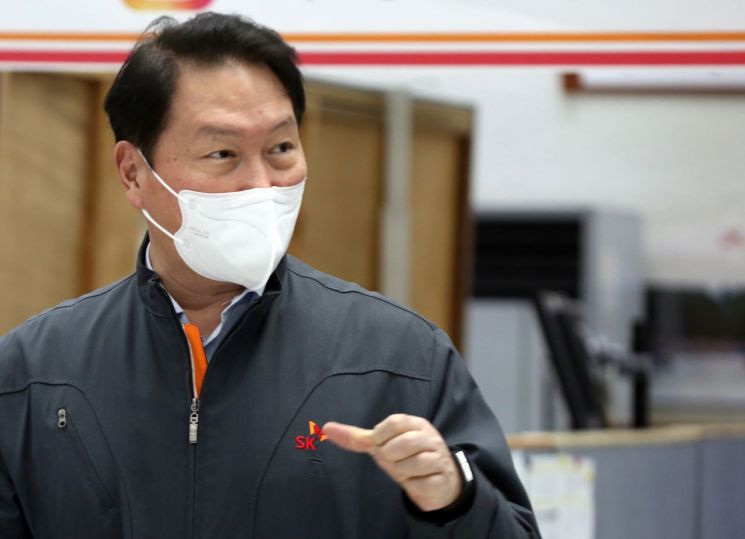
SK is accelerating its business model transformation to realize carbon neutrality.
Starting with the electric vehicle battery business, investments have expanded into eco-friendly, renewable energy, bio, and advanced materials sectors. This is the execution of the financial story 'From Carbon to Green.'
By spinning off SK On from SK Innovation, the pace of the battery business has been accelerated, and SK Inc. and SK E&S have expanded investments in renewable energy sectors such as the US hydrogen company Plug Power.
Additionally, SK Ecoplant has merged and acquired waste and water treatment companies like EMC Holdings, while SKC and SK Chemicals have entered the green energy and bio industries, respectively.
An SK Group official stated, "We will not be complacent with external growth such as asset size but will take the lead in enhancing core indicators such as corporate value, social value (SV), and ESG (environment, social, and governance), growing together with all stakeholders including shareholders, investors, partners, and local communities."
© The Asia Business Daily(www.asiae.co.kr). All rights reserved.
![Clutching a Stolen Dior Bag, Saying "I Hate Being Poor but Real"... The Grotesque Con of a "Human Knockoff" [Slate]](https://cwcontent.asiae.co.kr/asiaresize/183/2026021902243444107_1771435474.jpg)

















