"Prepare for a Major Outbreak by August"
Compensation for Vaccine Side Effect Deaths Raised to 100 Million Won... Government Also Responsible for Proof
No Decisions Made by a Single Cheong Quarantine Planning Officer... Advisory Body to Be Established
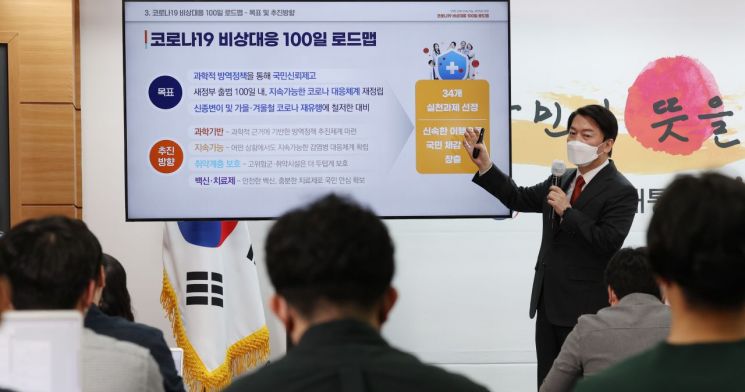
[Asia Economy Reporters Kim Hyemin and Geum Boryeong] Ahn Cheol-soo, chairman of the Presidential Transition Committee, announced on the 27th that he is considering declaring 'outdoor mask-free' within one month after the new government's launch. As part of the 'national responsibility system' for COVID-19 vaccine side effects, the condolence payment for deaths will also be doubled. A presidential advisory body for infectious disease crisis response will be newly established to gather expert opinions and create a structure for formulating COVID-19 policies.
Chairman Ahn held a press conference at the transition committee office in Tongui-dong, Jongno-gu, Seoul, and announced the 'COVID-19 100-day roadmap' with these details. The Transition Committee's Special Committee for COVID-19 Emergency Response set COVID-19 response as a core agenda for the new government and selected 34 practical tasks. The detailed implementation plans were divided into 30-day, 50-day, and 100-day units to form the roadmap. Chairman Ahn stated, "We will complete preparations for a COVID-19 pandemic by August."
Chairman Ahn prioritized reviewing the lifting of outdoor mask mandates as a task to be implemented within one month of the new government. This is interpreted as a guideline indicating that the new government will decide whether to lift the outdoor mask mandate.
Ahn said, "We will recommend (to the current government) to judge (whether to lift the mandate) around late May based on the situation at that time," adding, "If the criteria for removing outdoor masks drop to the level where advanced countries have lifted them, lifting will be possible." He continued, "The indoor mask mandate will continue for the time being," and added, "If masks are removed indoors, it will be almost a sign that daily life has fully recovered."
Along with this, he announced that a nationwide large-scale antibody positivity rate survey will be conducted within one month of the new government's launch. The Transition Committee judged that previous antibody positivity surveys were limited by region (metropolitan area) and subjects (blood donors, military recruits, etc.), making it difficult to accurately grasp the scale of the epidemic. Therefore, the new government plans to select about 10,000 representative samples by reflecting characteristics such as age, gender, and prevalence from 17 cities and provinces nationwide and conduct surveys quarterly.
A strategy to early procure about one million doses of oral antiviral treatments will also be prepared within one month of the launch. The existing planned procurement volume is 1,062,000 doses, but the Transition Committee sees this as insufficient to prepare for a resurgence in autumn and winter. After reassessment, it was determined that an additional 1,009,000 doses are needed. The new government plans to establish a public-private joint consultative body composed of related ministries and the medical community to devise a treatment procurement strategy.
Within 50 days of the launch, the COVID-19 response system will be shifted to focus on general medical care while strengthening emergency and special patient treatment systems. About 7,700 hospital beds will be secured in advance, and a system where patients are treated mainly in general hospitals will be established. Specifically, the number of respiratory clinics equipped with negative pressure facilities will be increased from the current 471 locations, and emergency treatment beds for continuous inpatient care of COVID-19 patients will be expanded from 427 beds to 1,400 beds. There is also a plan to establish specialized infectious disease hospitals.
Compensation for vaccine adverse reactions will also be strengthened. The scope of compensation, which was previously limited to causally recognized diseases by credible domestic and international institutions, will be expanded. Medical expense support will increase from 30 million KRW to 50 million KRW, and condolence payments for deaths will be significantly raised from 50 million KRW to 100 million KRW. The process requiring citizens to prove side effects themselves will be eliminated. The Transition Committee mentioned that after basic review of causality presumptions, support will be provided, shortening the processing period from the current 5-6 months to within 120 days. This has been selected as a task to be promoted within 100 days.
A presidential advisory body for infectious disease crisis response will also be newly established. Chairman Ahn explained, "Currently, a single person, the Blue House's quarantine planning officer, decides all COVID-19 policies," adding, "It is the right direction for multiple experts to gather, collect opinions from various angles, and reach the best conclusion." Additionally, a Vaccination Injury Compensation Support Center and a COVID-19 Vaccine Safety Research Center will be established under the Central Disease Control Headquarters.
© The Asia Business Daily(www.asiae.co.kr). All rights reserved.
![Clutching a Stolen Dior Bag, Saying "I Hate Being Poor but Real"... The Grotesque Con of a "Human Knockoff" [Slate]](https://cwcontent.asiae.co.kr/asiaresize/183/2026021902243444107_1771435474.jpg)















