European Gas Prices Surge... World Bank Warns of 51% Energy Price Increase This Year, Inflation Alert
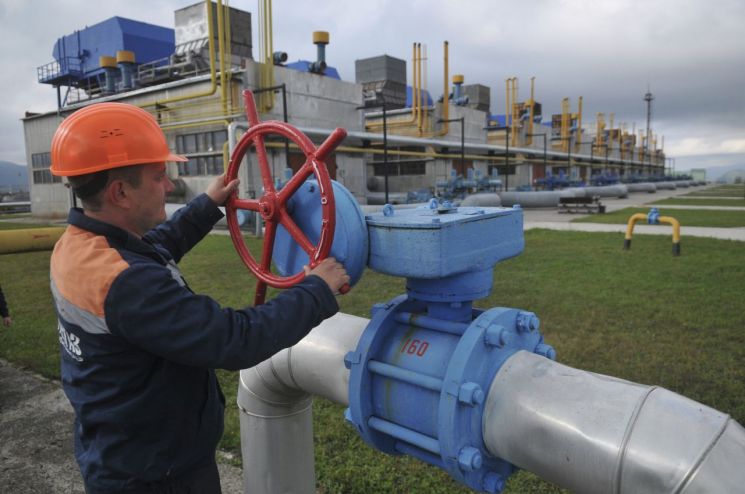
[Asia Economy Reporters Byunghee Park and Hyunwoo Lee] As Russian state-owned gas company Gazprom announced it would cut gas supplies to Poland and Bulgaria, European gas prices surged sharply, raising inflation risks once again. The World Bank warned that energy prices would soar by 50.5% this year and that commodity prices would remain high for a prolonged period due to the Ukraine war.
According to Bloomberg on the 27th (local time), Polish gas company PGNiG stated in a press release, "Gazprom has notified us that it will stop gas supplies starting from the 27th." Poland imports natural gas from Russia through the Yamal-Europe gas pipeline and depends on Russia for more than 40% of its total gas demand.
Polish Prime Minister Mateusz Morawiecki emphasized, "We have been threatened with a gas supply cut from Gazprom," adding, "Poland's gas storage is 76% full, and Poland has been preparing to diversify its gas supply sources."
Bulgaria also received notice of gas supply cuts from Russia. The Bulgarian Ministry of Economy issued a statement saying, "State-owned gas company Bulgargaz has been notified by Gazprom that gas supplies will be cut starting from the 27th." The Ministry protested, "Bulgaria has fulfilled its obligations under the current contract and has paid on time according to contract terms." Bulgaria depends on Russia for over 90% of its total gas imports.
It is presumed that the gas supply cut was triggered by both countries opposing Russia's earlier demand for gas payments in rubles. Previously, Russia demanded that European countries pay all gas fees in rubles or create separate foreign currency payment accounts at Gazprombank, setting a deadline of the 22nd of this month for preparations.
After news of the gas supply cut broke, European gas prices rose sharply. At the Netherlands TTF exchange, the May delivery futures price for natural gas rose 6.6% from the previous trading day to 99 euros per megawatt-hour (MWh). During the session, it peaked at 107 euros.
In a commodity market outlook report released the same day, the World Bank forecast energy prices to rise 50.5% and food prices 22.9% this year. The World Bank explained that energy prices already doubled last year, and the two-year increase in energy prices over last year and this year is the largest since the first oil shock in the early 1970s.
The World Bank expects commodity prices to gradually decline starting this year. It projects energy prices to fall 12.4% and food prices 10.4% next year.
However, it anticipates that it will take a long time for commodity prices to stabilize to pre-COVID-19 pandemic recovery levels.
The World Bank expects Brent crude oil prices to average $92 per barrel next year and then fall to $80 per barrel in 2024. This is 13.6% higher than last year's average price of $70.4.
Winter wheat prices are also expected to peak at $450 per ton this year, then fall to $380 and $370 per ton next year and the year after. However, these levels remain significantly higher than the 2020 and last year's average prices of $315 and $232, respectively.
Regarding future commodity market outlooks, the World Bank stated that it depends on how long the Ukraine war and sanctions on Russia will last but expects the war's impact to be long-lasting. The World Bank said, "The Ukraine war has changed the way commodities are traded, produced, and consumed," and "commodity prices will remain high for the next several years."
© The Asia Business Daily(www.asiae.co.kr). All rights reserved.
![Clutching a Stolen Dior Bag, Saying "I Hate Being Poor but Real"... The Grotesque Con of a "Human Knockoff" [Slate]](https://cwcontent.asiae.co.kr/asiaresize/183/2026021902243444107_1771435474.jpg)











