Impact of China's COVID Economic Lockdown
Investment Shrinks Amid Supply Chain Instability
Nasdaq Down 3.95% from Previous Day
23% Drop from Last November's Peak
Experts Predict Inevitable Downtrend
Advice to Avoid Fire Sales
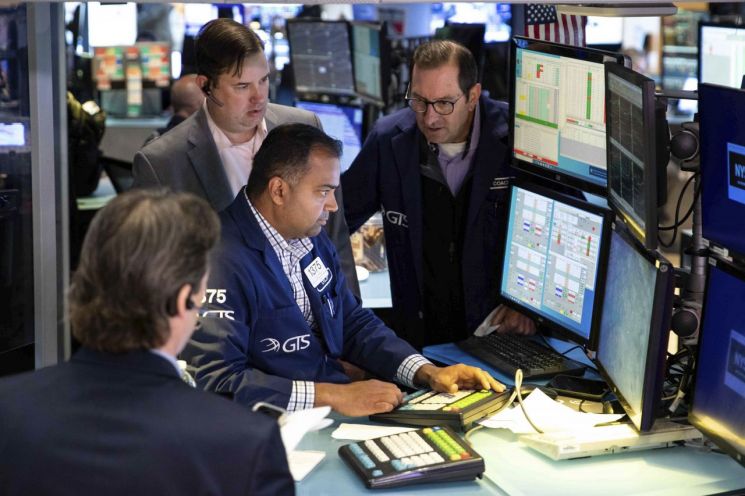
[Asia Economy Reporter Myunghwan Lee] On the 27th, the domestic stock market fell sharply due to the impact of the previous day's decline in the U.S. stock market. The U.S. stock market was negatively affected, with the Nasdaq dropping nearly 4% due to China's COVID-19 economic lockdowns, and the domestic market was also hit by the fallout. However, advice was also given to avoid panic selling during a downturn.
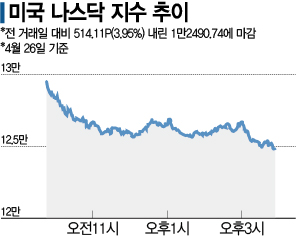
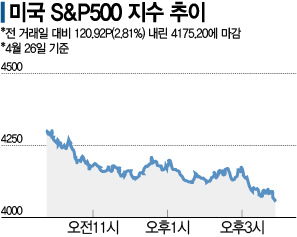
On the 26th (local time), the U.S. Nasdaq closed at 12,490.74, down 514.11 points from the previous trading day. This represents a 3.95% decline compared to the previous day and a 23% drop from the peak in November last year. With this decline, the Nasdaq index fell to its lowest level in about 1 year and 5 months since December 14, 2020, when it closed at 12,440.00. The S&P 500 index, centered on large-cap stocks, also closed at 4,175.20, down 120.92 points (2.81%), and the Dow Jones Industrial Average closed at 33,240.18, down 809.28 points (2.38%) from the previous day.
It is analyzed that the lockdown measures for COVID-19 prevention in China, which paralyzed major cities such as Shanghai, burdened the U.S. stock market. Sangyoung Seo, head of the Media Content Division at Mirae Asset Securities, said, "COVID-19 testing in 11 out of 16 districts in Beijing will continue until the 30th, and depending on the results, it will be decided whether to lock down the entire Beijing or only some areas, which has caused concern." He added, "As the COVID-19 lockdown in China continues, supply chain instability mentioned in U.S. corporate earnings reports has led to weakened investor sentiment."
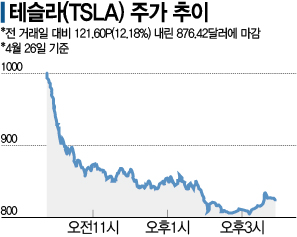
The decline was significant ahead of earnings announcements from major tech companies, and supply chain instability issues raised in some companies' earnings reports further dampened investor sentiment. Nvidia (-5.60%), MS (-3.74%), and Apple (-3.73%) all fell sharply. In particular, Tesla plunged 12.18% from the previous trading day amid concerns that Elon Musk's acquisition of Twitter could cause friction with governments in China and Europe.
The domestic stock market, which had closed higher the previous day due to major corporate earnings announcements, also experienced nearly a 2% decline in early trading due to the impact of the U.S. stock market drop. As of 10 a.m. that day, the KOSPI was at 2,623.95, down 44.36 points (1.66%) from the previous trading day. At the same time, the KOSDAQ index also fell 18.41 points (2.02%) to 892.75.
Experts believed it would be difficult for the stock market to avoid a downward trend that day. Seo said, "The earnings announcements and investment opinions of some U.S. companies highlighted a slowdown in growth in pandemic-beneficiary sectors, causing related stocks to fall and leading to domestic market weakness," adding, "The direction of the domestic market will be determined after the initial decline, depending on the flow of the foreign exchange market and movements in the Chinese stock market." Ji-young Han, a researcher at Kiwoom Securities, said, "Mixed earnings reports from U.S. big tech companies will be a neutral factor for the domestic market during the day," and "As the first-quarter earnings season is ongoing for domestic companies, the extent of stock price adjustments will vary depending on individual earnings issues."
However, advice was also given to avoid selling at bargain prices during a downturn. Han said, "(Recently, the stock market) is indeed in a phase requiring overall risk management, but the stock market crash centered on the U.S. since late last week has the characteristics of panic selling," advising, "It is necessary to refrain from joining panic selling at this point." Seo also said, "The U.S. stock market decline on the 26th was due to individual factors of panic selling, and there will be a relief rally seeking a rebound around next week's Federal Open Market Committee (FOMC) meeting," advising, "Investors holding cash may consider participating in bargain buying to some extent, but those holding stocks do not need to sell at current prices."
© The Asia Business Daily(www.asiae.co.kr). All rights reserved.

















