Decision on Two Major Crimes 'Corruption and Economic Crimes'
Yoon Administration's Enforcement Decree Completely Blocks Circumvention
Prosecutor's Supplementary Investigation Recognized for Police Transferred Cases
Strict Prohibition of Separate Investigations
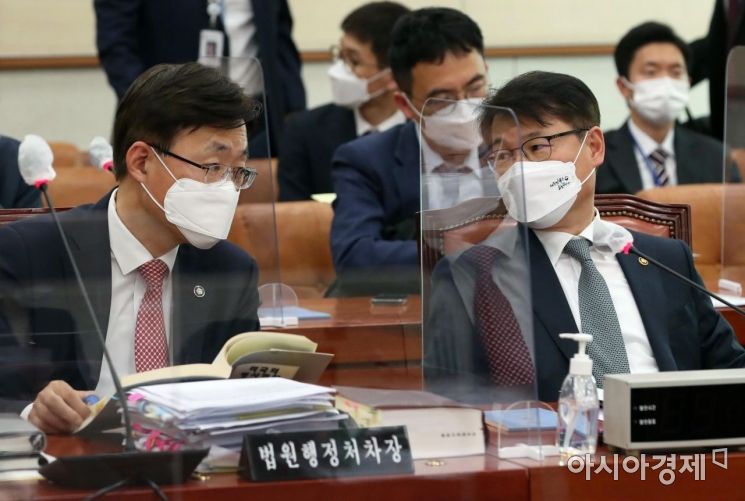 Deputy Minister of Justice Kang Seong-guk (right) and Deputy Director of the Court Administration Office Kim Hyung-doo attended the Subcommittee of the Legislation and Judiciary Committee held at the National Assembly on the 26th, seen talking before the meeting started. Photo by Yoon Dong-joo doso7@
[Asia Economy Reporter Moon Chae-seok] The Democratic Party of Korea's specific legislative bill on the separation of prosecution and investigation by the prosecution, commonly known as 'Geomsu Wanbak' (complete removal of prosecution's investigative authority), was revealed on the 26th. On the afternoon of the same day, the Democratic Party approved amendments to the Prosecutors' Office Act and the Criminal Procedure Act at the first subcommittee of the Legislation and Judiciary Committee, held without the participation of the People Power Party.
The amendments approved that day were based on the agreement reached on the 22nd between the Democratic Party and the People Power Party, mediated by National Assembly Speaker Park Byeong-seok, and reflected the adjustment opinions of the Legislation and Judiciary Committee. Although the People Power Party requested renegotiation, the Democratic Party regarded this as a breach of agreement and proceeded with the bill after slight modifications. During this process, some proposals from the Justice Party were partially accepted.
The Prosecutors' Office Act amendment, which passed the subcommittee after revisions by the Democratic Party, strictly limited the types of crimes for which prosecutors can conduct direct investigations to two categories: corruption and economic crimes. Notably, it stipulated that the investigative crimes must be defined as 'among corruption crimes and economic crimes,' rather than 'corruption crimes, economic crimes, etc.' as originally suggested in the committee's adjustment opinions. This is interpreted as completely blocking any indirect expansion of the investigative scope through enforcement ordinances by the Yoon Seok-yeol administration in the future.
Regarding investigations into corruption and economic crimes, the Democratic Party also included a provision requiring the Prosecutor General to report quarterly to the National Assembly on the status of direct investigation departments and affiliated prosecutors and investigators at frontline prosecutors' offices. The Democratic Party explained that this clause is intended to enable the National Assembly to monitor whether the agreement to reduce the current five Anti-Corruption and Strong Investigation Divisions to three, agreed upon by both ruling and opposition parties, is being implemented. This is because there is no way to legally enforce this reduction.
Additionally, through the agreement, the Democratic Party decided to keep election crimes among the four crimes (public officials, elections, defense industry, and major disasters) to be transferred to the police under prosecution until December 31 of this year. This was a proposal from the Justice Party that was not included in the original agreement. The intention is to dispel suspicions that removing the prosecution's investigative authority over election crimes is a 'political shield' by maintaining the prosecution's authority until the statute of limitations for the June 1 local elections (six months) expires at the end of this year. It is also seen as a strategic move to gain the Justice Party's cooperation in ending the filibuster (legitimate obstruction of parliamentary proceedings through unlimited debate) and in the subsequent vote on the bill.
The Democratic Party also included provisions partially recognizing the prosecution's supplementary investigative authority over cases transferred by the police. This can be interpreted as reflecting the claims of both the prosecution and the People Power Party to some extent. However, at the same time, the scope of investigation is limited to 'the extent that does not undermine the unity and identity of the case in question,' focusing on completely blocking separate investigations. The amendment to the Criminal Procedure Act also inserted a clause stating, "One shall not unjustly investigate separate cases without reasonable grounds for the purpose of clarifying the criminal suspicion of the case under investigation, nor force confessions or statements related to unrelated cases using evidence or materials obtained from other cases." This clause carries a declarative meaning prohibiting separate investigations.
Regarding the separation of prosecutors responsible for investigation and prosecution, the Democratic Party newly established a regulation stating, "A prosecutor shall not be involved in the prosecution of crimes they have initiated investigations on." Initially, the Legislation and Judiciary Committee proposed a clause preventing the investigating prosecutor from performing 'the duties necessary for the initiation and maintenance of prosecution' for the case, but the expression related to the maintenance of prosecution was deleted. This was in response to concerns from the Court Administration Office that if the investigating prosecutor participates during the criminal trial, the trial could be invalidated.
The Democratic Party decided to maintain the existing Criminal Procedure Act provision that broadly defines the right to file objections as 'complainants, etc.' The committee's adjustment opinion narrowed this to 'complainants,' but concerns were reflected that this would deprive victims or their legal representatives of the right to file objections.
© The Asia Business Daily(www.asiae.co.kr). All rights reserved.
![Clutching a Stolen Dior Bag, Saying "I Hate Being Poor but Real"... The Grotesque Con of a "Human Knockoff" [Slate]](https://cwcontent.asiae.co.kr/asiaresize/183/2026021902243444107_1771435474.jpg)















