Professor Park Gisu's Research Team at Konkuk University Develops Isothermal Nucleic Acid Amplification Technology
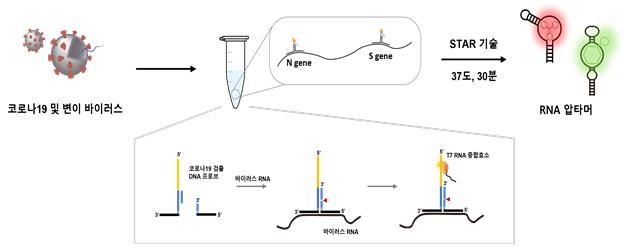 Schematic Diagram of a Novel Isothermal Nucleic Acid Amplification Technology for Rapid Detection of COVID-19 Variant Viruses
[Asia Economy Reporter Kim Bong-su] A molecular diagnostic technology capable of rapidly and accurately detecting not only COVID-19 but also future novel viruses within 30 minutes has been developed.
The National Research Foundation of Korea announced that Professor Ki-Soo Park's research team at Konkuk University developed a molecular diagnostic technology that can simultaneously detect COVID-19 and its variants using isothermal nucleic acid amplification technology. Isothermal nucleic acid amplification technology refers to a method that amplifies target nucleic acids at a constant temperature without repetitive temperature control processes.
COVID-19 diagnosis can be divided into molecular diagnostics, which detect the nucleic acid of SARS-CoV-2 using gene amplification technology, and immunodiagnostics based on antigen-antibody reactions. While immunoassays are relatively inexpensive, simple, and rapid, polymerase chain reaction (PCR)-based molecular diagnostics, which show high accuracy, involve relatively complex procedures and can only be performed in medical institutions equipped with specific facilities. Because it takes a considerable amount of time from sample collection to obtaining test results, immediate response is difficult.
The research team developed a new isothermal nucleic acid amplification technology (STAR) that can rapidly diagnose coronaviruses, including variants, and bacteria within 30 minutes at 37 degrees Celsius. It can detect not only the presence of viruses but also distinguish their types. Unlike existing PCR and isothermal nucleic acid amplification-based molecular diagnostic methods, STAR does not require temperature control before the reaction starts and uses only one enzyme (T7 RNA polymerase), with the reaction proceeding at a constant temperature of 37 degrees Celsius. Applying the technology to over 60 actual clinical samples, the team confirmed high sensitivity (96.7%) and specificity (100%) for COVID-19. They anticipate it can be used for detecting various nucleic acid biomarkers such as viruses, bacteria, and cancer.
Through the development of STAR, the research team proposed a way to reduce time and cost in the field of genetic diagnostics. It can be utilized as an alternative technology to replace current gene analysis technologies represented by PCR. However, additional research is needed to implement a system that allows easy on-site result confirmation, and continuous studies on detecting various nucleic acid biomarkers are required to verify the technology's scalability.
The research results were published online on the 31st of last month in the international journal in the biosensor field, Biosensors and Bioelectronics.
© The Asia Business Daily(www.asiae.co.kr). All rights reserved.
![Clutching a Stolen Dior Bag, Saying "I Hate Being Poor but Real"... The Grotesque Con of a "Human Knockoff" [Slate]](https://cwcontent.asiae.co.kr/asiaresize/183/2026021902243444107_1771435474.jpg)















