Plans to Increase Hydrogen (Commercial) Vehicle Refueling Stations to Expand Supply
Goal to Commercialize Fully Autonomous Driving (Level 4) by 2027 Announced
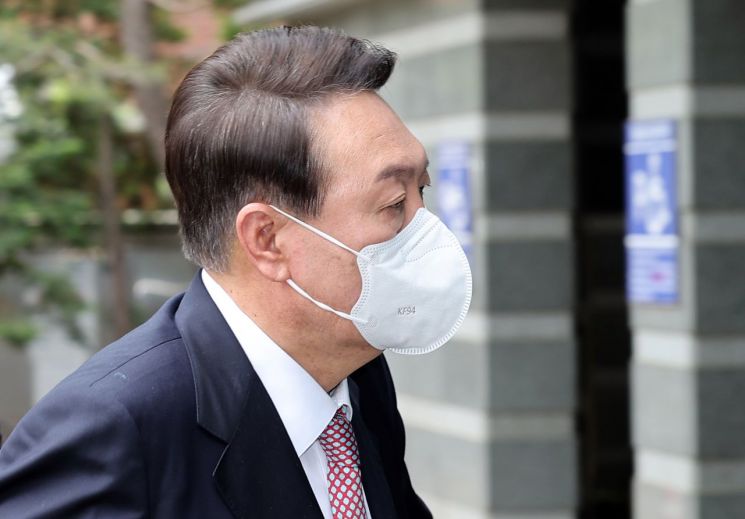 President-elect Yoon Suk-yeol is entering the Presidential Transition Committee in Tongui-dong, Jongno-gu, Seoul on the afternoon of the 25th. (Photo by Yonhap News)
[Asia Economy Reporter Geum Bo-ryeong] The Yoon Suk-yeol administration is expected to foster future mobility, including electric and hydrogen vehicles and autonomous vehicles, as a core growth engine.
The 20th Presidential Transition Committee announced on the 25th, "Mobility services such as vehicle sharing and data are fields expected to experience ultra-high-speed growth of more than 30 times," emphasizing this direction.
First, the transition committee will support the rapid shift of the parts ecosystem to future vehicles and the technological independence of core parts and materials to maximize the production and export capacity of electric and hydrogen vehicles. To increase the supply of hydrogen (commercial) vehicles, charging stations will also be expanded. Efforts will be strengthened to establish future vehicle clusters, build customized certification, inspection, and maintenance systems, and provide incentives (fuel subsidies, driving restrictions, and large vehicle replacement) to transportation operators.
The committee also set a goal to commercialize fully autonomous driving (Level 4) by 2027. According to the committee, about 270 Level 3 autonomous vehicles are expected domestically this year, increasing to 7,800 in 2024 and 14,000 by 2027. To achieve this, support will be provided for private sector core technology development and demonstration, and advanced infrastructure such as next-generation Cooperative Intelligent Transport Systems (C-ITS) and high-precision road maps will be established.
The committee also promised the commercialization of Urban Air Mobility (UAM) by 2025. Support will be given for UAM demonstrations and pilot projects, as well as the development of core technologies such as dual-use aircraft (AAV) for both civilian and military purposes.
An environment will also be created for the private sector to innovate mobility service business models. This includes expanding the disclosure of transportation and logistics big data, building a digital transformation foundation for data acquisition, analysis, and trading, establishing safety standards to promote personal mobility such as electric kickboards, and promoting the localization of parts.
The committee explained, "To promote the mobility revolution as a core policy of the Yoon Suk-yeol administration, these contents will be reflected in the national agenda."
© The Asia Business Daily(www.asiae.co.kr). All rights reserved.
![Clutching a Stolen Dior Bag, Saying "I Hate Being Poor but Real"... The Grotesque Con of a "Human Knockoff" [Slate]](https://cwcontent.asiae.co.kr/asiaresize/183/2026021902243444107_1771435474.jpg)















