[8 Experts' Diagnosis] One-sided, Command-style Policies Without Consensus
Backward Medical System Exposed
Endemic Won't Come Just by Government Declaration
Need for Proactive Measures Against New Infectious Diseases
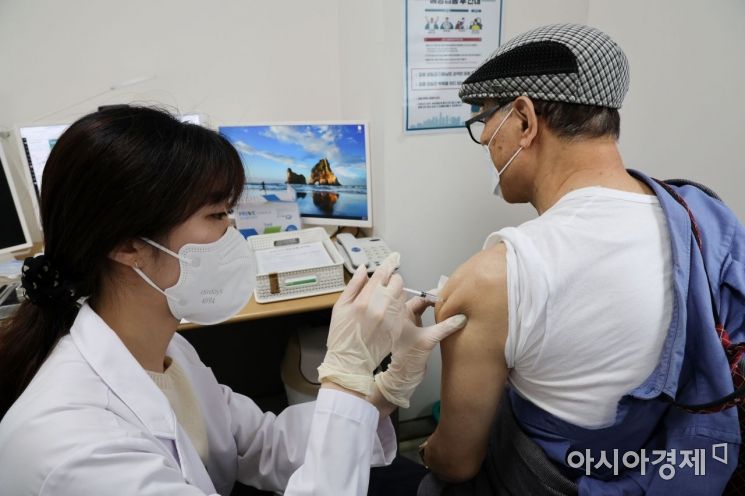 On the 25th, when the 4th COVID-19 booster vaccination for those aged 60 and above who made prior reservations began, a citizen is receiving the vaccine at Bumin Hospital in Gangseo-gu, Seoul. /Joint Coverage Team
COVID-19 quarantine policies are undergoing a rapid transition. On the 18th, social distancing measures for COVID-19 were lifted after more than two years, and starting from the 25th, eating and drinking will be fully allowed not only in movie theaters and indoor sports venues but also on trains and domestic flights. From this day forward, the infectious disease classification of COVID-19 will be downgraded from Level 1 to Level 2, and four weeks later, confirmed patients will no longer be required to isolate.
Although the government’s push for a return to normal life, including the lifting of social distancing, is progressing rapidly, infectious disease experts have proposed reorganizing the entire healthcare system and establishing a control tower to lead professional and consistent quarantine policies in preparation for the upcoming resurgence and the emergence of other infectious diseases.
-How would you evaluate the government’s COVID-19 quarantine policies?
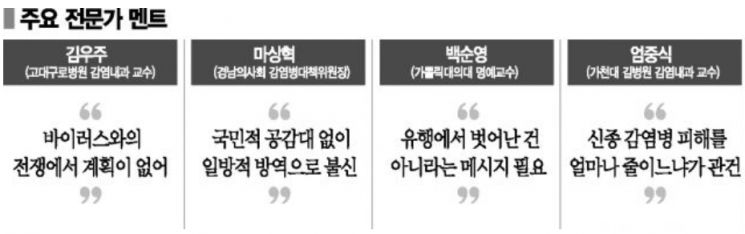
▶Kim Woo-joo= Until the end of last year, it was considered that we managed well with fewer than one million cumulative confirmed cases, but during this year’s Omicron surge, quarantine measures were relaxed instead, and the number of confirmed cases is approaching 17 million. Considering excess deaths beyond those classified as COVID-19 fatalities, the death toll is estimated to be between 40,000 and 50,000. Just as there are operational plans in war, having no plan in the over two-year war against the virus is a failing grade.
▶Ma Sang-hyuk= There were many policies without principles, such as inconsistent social distancing and mask-wearing rules. Policies were issued unilaterally and in a commanding manner before forming a national consensus. While there can be trial and error, the preparation phase was inadequate, and despite poor outcomes, the government only claims success.
-It is said that masks will soon be removed and the endemic phase (periodic infectious disease outbreaks) will arrive.
▶Baek Soon-young= I believe it is now safe to remove masks outdoors. Mask-wearing should only be mandatory in exceptional cases such as gatherings, protests, or situations where many people remove masks for extended periods or share food. However, political interests are entangled in the current mask debate, which raises concerns about lax quarantine measures. It would be good if the government also conveyed the message that ‘we have not completely escaped the risk of an outbreak yet.’
▶Jung Ki-seok= The government may want to declare endemicity, but it is still far off. Even if COVID-19 cases continue to appear, prevention and treatment must be possible at all times with vaccines and therapeutics, and medical institutions must operate normally, which is not the case now. The endemic phase occurs when the virus weakens and recedes on its own; it does not come simply because the government declares it.
-There is a possibility of a COVID-19 resurgence this fall, and concerns about other infectious diseases are also emerging.
▶Jung Ki-seok= An outbreak will definitely come this fall or winter.
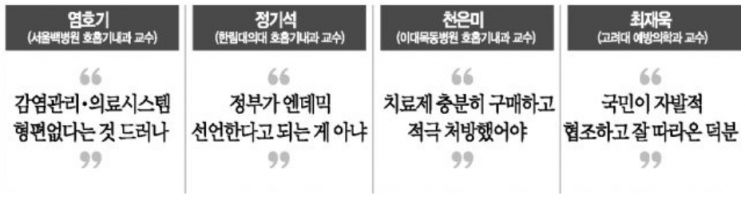
▶Cheon Eun-mi= It is regrettable that even if treatments remain unused, sufficient quantities were not purchased, and unlike other countries, prescriptions were not extended to those aged 12 and older. For preparing for the next resurgence, such systems need to be meticulously improved.
-What lessons have been learned over the 2 years and 3 months of COVID-19?
▶Yeom Ho-gi= We have long boasted that Korea’s medical standards are among the best in the world, but when the infectious disease struck, the reality was revealed: infection control and the medical system were backward, and manpower was severely lacking. Only the visible parts were excellent, but the underlying system’s capacity was poor. When the number of critically ill patients exceeded 1,000, there were no hospitals available for admission, so intensive care units were hastily created, but although beds existed, there was no medical equipment or staff, so they could not function as ICUs. COVID-19 has shown us the answers on how to change our medical system.
▶Choi Jae-wook= Investing in establishing an infectious disease response system, strengthening the healthcare system, supporting private companies developing vaccines, and forming a control tower to oversee national quarantine before damage from stricter distancing occurs will ultimately cost society less.
-What should be prepared for the post-COVID era?
▶Eom Jung-sik= COVID-19 may become endemic or a seasonal epidemic, and new infectious diseases may emerge and cause further outbreaks. The government uses the term ‘return to normal life’ and wants to go back to the past, but from the early days of the outbreak, experts repeatedly warned that ‘we cannot return to pre-COVID times.’ Now, whether individuals, communities, or the nation, we must change systems and cultures and discuss new technology development so that normal social and economic activities can be maintained even if new infectious diseases spread. We need to respond to new infectious diseases by researching and investing in environments where people can work without face-to-face contact and new technologies that can replace frequent handwashing.
▶Cheon Eun-mi= We must be able to proactively secure and develop treatments and vaccines for new infectious diseases. A system for sharing overseas information is also necessary. It would be ideal if domestic companies develop these independently, but if not, cooperation to quickly produce generic drugs and establish a system to receive some supplies preferentially is needed.
© The Asia Business Daily(www.asiae.co.kr). All rights reserved.
![Clutching a Stolen Dior Bag, Saying "I Hate Being Poor but Real"... The Grotesque Con of a "Human Knockoff" [Slate]](https://cwcontent.asiae.co.kr/asiaresize/183/2026021902243444107_1771435474.jpg)

















