Interview with US Washington DC Accompanying Reporters... Reflecting Before Retirement
"Remembering the SoBuJang Measures, Regret Over Failing to Stabilize Real Estate"
To Juniors: "The Foundation Is Not School or Regional Ties but Reputation Built on Passion and Sincerity"
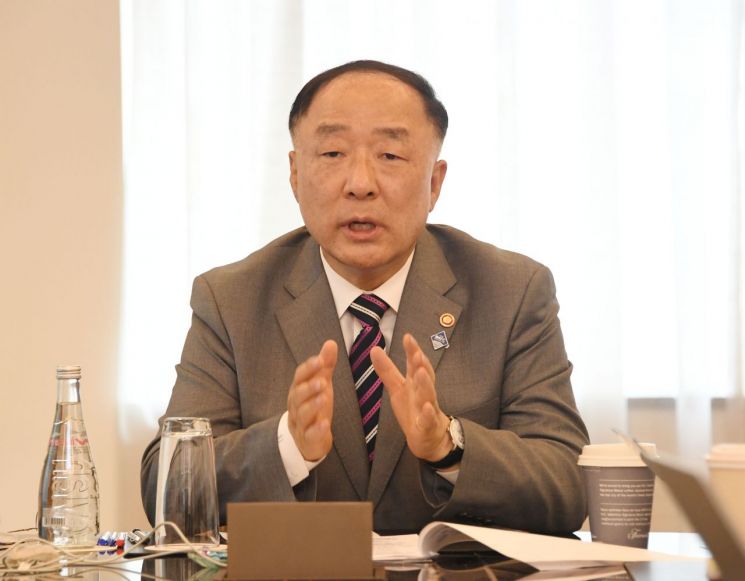
[Asia Economy Washington (USA) = Reporter Kwon Haeyoung] 'The longest-serving Minister of Economy and Finance in history with a tenure of 3 years and 5 months, having prepared the budget 11 times including 7 supplementary budgets, and unprecedented management of the COVID-19 pandemic.'
These are the records of Hong Namki, Deputy Prime Minister and Minister of Economy and Finance, the economic control tower of the Moon Jae-in administration's second term. After taking office in December 2018, when COVID-19 occurred just over a year later, he significantly expanded government spending, acting as the 'COVID-19 firefighter' to manage the crisis while simultaneously playing the contradictory role of 'national treasurer' to restore rapidly deteriorating fiscal soundness. Having passed through a darker and longer tunnel than ever before as the commander of the Korean economy, Deputy Prime Minister Hong will end his term with the inauguration of the new government on the 10th of next month. During his visit to Washington DC and New York from the 17th to 22nd (local time) to attend the G20 Finance Ministers' Meeting, Hong shared his reflections on his three and a half years as Deputy Prime Minister and 37 years of public service in several meetings with accompanying reporters. Washington DC is where Hong served as the Financial and Economic Counselor from 2007 to 2010, and he effectively concluded his last business trip in Washington, where he spent three years as a counselor.
"The most difficult moment as Deputy Prime Minister was being attacked for opposing the nationwide disaster relief payments."
In an interview with the accompanying reporters covering the G20 in Washington DC, Hong said, "Of the three and a half years in office, two and a half years were during the COVID-19 period, and what I remember most is facing the crisis, overcoming it, and trying to recover the economy." He added, "When I kept silent, the nationwide disaster relief payment was taken as a given, so I opposed it immediately. Fiscal resources are not an inexhaustible source. I even thought about stepping down."
During the process of managing COVID-19, Hong often clashed with the ruling Democratic Party over fiscal spending methods. He opposed the ruling party's call for universal cash support by advocating for reduced cash support and selective aid. When former Democratic Party leader Lee Nak-yeon announced the fourth nationwide disaster relief payment in a parliamentary speech in February last year, Hong immediately expressed opposition on Facebook. He faced harsh criticism such as "a really bad person," "playing politics," and even calls for his dismissal from the ruling party.
He emphasized, "If we do whatever the political circles say, the fiscal situation and the country might end up on that mountain," and added, "Fiscal policy is unavoidable. Even if I go back, I will have to endure criticism and do it."
Among the most memorable achievements during his three and a half years in office, he cited overcoming the COVID-19 crisis, the materials-parts-equipment (SoBuJang) measures, and the Korean New Deal.
He said, "The Korean New Deal is a project for transitioning to a digital and green economy," and added, "The new government may rename or fine-tune it, but I don't think it will be subject to restructuring." He also expressed great attachment to the SoBuJang measures established after Japan's export restrictions in July 2019. Hong said, "In my early years as a junior officer in 1986-1987, I stayed up all night working on measures to improve the trade imbalance with Japan, where SoBuJang was a key cause. Now, a generation later, as a minister, I made those measures again," and added, "To ensure our juniors won't have to deal with this again a generation from now, I insisted on establishing a special account for SoBuJang despite opposition from the Budget Office." As a result, government budgets of 2.1 trillion won in 2020 and 2.6 trillion won in 2021 were invested to enhance SoBuJang competitiveness.
As the economic commander of the Moon administration's second term, Hong is not free from responsibility for negative market evaluations such as public sector-centered employment, declining private sector vitality, and soaring real estate prices. Regarding real estate measures, Hong said, "I wish we had more time to bring prices down significantly and stabilize them," citing this as one of his biggest regrets during his term.
He also expressed regret over failing to pass the Fiscal Rules Act and the Framework Act on the Development of the Service Industry (Seoballop). He said, "Although fiscal spending was inevitable during the COVID-19 crisis, fiscal tightening is essential in the process of fiscal normalization," and urged that the Fiscal Rules Act, which has been dormant in the National Assembly for one and a half years, must be legislated under the new government. South Korea's national debt stands at 1,075.7 trillion won, with a debt-to-GDP ratio of 50.1%, up 14.1 percentage points from 36% in 2017, the first year of the current administration. Restoring fiscal soundness is urgent. Regarding the Seoballop, which includes fiscal, tax, and financial support policies to foster the service industry, he said, "I first proposed the bill in 2012 as Director General of Policy Coordination, but even now, 11 years later, it has not been legislated," and added, "I hope it will be legislated in the next government."
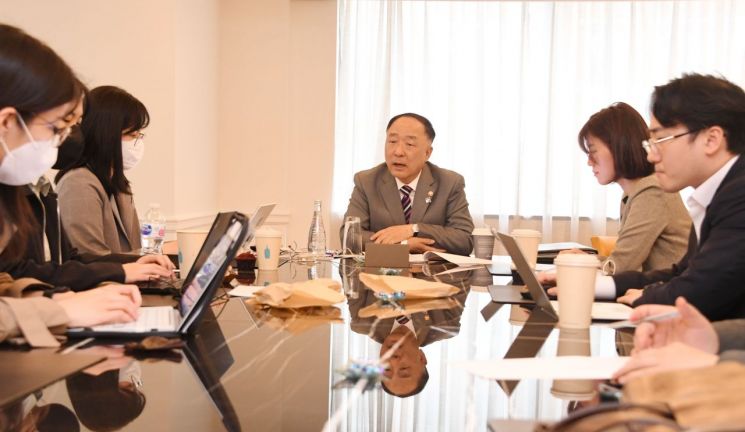
Deputy Prime Minister Hong is the minister who suffered the most from populist pressures from the political circles among all past Ministers of Economy and Finance. As nicknames like 'Hong Baekgi' and 'Hong Dusami' following Hong Namki suggest, the voices of the political circles, especially the ruling party, were louder during his tenure than in any previous National Assembly. From a policy maker's perspective, this meant less room to implement policies.
When asked if the imbalance in ruling party-government relations caused difficulties for the government, Hong said, "Since many policies are finalized through legislation, the ruling party's voice and power in the ruling party-government relationship have become very strong," and added, "The executive branch may have opinions that the legislative content is not desirable policy-wise, but if legislation proceeds regardless, it becomes policy." He continued, "In that sense, the voice of political parties has grown significantly and grew even more during the process of overcoming the COVID-19 crisis," and reflected, "As a result, I inevitably clashed a lot with the political circles."
Hong will conclude his 37 years of public service when the new government takes office next month. Regarding his plans after retirement, he said cheerfully, "I like islands, so I want to visit all the big islands in our country," and added, "Now I will return to being a private citizen."
When asked for advice to his juniors, Hong emphasized, "Unlike positions like heads of departments that receive the spotlight, even in overlooked positions where no one seems to pay attention, your self-evaluation accumulates," and said, "Wherever you are, if you work hard on your given tasks, your reputation builds up and you rise." He added, "The foundation is not academic or regional ties but a reputation built on passion and sincerity," and urged, "Civil servants should work like that."
© The Asia Business Daily(www.asiae.co.kr). All rights reserved.
![Clutching a Stolen Dior Bag, Saying "I Hate Being Poor but Real"... The Grotesque Con of a "Human Knockoff" [Slate]](https://cwcontent.asiae.co.kr/asiaresize/183/2026021902243444107_1771435474.jpg)

















