Seoul 2030 Generation Population Decreases by 8.2% Over 7 Years
Government Provides Up to 200,000 KRW Monthly Rent Support for Low-Income Youth for One Year
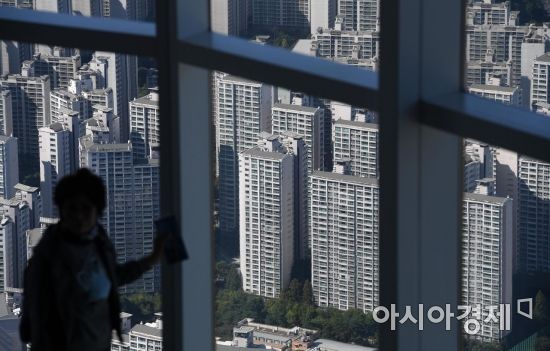 View of apartment complexes in Seoul city from Seoul Sky, the observation deck of Lotte World Tower in Seoul. The photo is unrelated to specific expressions in the article. Photo by Asia Economy DB.
[Asia Economy Reporter Heo Midam] It has been revealed that over 70,000 people in their 20s and 30s left Seoul last year. Young people leaving Seoul due to housing issues such as high housing prices are turning their attention to areas with excellent accessibility to Seoul, such as Gyeonggi and Incheon. In particular, in Gyeonggi and Incheon, it is possible to own a home with the deposit price of an apartment in Seoul, attracting continued interest from young demanders.
Seoul City recently analyzed the 20s and 30s living in Seoul using the '2021 Seoul Survey Urban Policy Indicator Survey.' The survey was conducted from September 6 to November 16 last year, targeting 20,000 households living in Seoul, 5,000 citizens, and 2,500 foreigners.
The survey results showed that the population of people in their 20s and 30s living in Seoul continues to decline. Last year, the total number of people in their 20s and 30s living in Seoul was 2,861,500, accounting for 30.1% of the total Seoul population. This is a decrease of 74,000 (2.5%) compared to 2,935,500 a year earlier. The 20s and 30s population reached 3.11 million in 2015 but decreased by 8.2% over seven years.
The main reasons for leaving Seoul were identified as family and job reasons for those in their 20s, and housing and family reasons for those in their 30s. In other words, feeling deprived due to skyrocketing housing prices, they leave Seoul to own a home or move out together when their parents relocate outside Seoul.
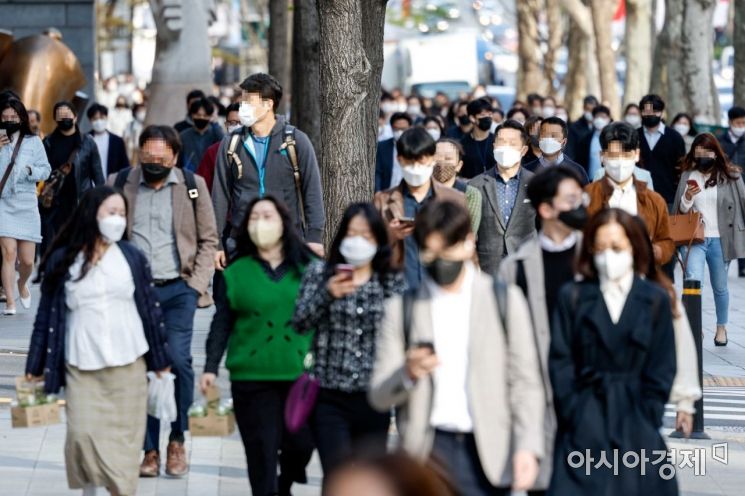 Office workers are wearing masks and heading to work on Teheran-ro in Gangnam-gu, Seoul. The photo is unrelated to specific expressions in the article. Photo by Jinhyung Kang aymsdream@
Meanwhile, with Seoul apartment sale and deposit prices rising sharply over several years, the housing cost burden on young people appears to be increasing.
According to KB Real Estate monthly time series data, as of March this year, the average apartment sale price in Seoul was 1,273.34 million KRW, up 15.7% from the previous year (1,099.93 million KRW).
On the other hand, during the same period, the average apartment sale prices in Gyeonggi Province and Incheon were 620.73 million KRW and 463.08 million KRW, respectively. These are lower than the average Seoul apartment deposit price of 674.19 million KRW, meaning it is possible to own a home in Gyeonggi and Incheon with the deposit price of a Seoul apartment.
Given this situation, young people lamented that owning a home in Seoul is nearly impossible without parental support.
Kim, a worker in his 20s, said, "Even if I save my salary for 10 years, owning a home without my parents' help is almost impossible. The problem is that housing prices show no signs of falling." He added, "I thought prices would drop this year, but I feel empty. How can I get married without a home?"
Young people who find it difficult to own a home in Seoul are considering moving to other areas with good accessibility. A netizen in their late 30s revealed on a real estate community, "I'm close to 40 but still haven't owned a home. I had thought about buying a house a few years ago but lacked the decisiveness and just watched the housing prices skyrocket." They added, "Since Seoul housing prices are too expensive, I started paying attention to Gyeonggi Province. Definitely, housing prices there are less burdensome than in Seoul."
Meanwhile, the government plans to alleviate young people's worries caused by soaring housing prices by providing monthly rent support of 200,000 KRW for 12 months. Accordingly, it is expected that more than 150,000 low-income young people living apart from their parents will benefit.
The Ministry of Land, Infrastructure and Transport announced on the 21st that the 'Youth Monthly Rent Temporary Special Support' project, aimed at reducing the housing cost burden on young people due to the prolonged COVID-19 pandemic, will be fully implemented from August.
The Youth Monthly Rent Temporary Special Support project targets low-income independent youth (aged 19-34) with household income at or below 60% of the median income and original household (including parents) income at or below 100% of the median income. It provides up to 200,000 KRW per month for 12 months. The project will be conducted temporarily from 2022 to 2024, with applications accepted until August 2023 and payments made over the three years from 2022 to 2024.
© The Asia Business Daily(www.asiae.co.kr). All rights reserved.
![Clutching a Stolen Dior Bag, Saying "I Hate Being Poor but Real"... The Grotesque Con of a "Human Knockoff" [Slate]](https://cwcontent.asiae.co.kr/asiaresize/183/2026021902243444107_1771435474.jpg)

















