Rushing to Build Additional Nuclear Power Plants in Zhejiang, Shandong, and Guangdong Provinces Amid Energy Security Risks
China's Dream to Become a Nuclear Power Leader Around 2030, Including Nuclear Power Exports
[Asia Economy Beijing=Special Correspondent Jo Young-shin] The Chinese government has approved three new nuclear power plant construction projects.
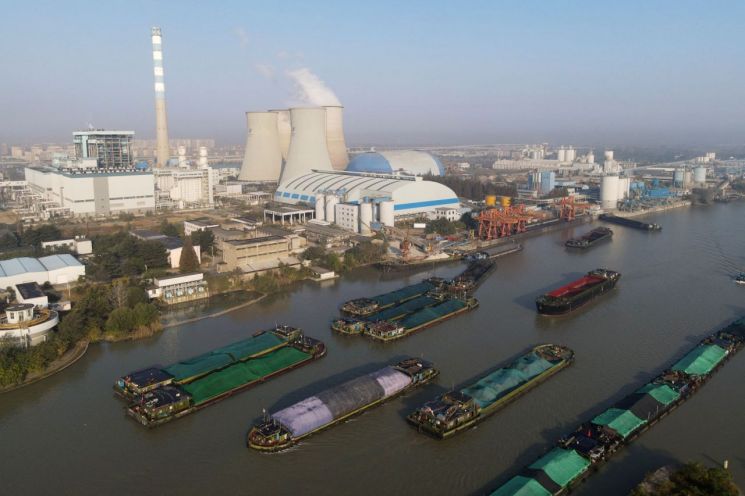
Following Russia's invasion of Ukraine and the surge in international oil prices, concerns over energy security have increased, prompting the swift approval of nuclear power projects. Additionally, since these projects involve massive investments, they are also seen as a means to stimulate the economy. There is also an assessment that China is moving quickly toward its goal of becoming a "nuclear power superpower by 2030."
According to Chinese media including the state-run Xinhua News Agency on the 21st, the State Council of China held an executive meeting chaired by Premier Li Keqiang the previous day and gave final approval to three nuclear power development projects.
The approved nuclear power plants will be constructed in Xiamen, Zhejiang Province; Haiyang, Shandong Province; and Lufeng, Guangdong Province. These areas experienced power shortages last year due to coal shortages.
Premier Li, while approving the nuclear power plant construction projects in these three regions, stated, "Energy is a fundamental resource for the national economy and society," and added, "We must continuously optimize energy resources in response to new challenges in the external environment."
Regarding the nuclear power approval, Chinese economic media Caijing reported that third-generation nuclear power technology will be applied to these projects, with a total of 6 to 8 reactors to be built across the three sites.
These nuclear power projects stem from the Chinese government's carbon neutrality blueprint, which aims to build 150 reactors by 2035, but the emphasis is placed on energy security and economic stimulus. Premier Li suggested the economic stimulus intent behind the approval by stating immediately after the State Council meeting, "Energy investment must be able to stimulate employment."
Caijing reported that the total investment in these nuclear power projects will be 160 billion yuan (approximately 23 trillion Korean won), with about 20 billion yuan invested per reactor.
The media also hinted at China's ambition in the nuclear power sector. Citing the World Association of Nuclear Operators (WANO), Caijing reported that European countries outside China are accelerating nuclear projects for carbon neutrality, and that global demand for reactors will exceed 1,000 units by 2050.
Given the large demand, this implies China's intention to join the ranks of nuclear power exporting countries. In fact, earlier this year, China received design approval from the UK's Office for Nuclear Regulation (ONR) for its self-developed reactor technology, Hualong One. Once the environmental impact assessment is completed, China will build nuclear power plants in the UK.
Caijing confidently stated that China is currently a major nuclear power and will become a nuclear power superpower around 2030.
© The Asia Business Daily(www.asiae.co.kr). All rights reserved.
![Clutching a Stolen Dior Bag, Saying "I Hate Being Poor but Real"... The Grotesque Con of a "Human Knockoff" [Slate]](https://cwcontent.asiae.co.kr/asiaresize/183/2026021902243444107_1771435474.jpg)











