On the 20th, Local Government Council, Poien, Hansol Paper, and Socar Signed a Business Agreement to Establish a Regional Resource Circulation System · Last Month, Coffee Grounds Collection Team Formed, Monitoring Center Established to Monitor Future Collection and Intermediate Storage Points... Yangcheon-gu Sets a Goal to Reduce Greenhouse Gas Emissions by 40% by 2030, Focusing on 45 Detailed Projects in Four Major Areas... Geumcheon-gu Signed a Business Agreement with Dongil Academy School Foundation to Create a Public Parking Lot... Yeongdeungpo-gu Provides Free Food Waste Payment Certificates for Small Restaurants
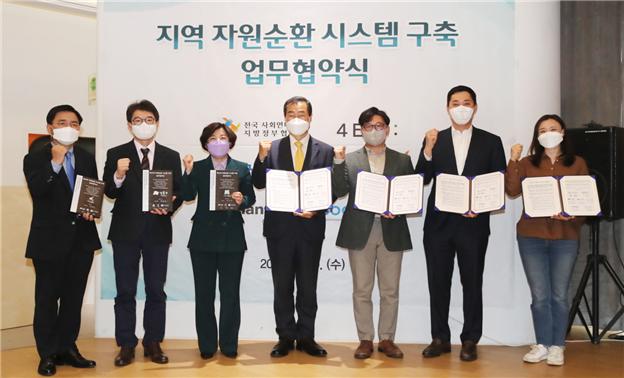
[Asia Economy Reporter Park Jong-il] Seongdong-gu (Mayor Jung Won-oh) is establishing a waste recycling resource circulation model and is officially launching the ‘Resident-led Coffee Grounds Recycling Project.’
At the end of last year, Seongdong-gu was selected for the Resident-led Regional Balanced New Deal Project hosted by the Ministry of the Interior and Safety, collaborating with Anseong City and Hwaseong City in Gyeonggi Province. Accordingly, on the 20th of this month, Jung Won-oh, Mayor of Seongdong-gu, Moon Seok-jin, Chair of the National Social Solidarity Economy Local Government Council, Lee Ho-cheol, CEO of POIN, Cho Sung-min, Executive Director of Hansol Paper, and Park Jin-hee, Vice President of SOCAR, gathered to sign a ‘Business Agreement for Establishing a Regional Resource Circulation System.’
This agreement mainly focuses on mutual cooperation to establish a ‘regional resource circulation system’ by introducing innovative technologies from social economy enterprises in the waste discharge and recycling process, streamlining waste collection, and creating jobs by employing local residents as collection personnel.
According to the agreement, the Local Government Council will disseminate best practices of resource circulation construction through innovative technologies nationwide, and member local governments will support various administrative matters to facilitate the smooth introduction of innovative technologies and local resident participation. POIN will be responsible for building and operating a resource circulation system reflecting regional characteristics, while companies such as Hansol Paper and SOCAR will provide various infrastructure supports, including eco-friendly products, eco-friendly packaging, and collection vehicles.
Last month, Seongdong-gu formed a coffee grounds collection team by employing local residents through Seongdong Future Job Corporation. Moving forward, the district plans to establish an intermediate collection point for coffee grounds within the region and build a control center to monitor the overall collection and recycling of coffee grounds by participating local governments at a glance.
Previously, through a business agreement with the social cooperative ‘Resources and Circulation’ (July 2021), Seongdong-gu established Seoul’s first systematic coffee grounds collection system. Subsequently, it signed a business agreement (October 2021) with POIN, which possesses technology to recycle coffee grounds into eco-friendly fuel, and Hyundai Oilbank to promote a project converting coffee grounds into eco-friendly biomass energy sources (primarily supplying boiler fuel operated as factory equipment at Hyundai Oilbank’s refining and chemical plants).
Seongdong-gu plans to actively promote innovative technology policies and take a significant step forward as a sustainable ESG leading city while announcing the full-scale promotion of the project nationwide through cooperation with the National Social Solidarity Economy Local Government Council.
Jung Won-oh, Mayor of Seongdong-gu, said, “I am honored that Seongdong-gu and the three basic local governments of Hwaseong City and Anseong City in Gyeonggi Province are collaborating on this project. Through this agreement, we will strengthen mutual cooperation among collaborating local governments and participating companies and make every effort to realize ESG values by promoting the exchange of waste recycling technologies between regions.”
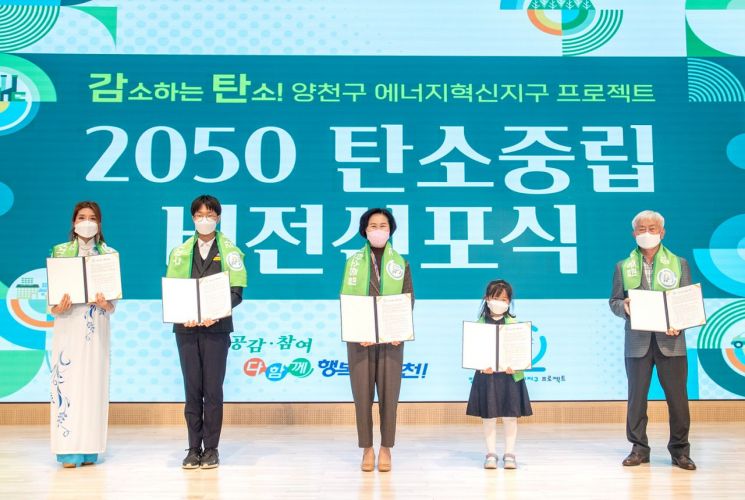
Yangcheon-gu (Mayor Kim Soo-young) announced that it completed the ‘Yangcheon-gu Climate Change Response Plan’ to establish a 2050 carbon neutrality roadmap at the end of March.
The district conducted a research project to establish the ‘2050 Carbon Neutral Yangcheon-gu Climate Change Response Plan’ for about nine months from June last year to March this year, receiving national subsidies from the Ministry of Environment?the first among Seoul’s autonomous districts.
Through multiple rounds of expert and resident opinion collection, the district decided to reduce emissions by 40% by 2030 based on Yangcheon-gu’s greenhouse gas emissions in 2018.
This target aligns with the national greenhouse gas reduction goal (NDC). To achieve this, the district plans to focus on 45 detailed greenhouse gas reduction projects across four major sectors: buildings (energy), transportation, waste, and carbon sinks.
The main sources of greenhouse gas emissions in Yangcheon-gu are buildings (63%) and transportation (25%). Therefore, to reduce emissions in these sectors, the district will focus on energy efficiency improvements in new and old buildings, transitioning to electric and hydrogen vehicles, and energy-saving practices involving resident participation.
Additionally, as a roadmap for carbon neutrality, the district analyzed the impact of mid- to long-term core projects such as the Mokdong reconstruction, Western Truck Terminal development, Mokdong Line light rail, and the National Assembly Boulevard upper park project.
In particular, the Mokdong reconstruction project showed that if the entire complex (complexes 1 to 14) were built as zero-energy buildings, it could reduce Yangcheon-gu’s total greenhouse gas emissions by 15 to 49% (260,000 to 840,000 tons), confirming the urgent need for environmental progress.
A representative from the Green Environment Division stated, “We will share the newly established Yangcheon-gu Climate Change Response Plan with residents and lead the carbon neutrality sector proactively through phased implementation.”
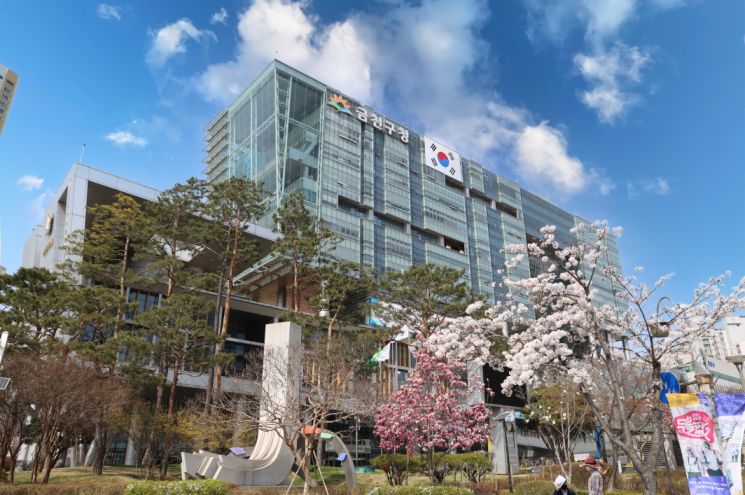
Geumcheon-gu signed a ‘Business Agreement for the Construction of a Public Parking Lot Using the Site of the Planned Reconstruction of Dongil Middle School’ with Dongil Academy Foundation (Chairman Kim Jae-moon) on the 20th to alleviate parking difficulties in the Siheung 2-dong area.
The agreement ceremony was held with officials from Geumcheon-gu and Dongil Academy Foundation in attendance. Through the agreement, Geumcheon-gu will secure the necessary funds for constructing the public parking lot, and Dongil Academy Foundation will provide the site for the public parking lot.
Yoo Dong-kwan, Director of the Parking Management Division, said, “We are grateful to Dongil Academy Foundation for willingly providing the site for the public parking lot to alleviate parking difficulties for local residents. We will work closely with Dongil Academy Foundation to ensure the successful establishment of the public parking lot.”
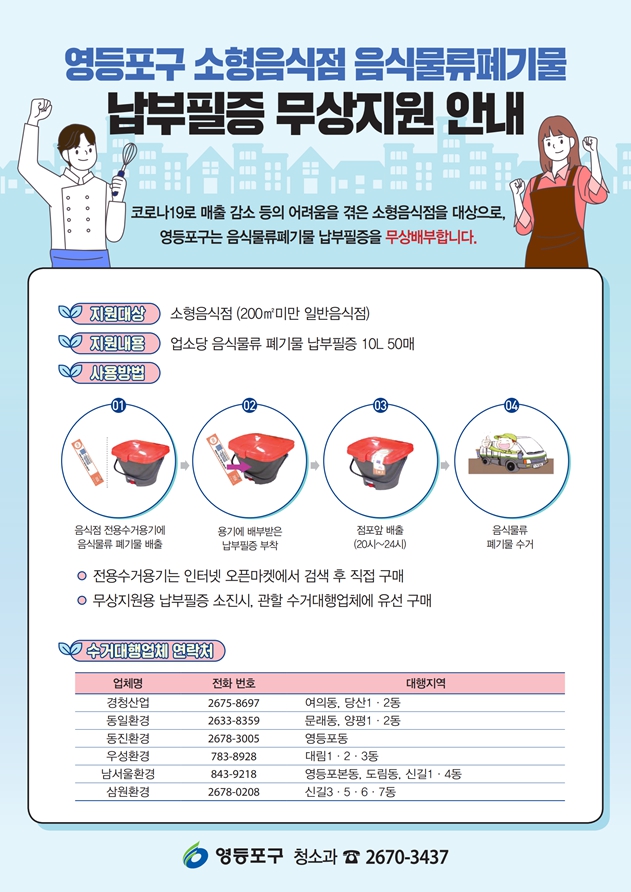
Yeongdeungpo-gu (Mayor Chae Hyun-il) announced that it will temporarily provide free payment certificates for food waste from small restaurants to support local small business owners affected by the prolonged COVID-19 pandemic.
This measure aims to reduce the burden on small restaurants experiencing operational restrictions and sales declines due to social distancing and to stabilize the weakened local economy.
To this end, the district amended the ‘Ordinance on the Suppression, Collection, Transport, and Recycling of Food Waste in Yeongdeungpo-gu, Seoul’ in April this year to establish the legal basis for free payment certificate support.
The ordinance newly stipulates that waste discharge fees can be reduced or supported in the event of disasters, enabling smooth and prompt support during various disaster situations, including infectious diseases.
The free payment certificates are targeted at registered general restaurants with business areas under 200㎡, excluding rest stops, large waste generators, and business waste emitters.
The district plans to distribute 50 certificates per business for 10-liter food waste through the Yeongdeungpo branch of the Korea Foodservice Industry Association.
Each business should place food waste in designated collection containers, attach the distributed payment certificates, and dispose of waste after 8 p.m. as before. After exhausting the free certificates, businesses must purchase certificates from the designated collection agencies.
The district expects that about 6,000 small restaurants in Yeongdeungpo will benefit from a total fee reduction of approximately 420 million KRW through this free payment certificate support.
Chae Hyun-il, Mayor of Yeongdeungpo-gu, said, “I hope this free payment certificate support will ease the burden on small business owners, including small restaurants, who are going through difficult times due to the prolonged COVID-19 pandemic. We will continue to strive to prepare various support measures for local economic recovery.”
© The Asia Business Daily(www.asiae.co.kr). All rights reserved.
![Clutching a Stolen Dior Bag, Saying "I Hate Being Poor but Real"... The Grotesque Con of a "Human Knockoff" [Slate]](https://cwcontent.asiae.co.kr/asiaresize/183/2026021902243444107_1771435474.jpg)

















