Factors Driving the Market: Relaxation of Reconstruction and Redevelopment Regulations
Seoul Apartment Prices Shift from Decline to Stabilization... Gangnam and Seocho Districts Remain Stable
Financial Policies Also Affect Purchase Sentiment
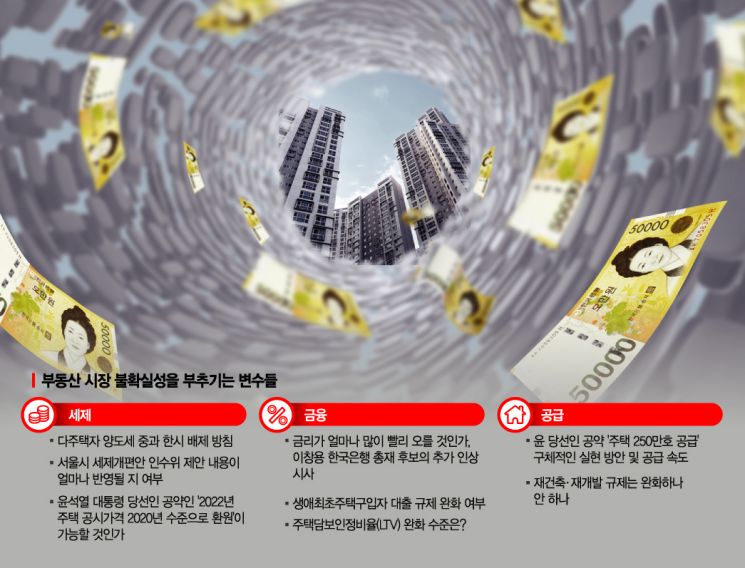
[Asia Economy Reporter Kim Min-young] Currently, there are three major areas contributing to the uncertainty in the real estate market: taxes, finance, and supply. In other words, variables span all sectors that determine the real estate market. Among these, the supply side is somewhat predictable. This is because the supply volume and subscription schedule for Seoul apartments this year are somewhat fixed. The problem lies in taxes and finance. Since the new government took office in May, there is a high possibility of changes in tax policies, and although interest rate hikes have been announced in the financial sector, the pace is unpredictable.
For now, the strongest factor moving the real estate market is the anticipation of regulatory easing related to reconstruction and redevelopment, which is directly linked to supply. According to the weekly apartment trend report by the Korea Real Estate Board, Seoul apartment prices stopped declining in April and shifted to stabilization. In Gangnam District, apartment sale prices turned positive by 0.01% on March 21 after the presidential election and have continued to rise for four consecutive weeks. Seocho District shows a similar trend. As of the 11th, apartment prices in the southeastern area, including Songpa, Gangnam, and Seocho, rose by 0.01%. Apartment prices in Yangcheon District, which includes Mok-dong with many reconstruction complexes, recorded stabilization at the end of March and turned to a 0.01% increase last week. Since the presidential election, with President-elect Yoon Seok-yeol emphasizing regulatory easing on reconstruction and redevelopment and forming a new government, the market sentiment has changed, especially in areas benefiting from these positive factors.
However, experts say Gangnam should be viewed as a special market that is not subject to capital regulations. They argue that the atmosphere in some parts of Gangnam does not reflect the overall market sentiment. Yoon Ji-hae, Chief Researcher at Real Estate R114, said, "Gangnam is a special market with demand segments unaffected by loan regulations," adding, "In Nowon District, a residential area for the working class, large-scale reconstruction projects are underway centered on Sanggye Jugong Apartments, but the price movements are not as significant as in Gangnam."
Among the reconstruction regulation relaxations, lowering the weighting of the detailed safety inspection can be achieved through revision of enforcement ordinances, but the Reconstruction Excess Profit Recovery System requires the consent of the Democratic Party, making it difficult to achieve the level of regulatory easing the market desires. This means that depending on the degree of regulatory easing, housing prices could fluctuate again.
Tax factors are also a key variable influencing the market. The Presidential Transition Committee's declared plan to temporarily exclude the heavy capital gains tax on multi-homeowners can be implemented through enforcement ordinance revision and is expected to be realized without difficulty. This is likely to have some effect on revitalizing transactions. President-elect Yoon Seok-yeol's pledges, such as restoring official housing prices to 2020 levels, lowering the cap on the increase rate of tax burdens, and reducing the tax rate for single-homeowners to pre-current government levels, are factors that influence whether homeowners continue to hold their properties, affecting demand for gifts or switching homes. Park Won-gap, Senior Real Estate Specialist at KB Kookmin Bank, said, "These policy changes will act as short-term psychological variables (within six months)."
The flow of financial policies is the condition that most significantly affects real estate purchase sentiment. The amount of available funds when buying a house and the level of loan interest rates are all influenced by financial policies. The current uneven trend in Seoul apartment prices is due to the temperature difference between areas like Gangnam, which are not affected by loan regulations, and working-class residential areas such as Dobong and Nowon Districts. This is why there is keen interest in the level of Loan-to-Value (LTV) ratio relaxation and whether loan regulations for first-time homebuyers will be eased.
The factor that stopped the panic buying by the 2030 generation, which led the real estate market last year, was precisely loan regulations. However, there is concern that loan easing, combined with signals of regulatory relaxation, could fuel the 'short-term rapid price increase' currently seen in some parts of Gangnam, posing a dilemma for the new government. Since the Yoon Seok-yeol administration came to power on real estate public sentiment, it is uncertain whether it will confront these concerns head-on, making it difficult at present to gauge the extent of regulatory easing.
© The Asia Business Daily(www.asiae.co.kr). All rights reserved.
![Clutching a Stolen Dior Bag, Saying "I Hate Being Poor but Real"... The Grotesque Con of a "Human Knockoff" [Slate]](https://cwcontent.asiae.co.kr/asiaresize/183/2026021902243444107_1771435474.jpg)
















