Flight Increase Still at 8% Level
"Difficult for Leave Workers to Return Immediately"
[Asia Economy Reporter Hyunseok Yoo] Although the skies are gradually reopening with exemptions from self-quarantine and increased international flights, the aviation industry's outlook is not very bright. This is because the number of flights is still insufficient compared to pre-COVID-19 levels, and the swift return of furloughed employees remains unlikely. The industry acknowledges that while the end of the COVID-19 tunnel is in sight, there is still a long way to go before full normalization.
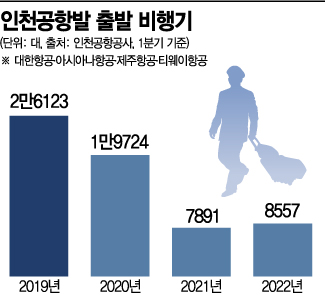
According to Incheon International Airport Corporation on the 20th, the number of flights departing from Incheon Airport by Korean Air, Asiana Airlines, Jeju Air, and T'way Air in the first quarter was 8,557. This is an 8.44% increase compared to 7,891 flights in the same period last year. However, it represents a decrease of 67.24% and 56.61% compared to 26,123 flights in 2020 and 19,724 flights in 2019, respectively. This decline is due to the closure of air routes caused by COVID-19.
The market views the second quarter of this year as the starting point of the 'post-COVID-19' era. With the transition to COVID-19 endemic status, all self-quarantine measures have been lifted, and previously suspended flights are significantly increasing. The Ministry of Land, Infrastructure and Transport plans to increase the number of regular international flights starting next month. Weekly flights will increase from 420 this month to 520 next month and 620 in June. From July, the number will expand by 300 flights per week.
Airlines are also increasing international flights. Korean Air, a full-service carrier (FSC), has expanded routes to Japan and Singapore, while Asiana Airlines has increased flights to London and Paris. Compared to April next month, these will increase by 16 and 4 flights per week, respectively. Low-cost carriers (LCCs) like Jeju Air plan to increase their routes from 8 this month to 14 next month, with flight frequencies rising from 88 to 174. T'way Air will resume routes to Thailand (Bangkok) and Vietnam (Ho Chi Minh City and Da Nang). Air Busan will also operate five regular flights to Saka, Narita, Nha Trang, Kota Kinabalu, and other destinations.
However, since flights are increasing gradually rather than rapidly, the industry’s response is that full normalization has not yet been achieved. The Ministry of Land, Infrastructure and Transport plans to expand operations to 2,420 flights per week by November. However, this is only 50% of the pre-COVID-19 levels. The swift return of furloughed employees working at Korean Air, Asiana Airlines, and LCCs has not yet occurred. An airline official explained, "We are adjusting personnel according to the slowly increasing flight schedules," adding, "It is not a situation for a sudden return."
The industry argues that to achieve rapid normalization, it is necessary to expand flight increases and ease the burden of polymerase chain reaction (PCR) tests, which impose costs on international travelers. An aviation industry official said, "The number of regular international flights in May was lower than expected, so the pace of increase needs to accelerate," adding, "To reduce the burden of overseas travel, mandatory PCR testing for inbound travelers should be exempted sequentially according to each country's COVID-19 situation and ultimately eliminated completely."
© The Asia Business Daily(www.asiae.co.kr). All rights reserved.
![Clutching a Stolen Dior Bag, Saying "I Hate Being Poor but Real"... The Grotesque Con of a "Human Knockoff" [Slate]](https://cwcontent.asiae.co.kr/asiaresize/183/2026021902243444107_1771435474.jpg)















