Introduction of Construction Site Waste Generator Reporting System, Tight Management from Generation Stage
Minimizing Direct Landfill of Combustible Waste through Separate Discharge by Type from Emission Stage
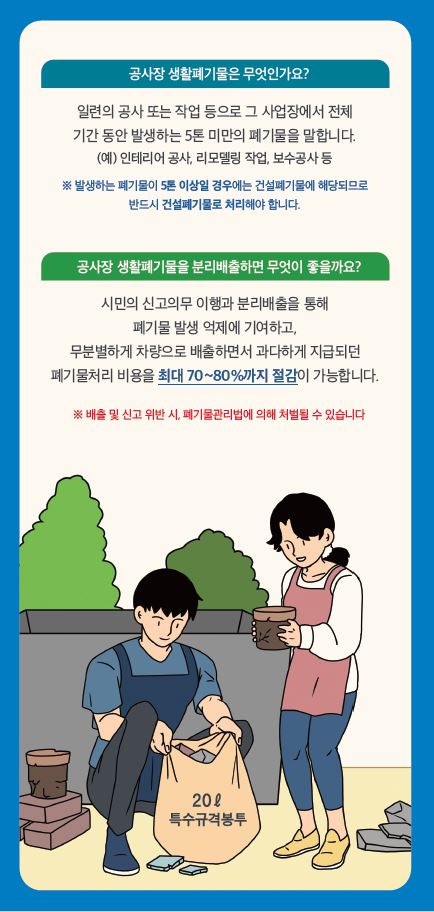
[Asia Economy Reporter Lim Cheol-young] Seoul City announced on the 20th that it will establish a meticulous management system, including the introduction of a reporting system for construction site household waste emitters generating less than 5 tons, to increase the recycling rate of waste and reduce landfill and incineration amounts.
The amount of household waste generated at construction sites in Seoul is 2,761 tons per day and is continuously increasing. Among this, the landfill amount is 804 tons, accounting for 29.1% of the total generated amount, requiring continuous management to increase the recycling rate.
Until now, there was no obligation to report the emission of construction site household waste, making it difficult to calculate accurate statistics on generation and treatment amounts. In addition, recyclable resources such as waste concrete and waste wood were mixed and emitted, resulting in a significant portion being incinerated or landfilled, highlighting the need for thorough management of construction site household waste.
Accordingly, Seoul City has organized a separate discharge system to maximize the recycling of small construction site household waste under 5 tons by ▲introducing a reporting system for construction site household waste emitters ▲ minimizing direct landfill of combustible waste through source-separated discharge by type ▲ ensuring compliance with the total import volume system for construction site household waste at the metropolitan landfill site through agreements between autonomous districts and construction waste companies.
First, by introducing the reporting system for construction site household waste emitters, all stages from waste generation to treatment will be managed, and the possibility of illegal dumping will be blocked in advance. The system has been in pilot operation since April and is scheduled to be fully implemented in the second half of the year. The reporting target applies to those who emit construction site household waste under 5 tons starting from 10 special specification bags of 20ℓ, and the reporting methods include autonomous district websites, mobile apps, and in-person submissions.
To minimize direct landfill of combustible waste from construction site household waste, source-separated discharge by type is encouraged from the emission stage. Waste generated from interior remodeling, repair work, and other construction activities at business sites can be divided into large household waste, recyclables, combustible waste, and non-combustible waste.
The city expects that through the introduction of the emitter reporting system and proper source-separated discharge, waste treatment costs, which were excessively paid due to indiscriminate discharge, can be reduced by up to 70-80%, lowering costs from 300,000 KRW per ton to 60,000 KRW. Furthermore, by improving the recycling rate and quality of waste bricks, waste wood, and waste synthetic resin, which constitute a significant portion of construction site household waste, the amount landfilled can be reduced, accelerating the transition to a circular economy that recycles waste.
Meanwhile, with the total import volume system for construction site household waste at the metropolitan landfill site in effect since January this year, the city has encouraged autonomous districts and construction waste treatment companies to sign agreements on construction site household waste treatment to ensure compliance with import volumes. The main contents of the agreement include ▲ construction waste treatment companies must properly treat construction site household waste to maximize recycling and minimize landfill ▲ report monthly treatment performance to autonomous districts ▲ supplement facilities such as scales, CCTV installation, separation of construction waste and construction site household waste areas, and dust prevention walls.
The city plans to reduce the total emission volume by 10% in the second half of this year compared to the first half through various efforts such as the reporting system and agreements, and to reduce it by 10% annually until 2025. Oh Yong-seon, Director of the Seoul City Living Environment Division, said, “The introduction of the reporting system for construction site household waste emitters fundamentally improves the existing treatment method, enabling accurate tracking of construction site household waste and reducing the amount of waste landfilled at the metropolitan landfill site.” He added, “We will take the lead in promoting recycling of construction site household waste by thoroughly managing from the emission stage to prevent recyclable resources from being arbitrarily landfilled or improperly treated.”
© The Asia Business Daily(www.asiae.co.kr). All rights reserved.
![Clutching a Stolen Dior Bag, Saying "I Hate Being Poor but Real"... The Grotesque Con of a "Human Knockoff" [Slate]](https://cwcontent.asiae.co.kr/asiaresize/183/2026021902243444107_1771435474.jpg)















