Adoption Without Vote on Confirmation Hearing Report
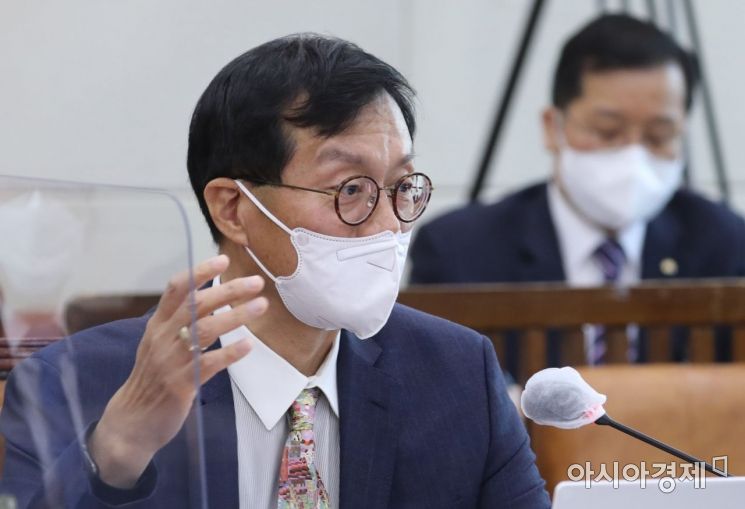 Lee Chang-yong, nominee for Governor of the Bank of Korea, is attending the confirmation hearing held at the National Assembly on the 19th, responding to questions from lawmakers. Photo by Yoon Dong-joo doso7@
[Asia Economy Reporter Seo So-jeong] Lee Chang-yong, the nominee for Governor of the Bank of Korea, forecasted that the inflationary phase will continue for at least 1 to 2 years. Amid high inflation, he emphasized the importance of the central bank proactively signaling interest rate hikes to stabilize expectations and reiterated the stance of a tight monetary policy.
On the morning of the 19th, during the confirmation hearing held at the National Assembly’s Planning and Finance Committee plenary session, Lee responded to a question from Seo Byung-soo, a member of the People Power Party, asking, "To what extent do you expect inflation to continue going forward?"
Lee stated, "There is a significant rise in housing costs domestically that has not been fully reflected in the Consumer Price Index, and it is true that the hardship for low-income households is substantial," adding, "Due to factors such as the Ukraine crisis and supply chain issues caused by COVID-19, I expect inflation to remain in an upward phase for at least 1 to 2 years."
Regarding the future direction of monetary policy, he said, "If we do not send signals in advance through interest rate hikes to curb inflation, inflation expectations could rise further," and added, "I believe it is appropriate so far to proactively send interest rate signals to stabilize expectations." He pointed out that, unlike the U.S., where interest rates were rapidly raised after inflation increased, such a swift approach can cause significant side effects for vulnerable groups.
While the April Monetary Policy Committee raised interest rates by 0.25 percentage points focusing on inflation, Lee expressed the intention that the Monetary Policy Committee in May and July will take a balanced view of growth and inflation.
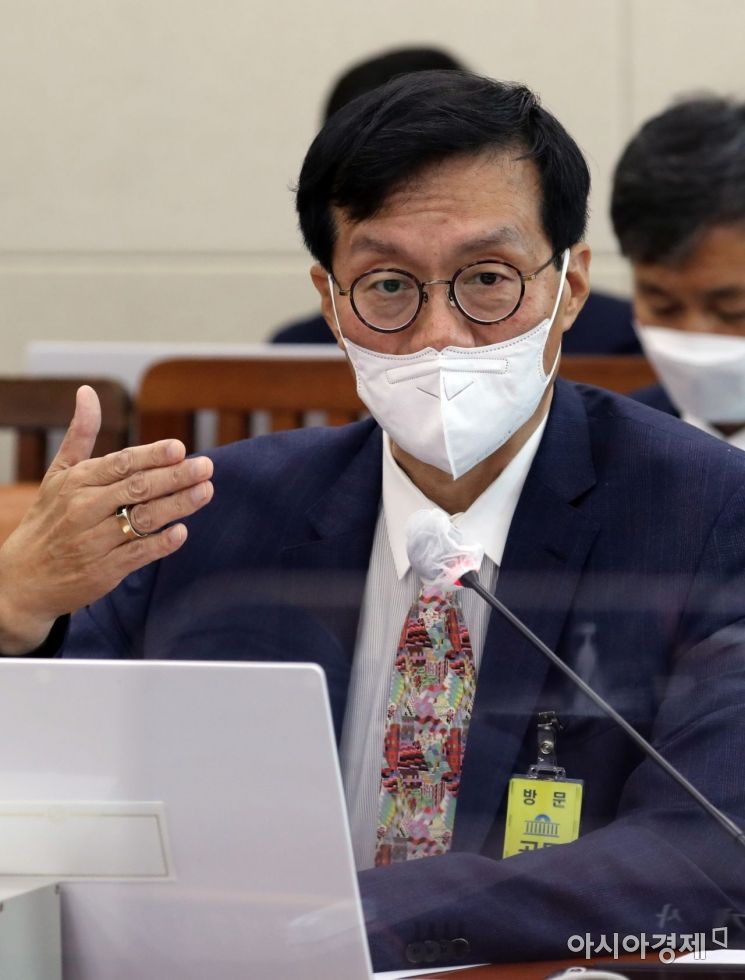 Lee Chang-yong, the nominee for Governor of the Bank of Korea, is attending the confirmation hearing held at the National Assembly on the 19th, responding to questions from lawmakers. Photo by Yoon Dong-joo doso7@
Lee emphasized the need for interest rate hikes to address the household debt problem, which is approaching approximately 1,900 trillion won. He said, "The household debt issue is also related to real estate, so signaling through interest rates is important, but it is impossible to solve it solely through the Bank of Korea’s interest rate policy," adding, "A government-wide task force (TF) should be formed to develop a comprehensive solution considering structural, fiscal, and vulnerable group issues."
Regarding slowing the pace of household debt increase, he stated that the new government’s easing of loan regulations should be limited. Lee said, "It is desirable that the easing of the loan-to-value (LTV) ratio announced by the new government be primarily limited to first-time homebuyers," and warned, "If loan regulation easing policies are implemented all at once, it could burden inflation and the macroeconomy."
On concerns that the government’s supplementary budget might stimulate inflation, he responded, "The current supplementary budget is a micro-level policy supporting small business owners and self-employed individuals, so I think it is an unavoidable selective compensation," but added, "If the total amount becomes very large and affects inflation on a macro level, naturally the policy authorities and the Bank of Korea should discuss how to manage the inflation impact, and the Bank of Korea should also be involved."
Regarding the privatization plan of the state-run Korea Development Bank (KDB), which was pursued in the past but failed, he expressed the view that it was a wrong decision. In 2008, the government attempted to convert KDB into a private commercial bank and establish a new policy finance institution with the proceeds from the sale but later withdrew the plan.
Lee said, "I sincerely pursued the privatization of KDB, so it is regrettable that it reverted to its original state," and explained, "The purpose was to expand private functions through KDB privatization to develop the investment side and modernize public functions through a policy finance corporation." He added, "Unfortunately, after I left public office, this policy reverted to its original state, which caused significant costs, so I heard it was considered a failure," and stated, "Given that there were no major changes in 2015, I think it was a wrong decision to revert KDB privatization."
Regarding government officials such as the Vice Minister of Strategy and Finance and the Vice Chairman of the Financial Services Commission attending the Bank of Korea’s Monetary Policy Committee meetings and having the right to speak ('seated speaking rights'), he expressed the view that it is "not effective." He said, "Even if the government expresses opinions through seated speaking rights, if the conclusion does not change, it only signals that the government and the Bank of Korea are not coordinated."
In response to criticism that internal changes are needed within the Bank of Korea’s organization, Lee replied, "Based on my several years of public service experience, no matter how much reform is pushed from the top, it is difficult if there is no acceptance from below, so within the next 1 to 2 months, I will try to prepare a plan that can gain consensus and work on improvements."
The National Assembly’s Planning and Finance Committee adopted the confirmation hearing report on Lee without a vote during the plenary session in the afternoon.
The committee stated in the report, "The nominee has conducted research on economic issues such as responding to the foreign exchange crisis while serving as a professor in the Department of Economics at Seoul National University. He has government practical experience through positions such as Vice Chairman of the Financial Services Commission and Head of the Planning and Coordination Team for the G20 Summit Preparatory Committee. He has also gained diverse policy and international experience as a Senior Economist at the Asian Development Bank (ADB) and as Director for Asia and Pacific at the International Monetary Fund (IMF)."
© The Asia Business Daily(www.asiae.co.kr). All rights reserved.
![Clutching a Stolen Dior Bag, Saying "I Hate Being Poor but Real"... The Grotesque Con of a "Human Knockoff" [Slate]](https://cwcontent.asiae.co.kr/asiaresize/183/2026021902243444107_1771435474.jpg)

















