Announcement of Plan to Strengthen Guarantee of Mobility Rights for Disabled
Mandatory Replacement of City Buses with Low-Floor Buses
Installation of Elevators in Subway Stations, etc.
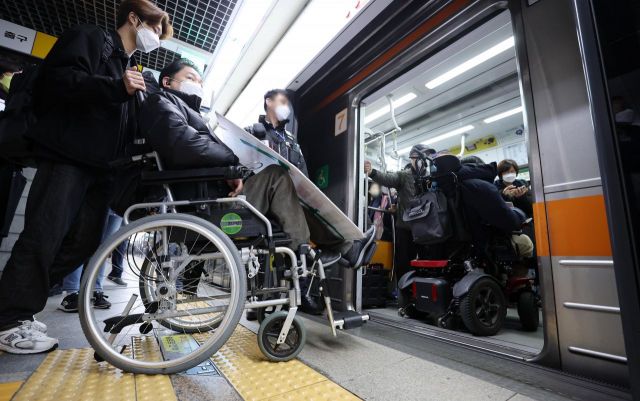 Officials from the National Solidarity for the Elimination of Discrimination against Persons with Disabilities are staging a boarding protest on the Seoul Subway Line 3 at Gyeongbokgung Station on the 24th, demanding the guarantee of mobility rights for persons with disabilities. Photo by Kim Hyun-min kimhyun81@
[Asia Economy Reporter Yoo Byung-don] The Presidential Transition Committee (Transition Committee) announced a plan to strengthen the guarantee of mobility rights for persons with disabilities on the 19th.
On the afternoon of the same day, one day before Disability Day, Ahn Sang-hoon, a member of the Social Welfare and Culture Subcommittee of the Transition Committee, held a briefing at the Transition Committee office in Tongui-dong, Jongno-gu, Seoul, and announced disability policies including the mandatory replacement of city buses with low-floor buses and the installation of elevators in subway stations.
First, regarding the mobility rights of persons with disabilities, the Transition Committee plans to mandate the replacement of city buses with low-floor buses by 2023 and expand the introduction of express and intercity buses that can accommodate wheelchair boarding.
The introduction rate of disability call taxis will also be raised to 100% by 2027, and the statutory number of vehicles will be increased, especially in areas where it is difficult to use public transportation. In addition, the quality of service will be improved through metropolitan mobility and 24-hour operation of disability call taxis.
Furthermore, at least one elevator will be installed in each subway station, and for subway stations with many passengers, securing two elevator routes per station will be promoted step by step. The Transition Committee expects this to expand a "barrier-free transportation environment" where transportation-vulnerable individuals can move safely and conveniently.
The introduction of a personal budget system for persons with disabilities is also under consideration. Committee member Ahn stated, "From the review process, we will form a public-private consultative body including the disability community to fully listen to the opinions of persons with disabilities and discuss them."
Regarding the need for a permanent national disability organization, Ahn explained, "Since there are various types of disabilities and differing viewpoints, a discussion body may be necessary," adding, "Whether to establish it temporarily as a task force (TF) or make it permanent when introducing the system requires further review."
Additionally, the Transition Committee plans to create new job models suitable for persons with disabilities and expand digital training centers needed in the digital transformation era. Ahn said, "In the era of the 4th Industrial Revolution, there are many jobs in fields like coding that can be done remotely," and added, "I mentioned moving toward a system that provides appropriate vocational training and education so that persons with disabilities can enter even high-level occupations."
Facilities for persons with disabilities will also be significantly improved in museums, art galleries, and other venues. The Transition Committee will improve accessibility facilities at these locations to transform them into "barrier-free cultural facilities" and expand socially integrated sports facilities where persons with and without disabilities can participate together.
The barrier-free tourism city project will also be promoted. Furthermore, plans include establishing dedicated performance halls and exhibition spaces for disabled artists, activating performances and exhibitions by disabled artists at national and public performance and exhibition venues, and laying the legal foundation for priority public institution purchases of works by disabled artists.
Ahn stated, "Improving the quality of life for persons with disabilities and creating a society without boundaries between disability and non-disability is a core national agenda," adding, "Detailed policy contents will be concretized in the new government after review by the Transition Committee."
He continued, "After holding several meetings with disability field officials and organizations, we found that there are very diverse perspectives on deinstitutionalization," and added, "After deinstitutionalization, a family environment and community infrastructure capable of properly caring for persons with disabilities must be established, and we are comprehensively reviewing this including resolving prerequisite issues."
© The Asia Business Daily(www.asiae.co.kr). All rights reserved.
![Clutching a Stolen Dior Bag, Saying "I Hate Being Poor but Real"... The Grotesque Con of a "Human Knockoff" [Slate]](https://cwcontent.asiae.co.kr/asiaresize/183/2026021902243444107_1771435474.jpg)
















