Semiconductor Industry Technical Workforce Hiring Growth Rate 9.5%... Tops 12 Major Industries
Ruling Party Proposes 'Semiconductor Engineering University Act'... Aims to Solve Workforce Shortage
President-Elect Yoon Seok-yeol Also Pledges 'Super-Gap'... Unprecedented Support Promised
[Asia Economy Reporters Sunmi Park, Jinho Kim] "The movement of semiconductor specialists between Samsung Electronics and SK Hynix has now become a common occurrence. This is a clear indication of the shortage of semiconductor experts in Korea."
Samsung Electronics and SK Hynix, the two major pillars of the domestic semiconductor industry, are suffering from an intensifying shortage of specialized personnel. As the global semiconductor labor shortage worsens, attracting overseas talent has become difficult, prompting these companies to invest heavily in offering better compensation than their competitors. However, since fundamental solutions such as nurturing specialized talent have not yet emerged, the competition to prevent personnel movement between companies is expected to accelerate further.
According to the semiconductor industry on the 19th, SK Hynix is currently conducting a ‘Junior Talent’ recruitment process targeting candidates with less than five years of experience, and it has been confirmed that a significant number of Samsung Electronics semiconductor employees are preparing for SK Hynix interviews. On the anonymous workplace community ‘Blind,’ numerous questions have been posted by Samsung Electronics employees regarding SK Hynix’s working environment, commuting methods, and compensation and welfare levels ahead of SK Hynix’s interview schedule.
An industry insider said, "The movement of personnel between Samsung Electronics and SK Hynix has already become a common sight," adding, "Especially recently, SK Hynix’s performance bonuses and welfare levels have become a hot topic, creating an atmosphere where the MZ generation (Millennials + Generation Z) is comparing the two companies and considering job changes."
In a situation where the major countries’ hegemony battles over the semiconductor industry are intensifying, the shortage of specialized talent pools has created an environment where personnel movement between companies is inevitably active.
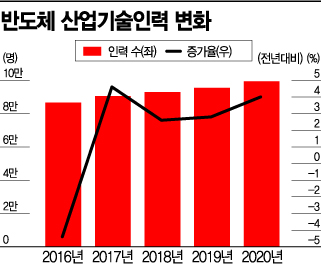
According to the ‘2021 Industrial Technology Workforce Supply and Demand Survey’ released by the Korea Institute for Industrial Technology Promotion, as of the end of 2020, the number of workers engaged in the semiconductor industry was 179,885. Among them, 99,285 are industrial technology personnel responsible for research and development, technology, and production within companies, marking a 4% increase compared to 2019.
While the semiconductor industrial technology workforce growth rate was in the 2% range for two consecutive years in 2018 and 2019, it rose to 4% in 2020, but the industry still complains about a shortage of necessary personnel. The Institute estimates the shortage of industrial technology personnel in the semiconductor industry to be about 1,621. Among the 12 key industries, the semiconductor industry has the highest industrial technology workforce recruitment growth rate at 9.5%.
An industry official said, "This is also a very conservative estimate," adding, "The actual shortage of specialized personnel felt within the industry is much more severe than what is perceived externally."
Due to the chronic labor shortage, the semiconductor industry, which is Korea’s top export contributor, is at risk of being shaken to its core. The industry has been appealing for government-level measures to address the chronic shortage of personnel for years, but due to complacent responses from various ministries, nurturing core talent in the semiconductor industry has been pushed to the sidelines.
Meanwhile, major countries such as the United States, China, and Europe have successively declared their semiconductor ambitions, putting the status of ‘Semiconductor Korea’ under threat. This is the background behind the government and political circles, belatedly recognizing the seriousness, pulling out support cards one after another. President-elect Yoon Suk-yeol has also emphasized the need to further activate the semiconductor industry, a core pillar of future national competitiveness, to secure the so-called ‘semiconductor super-gap,’ leading to expectations that related industry development will be pursued in the next administration.
There Is No Political Divide in Semiconductor Development
According to the National Assembly’s legislative information system, 13 lawmakers including Minseok Ahn of the Democratic Party of Korea proposed the ‘Korea Artificial Intelligence and Semiconductor Engineering University Act’ the day before. The bill aims to establish a so-called semiconductor university to solve the industry’s chronic labor shortage.
The background for proposing the bill was the judgment that securing 36,000 semiconductor industry personnel needed over the next 10 years is practically impossible under the current system. Representative Ahn explained, "It is intended to contribute to strengthening national competitiveness and to leap forward as a leading country in the Fourth Industrial Revolution era."
Specifically, the bill stipulates establishing a special corporation semiconductor university to provide a basis for stable financial support and to serve as a control tower by building an industry-academia-research cooperation system to nurture specialized personnel. It also mandates that the Minister of Trade, Industry and Energy directly support and foster the university and coordinate and supervise its operations.
Notably, the bill includes provisions exempting the establishment of the related school from the Capital Region Readjustment Planning Act. Considering the significant disagreements between ministries and local communities regarding the amendment of this law, this presents a new solution for establishing a new school. Therefore, if the bill passes, it is expected to significantly help alleviate the industry’s chronic labor shortage.
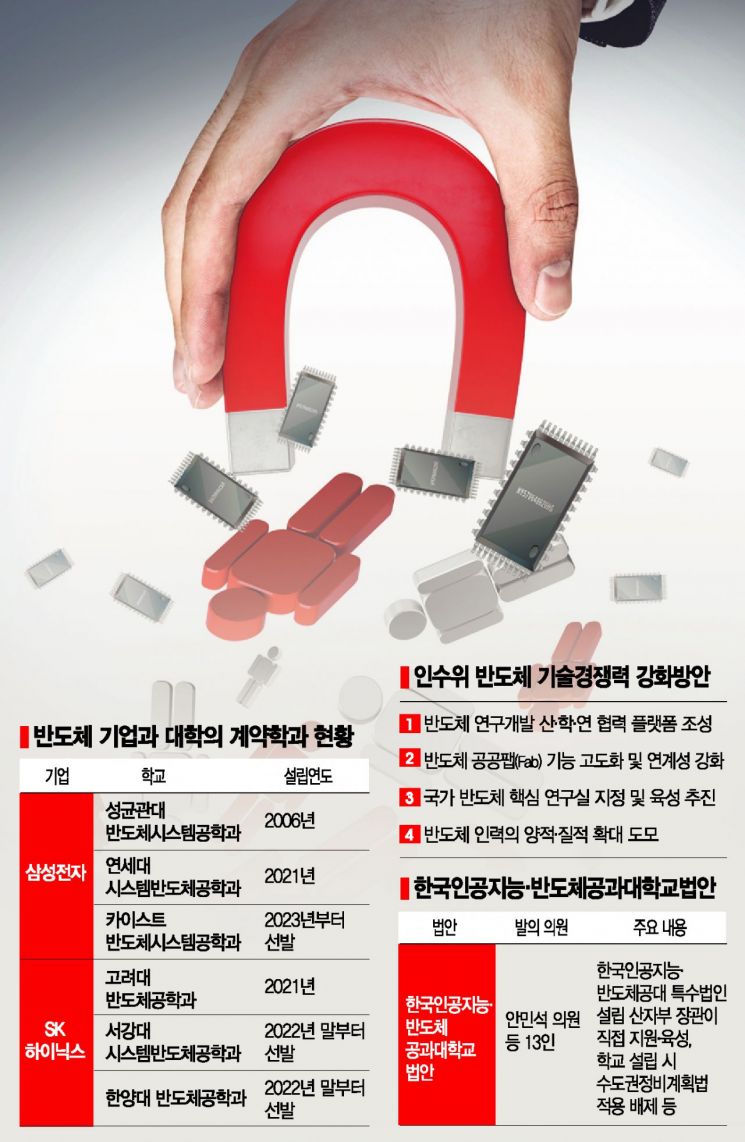
President-elect Yoon has also been unveiling support measures to secure the ‘semiconductor super-gap.’ The Science, Technology, and Education division of the transition committee announced the day before that ‘strengthening semiconductor technological competitiveness’ will be a key national agenda. Specifically, this includes ▲ establishing an industry-academia-research cooperation platform for semiconductor R&D ▲ enhancing the functions and connectivity of public semiconductor fabs ▲ designating and fostering national core semiconductor research labs ▲ and promoting quantitative and qualitative expansion of semiconductor personnel.
Both ruling and opposition parties voicing unified support for semiconductor industry development reflects the seriousness of the situation. It also reflects the sense of crisis that Korea can no longer afford to lag behind as major countries worldwide are pouring out unprecedented full-scale support plans to secure semiconductor competitiveness. In fact, the United States, the European Union, and Taiwan have recently launched unprecedented full-scale support for semiconductor industry development.
Companies Pouring Money... Rolling Up Sleeves to Secure Talent
Companies are competitively improving employee salaries and welfare to actively recruit talent. The semiconductor industry expects Samsung Electronics and SK Hynix to have salary increase rates around 8% this year as well. SK Hynix already decided on an 8% wage increase for employees last year, double the usual rate. Wage negotiations for 2022 are expected to begin as early as next month. Since a significant wage increase was already decided last year, there is little room to raise it further this year, but given the fierce competition for semiconductor personnel, maintaining last year’s wage increase rate is considered a possible scenario.
Samsung Electronics, which raised employee wages by an average of 7.5% last year, is currently in wage negotiations between labor and management. The increase rate has not yet been finalized. Samsung Electronics labor representatives demanded a record-high basic increase rate of 15.72% this year, but management rejected this. The general view is that the increase rate will likely be aligned with SK Hynix’s level. Foundry specialist DB Hitek has taken a bold step to secure semiconductor personnel by raising the starting salary for new employees by 14.3% this year. DB Hitek’s new employee starting salary is now aligned with Samsung Electronics’ level.
They have also jumped into direct talent development. These companies have partnered with universities to establish semiconductor departments so they can secure new graduates as new employees immediately after graduation. SK Hynix signed a contract this month with Hanyang University to nurture next-generation semiconductor talent and support the establishment of a semiconductor engineering department.
Under the agreement, Hanyang University will establish a semiconductor engineering department within its College of Engineering and select the first batch of 40 freshmen (24 early admission, 16 regular admission) by the end of the year. Selected students will receive full tuition and academic scholarships and will be employed by SK Hynix after graduation. SK Hynix previously signed agreements with Korea University and Sogang University to establish departments for semiconductor specialist training. Samsung Electronics is also cooperating with Sungkyunkwan University, Yonsei University, KAIST, and POSTECH on semiconductor departments.
Sungseongcheol, senior research fellow at the Korea Semiconductor Display Technology Society, said, "Since semiconductors are directly linked to national security, regardless of the new government, both ruling and opposition parties must work together to foster the industry," adding, "The government should actively drive policies focusing on tax support, infrastructure expansion, deregulation, and talent development."
© The Asia Business Daily(www.asiae.co.kr). All rights reserved.


















