Ministry of the Interior and Safety Approves 'BooUlGyeong Special Union' Charter
Related Ministries and BooUlGyeong Sign 'Decentralization Agreement' and 'Ultra-Wide Area Joint Cooperation MOU'
 Jeon Hae-cheol (center), Minister of the Ministry of the Interior and Safety, Park Hyung-joon, Mayor of Busan Metropolitan City, Song Cheol-ho, Mayor of Ulsan Metropolitan City, Ha Byung-pil, Acting Governor of Gyeongnam Province, and related ministries are taking a commemorative photo after signing a decentralization agreement and a memorandum of understanding for joint cooperation in the ultra-wide area at the agreement ceremony to support the Bu-Ul-Gyeong Special Local Government held on the morning of the 19th at the annex of the Government Seoul Office in Jongno-gu, Seoul.
[Asia Economy Reporter Lim Cheol-young] Following the government's approval of the regulations related to the country's first special local government 'Busan-Ulsan-Gyeongnam Special Union,' established with the goal of becoming one of the eight mega cities in Northeast Asia, the relevant ministries and the Busan-Ulsan-Gyeongnam (Bu-Ul-Gyeong) region have signed a 'Decentralization Agreement' and a 'Memorandum of Understanding for Joint Cooperation on the Bu-Ul-Gyeong Super Metropolitan Area Development Plan,' marking the start of full-scale support.
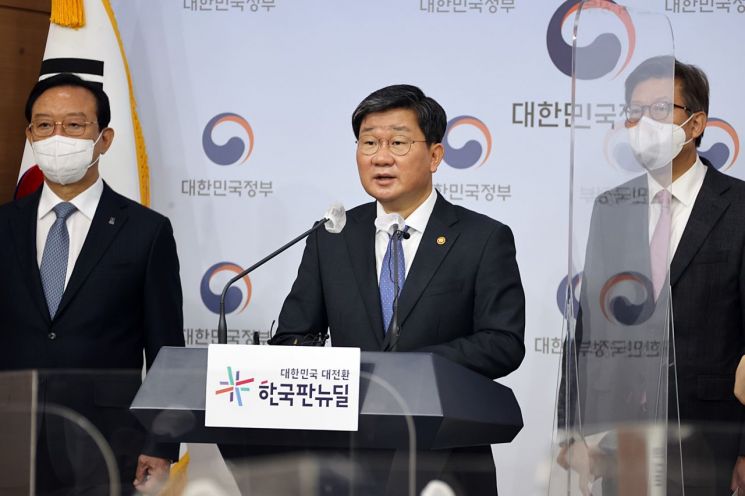
On the 19th, the government held a 'Support Agreement Ceremony for the Bu-Ul-Gyeong Special Local Government,' following the establishment of the nation's first special local government, the 'Busan-Ulsan-Gyeongnam Special Union.' A joint briefing was held with the attendance of relevant ministers including Jeon Hae-cheol, Minister of the Ministry of the Interior and Safety, and heads of the Bu-Ul-Gyeong local governments such as Park Hyung-joon, Mayor of Busan. The approved regulations took effect from midnight on the same day.
Minister Jeon stated in his opening remarks, "On the 18th, the Ministry of the Interior and Safety gave final approval to the regulations, leading to the birth of the 'Busan-Ulsan-Gyeongnam Special Union.' The special local government will have authority over personnel and organizational matters, enactment of ordinances and rules within the scope of duties defined by the regulations, and will form a separate head and local council to make independent decisions," he explained.
A special local government is a local government established when two or more local governments jointly need to handle certain affairs on a metropolitan scale. Since the full revision of the Local Autonomy Act, which includes specific provisions for the establishment and operation of special local governments, came into effect in January, the system can now be actively utilized.
In particular, special local governments have autonomy over personnel and organizational authority, ordinance and rule enactment within the scope of duties defined by the regulations, and can form separate heads and local councils, enabling independent decision-making beyond the interests of individual local governments, unlike existing administrative councils or local government unions.
Therefore, special local governments are expected to promote super-metropolitan cooperation between metropolitan local governments. They will create super-metropolitan transportation networks crossing city and provincial boundaries, jointly utilize each region's industrial base to secure the industrial capacity of the entire area, and establish cooperative systems for local talent retention, thereby strengthening regional competitiveness through special local governments.
Minister Jeon said, "According to the contents of this agreement, special local governments will be granted the authority necessary to perform metropolitan administrative functions that cross city and provincial boundaries, such as submitting metropolitan transportation implementation plans and establishing and operating metropolitan bus rapid transit (BRT) systems." He added, "As a party to the agreement, the government will promptly revise related laws and regulations to ensure the smooth operation of the 'Busan-Ulsan-Gyeongnam Special Local Government.'"
The Bu-Ul-Gyeong special local government originated from the will of Busan, Ulsan, and Gyeongnam to create the 'Bu-Ul-Gyeong Mega City' as a development strategy to compete with the Seoul metropolitan area. On February 25 last year, Bu-Ul-Gyeong officially announced the promotion of super-metropolitan cooperation between metropolitan local governments through the 'Southeast Mega City Construction Strategy Report,' and in July, formed the 'Bu-Ul-Gyeong Special Local Government Joint Promotion Team' to prepare for the establishment of the special local government.
Since then, the government, centered on the joint promotion team, has identified joint affairs to be performed by the special local government and prepared the current regulations. The special union will go through preparatory processes such as enacting ordinances and establishing offices necessary for performing duties, and according to the supplementary provisions of the regulations, will begin handling affairs from January 1, 2023.
The national affairs delegated to the special union were decided based on demands identified by Bu-Ul-Gyeong and after review and consultation with relevant ministries. Since November last year, the Ministry of the Interior and Safety has formed the 'Inter-Ministerial Task Force for Supporting Super-Metropolitan Cooperation in Institutional Areas' and has discussed with relevant ministries the necessity and feasibility of delegating national affairs requested by Bu-Ul-Gyeong. As a result, it was agreed to delegate to the special union the affairs under the Ministry of Land, Infrastructure and Transport, including ▲submission of metropolitan transportation implementation plans, ▲establishment and operation of metropolitan bus rapid transit (BRT) systems, and ▲designation of general logistics complexes spanning two or more cities and provinces.
The 'Bu-Ul-Gyeong Super Metropolitan Area Development Plan,' for which the memorandum of understanding was signed, contains strategies for industry, talent, and spatial sectors of Bu-Ul-Gyeong, which will serve as a leading model to overcome the unipolar system of the Seoul metropolitan area, including 30 first-phase leading projects and 40 mid- to long-term projects, totaling 70 core projects. Park Hyung-joon, Mayor of Busan Metropolitan City, said, "We will focus on fostering the three major industries of the Bu-Ul-Gyeong super metropolitan area?automobiles, shipbuilding, and aviation?strengthen inter-city and provincial linkage and cooperation for rapid transition to an eco-friendly industrial structure and enhancement of new industry competitiveness." He added, "We plan to strategically link the hydrogen industry as a hub for the three major industries and support the innovation base of the core industries through fostering digital new industries and activating super-metropolitan R&D."
The government plans to secure funding for the stable promotion of projects included in the Bu-Ul-Gyeong Super Metropolitan Area Development Plan and prioritize support for leading projects to create a successful super metropolitan area model. Additionally, it will cooperate in supporting local fiscal investment reviews, establishing evaluation systems for super-metropolitan cooperation projects, and operating councils to discuss matters necessary for implementing the super metropolitan area development plan. Furthermore, Bu-Ul-Gyeong has agreed to cooperate in securing investment resources, managing project progress and outcomes, and providing administrative and financial support to the Bu-Ul-Gyeong special local government.
Gu Yoon-cheol, Director of the Office for Government Policy Coordination, emphasized, "The three cities and provinces of Bu-Ul-Gyeong will annually secure necessary investment resources and manage project progress and outcomes, fulfilling roles essential for regional and national development." He added, "We hope that the super-metropolitan cooperation initiated in Bu-Ul-Gyeong will become a cornerstone for balanced national development and enhancing national competitiveness."
© The Asia Business Daily(www.asiae.co.kr). All rights reserved.


















