IMF to Release World Economic Outlook on 19th... Focus on Upward Revision of Consumer Prices
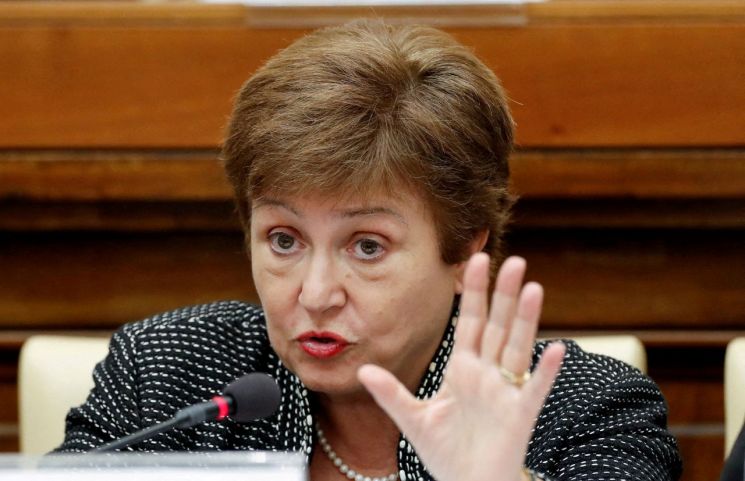
[Asia Economy Washington (USA) = Reporter Kwon Haeyoung] The International Monetary Fund (IMF) has forecast a downward revision of the global economic growth rate this year due to the aftermath of the Ukraine crisis, drawing attention to the extent of the downward revision of South Korea's growth rate. With a downward revision to the 2% range for this year's growth rate becoming a foregone conclusion, the key issue is how much to raise the consumer price inflation rate. In particular, with the global economic slowdown causing a contraction in trade, combined with the 'three highs' of high inflation, high interest rates, and high exchange rates, the next government will be inaugurated under more difficult economic conditions than ever before.
According to the Ministry of Economy and Finance on the 18th, the IMF will announce the global economic outlook, including South Korea, on the 19th (local time), when the annual meeting is held. This is the first forecast since the outbreak of the Russia-Ukraine war in February, and the IMF has announced that it will fully reflect the impact of the war and lower the growth rates of 143 countries compared to the forecast made in January.
Previously, in its January forecast, the IMF projected South Korea's growth rate for this year at 3.0%, down 0.3 percentage points from the previous forecast (3.3%). If the growth rate is revised downward again in this forecast, which will be announced three months later, it will fall into the 2% range.
The possibility of a slowdown in global economic growth due to the Ukraine war is particularly bad news for South Korea's economy, which is highly dependent on foreign trade. The World Trade Organization (WTO) has predicted that global trade growth could be as low as 2.4% this year due to Russia's invasion of Ukraine.
Attention is also focused on the consumer price inflation forecast, which surpassed 4% last month for the first time in about 10 years. The IMF projected South Korea's inflation rate at 3.1% this year, and the key question is how much this will be revised upward in the upcoming forecast. The ASEAN+3 Macroeconomic Research Office (AMRO) also significantly raised South Korea's inflation forecast to 2.9% from the previous 2.1% in its regional economic outlook released on the 12th. The growth rate forecast was maintained at 3.0%.
In fact, domestic consumer prices remained at 3.6% in January and 3.7% in February, but surged to 4.1% in March as the impact of the Ukraine war was fully reflected. Energy prices such as diesel (37.9%) and gasoline (27.4%) soared, and dining-out prices also rose 6.6%, marking the highest increase in 24 years. The rise in energy and grain prices due to the Ukraine war has begun to be fully reflected in inflation. Additionally, the US monetary tightening and geopolitical risks have led to a preference for safe assets, strengthening the dollar and further pushing up import prices.
Hong Nam-ki, Deputy Prime Minister and Minister of Economy and Finance, recently said at a press conference with foreign journalists, "I think the IMF's global economic outlook will lower the growth forecasts for advanced and developing countries, including South Korea," and added, "Regarding inflation, the forecast will inevitably be much higher than now."
© The Asia Business Daily(www.asiae.co.kr). All rights reserved.
![Clutching a Stolen Dior Bag, Saying "I Hate Being Poor but Real"... The Grotesque Con of a "Human Knockoff" [Slate]](https://cwcontent.asiae.co.kr/asiaresize/183/2026021902243444107_1771435474.jpg)
















