Raw Material Import Slump, Manufacturing Crisis
Q1 Economic Growth Estimated at 4.5%
1%P Below This Year's Target
Premier Li Keqiang Orders Financial Support
Possible Cuts to LPR for Consumers Alongside RRR and MLF for Financial Sector
[Asia Economy Beijing=Special Correspondent Cho Young-shin, Reporter Kim Hyun-jung] The Chinese government has announced a response involving interest rate cuts ahead of the first-quarter Gross Domestic Product (GDP) data release scheduled for the 18th. This signals the use of monetary policy tools as the domestic and international economic environment rapidly deteriorates due to consumption contraction caused by the resurgence of COVID-19 and rising international raw material prices following Russia's invasion of Ukraine.
Within China, the first-quarter economic growth rate is estimated to be only around 4.5% year-on-year. This figure is a full 1 percentage point lower than the initial target of approximately 5.5%.
◆Possibility of Interest Rate Cuts Amid Economic Slowdown
According to Chinese media including the state-run Xinhua News Agency on the 14th, Premier Li Keqiang held a State Council executive meeting the previous day and instructed the preparation of measures to expand financial support to stabilize the real economy. Premier Li emphasized that consumption is the driving force of the economy and requested funding supply to industries closely related to people's livelihoods such as the food service industry, retail, and tourism. He particularly mentioned the reserve requirement ratio (RRR), stating the need to timely utilize monetary policy tools that help the real economy.
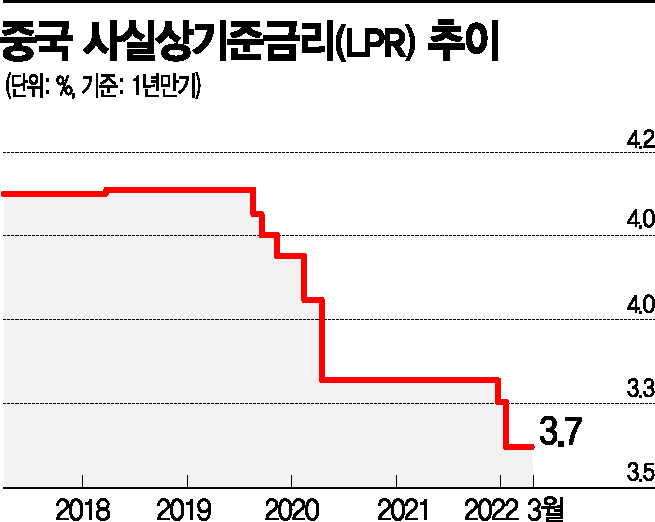
The monetary policy tools used by Chinese authorities mainly include three types: RRR, Medium-term Lending Facility (MLF) loan interest rates, and the Loan Prime Rate (LPR), which serves as the benchmark interest rate.
RRR is the cash reserve ratio that commercial banks must deposit with the central bank. Typically, a 0.5% cut in RRR creates an additional lending capacity of 1.2 trillion yuan (approximately 231 trillion won). Premier Li's mention of RRR essentially means lending more money to the market.
Another tool is the MLF, which is the interest rate on policy funds supplied by the People's Bank of China, the central bank, to banks and other financial institutions. Last December, when adverse factors such as rising international raw material prices and coal shortages emerged, the People's Bank of China sequentially cut RRR, MLF, and LPR rates.
The most powerful tool is the LPR. While RRR and MLF target the financial sector, LPR targets financial consumers. Lowering the LPR reduces overall interest rates, significantly expanding credit.
Currently, there is a strong expectation within China that the MLF rate will be cut on the 15th, along with an RRR cut within this week. Furthermore, depending on the GDP results scheduled for the 18th, there is speculation that the government may use the LPR tool on the 20th.
However, opinions on the effectiveness of interest rate cuts are somewhat divided within China. This is because local governments are already issuing special bonds in large quantities, releasing sufficient funds into the market. As of the end of March, the broad money supply M2, indicating cash liquidity in the market, increased by 9.7% year-on-year to 249.77 trillion yuan (48,411 trillion won), and the narrow money supply M1 also rose by 4.7% year-on-year to 64.51 trillion yuan.
◆"Overall Pressure on Manufacturing, Trade, and Retail"
China is considering the interest rate cut option because its economic situation is serious.
On the 13th (local time), Bloomberg reported that since last month, strengthened COVID-19 prevention measures and lockdowns in major cities such as Shanghai have pressured the entire economy from manufacturing and trade to retail markets.
According to the General Administration of Customs of China, China's imports in March decreased by 0.1% year-on-year to $228.7 billion (approximately 279.95 trillion won). This not only fell far short of the market forecast of a 10% increase but also marked the first decline since August 2020. Wang Jun, an economist at Zhongyuan Bank, said, "The collapse of import growth is due to domestic demand contraction," and predicted, "April data will worsen further due to COVID-19 prevention measures."
China's raw material imports in March were particularly weak due to price increases caused by the Ukraine war and demand shocks from COVID-19 lockdowns. According to the International Energy Agency (IEA), China's jet fuel demand this year is expected to decrease by an average of 25,000 barrels per day (3.5%). This is a significant downward revision from the previous forecast of a 10,000-barrel increase.
According to the real-time flight tracking site AirPortia, as of the 12th, China's daily flights (7-day average) were below 2,700, marking the lowest level since 2020. LNG imports in the first quarter of this year also fell 14% year-on-year.
The manufacturing sector, considered the backbone of China's economy, is also facing a crisis. China's largest semiconductor manufacturer, Shanghai SMIC, Taiwan's TSMC, Foxconn, and others have been operating a 'closed-loop system' since the Shanghai lockdown on the 28th of last month, preventing employees from leaving the factory to maintain operations. Automobile and related parts manufacturers such as Tesla, Volkswagen, local electric vehicle maker NIO, and Bosch are also experiencing production disruptions due to partial factory closures in China. Communications warned, "If local manufacturing halts and inventories of smartphones, servers, and electric vehicles run out, the global supply crisis could worsen."
Domestic economic indicators in China began to show 'warning signs' starting last month. Passenger car sales in March fell 10.9%, and domestic sales of excavators, a leading construction indicator, plunged 64% year-on-year. The sluggish housing sales trend also worsened. According to China Real Estate Information Corporation (CRIC), the March housing sales amount of the top 100 real estate developers in China plummeted 58% year-on-year. The decline rate worsened from 39.6% in February and 47.2% in January.
© The Asia Business Daily(www.asiae.co.kr). All rights reserved.
![Clutching a Stolen Dior Bag, Saying "I Hate Being Poor but Real"... The Grotesque Con of a "Human Knockoff" [Slate]](https://cwcontent.asiae.co.kr/asiaresize/183/2026021902243444107_1771435474.jpg)















