Four Specialized Flat Types... Sequential Application Starting from New Order Complexes
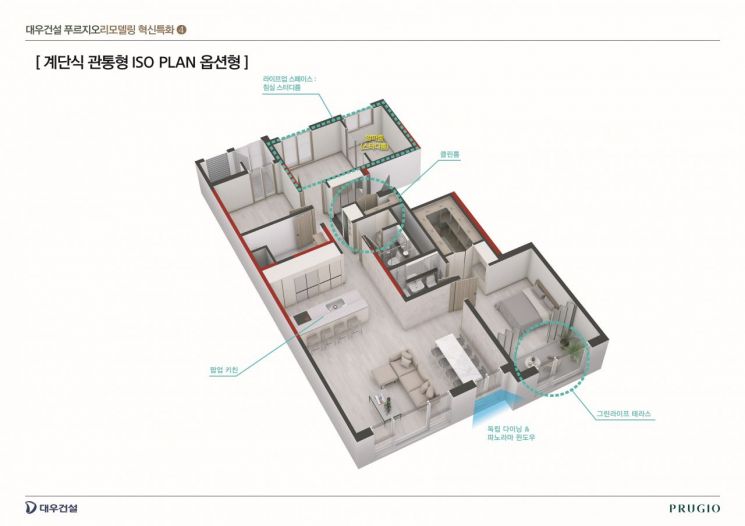
Daewoo E&C announced on the 13th that it has developed a new 'specialized floor plan' to be applied to apartment extension-type remodeling projects. While remodeled apartments had the drawback of lowered ceiling heights after construction, this issue has been resolved, and through structural innovation, the latest residential trends can now be significantly reflected. This floor plan will be sequentially applied to newly contracted complexes starting this year.
Extension-type remodeling is possible for complexes that are over 15 years old after completion and have received a safety inspection rating of C or higher (B or higher for vertical extensions). Recently, the number of apartment complexes over 15 years old in first-generation new towns such as Bundang and Ilsan has rapidly increased, and the number of apartment complexes pursuing remodeling projects is steadily growing due to the government's continuous deregulation policies.
In line with this trend, Daewoo E&C declared its full-scale entry into the remodeling business last year and has now developed a specialized remodeling floor plan. The specialized floor plan was developed to address various structural problems that existing pre-remodeling apartments had, such as non-extended balconies, and insufficient bathroom and storage spaces.
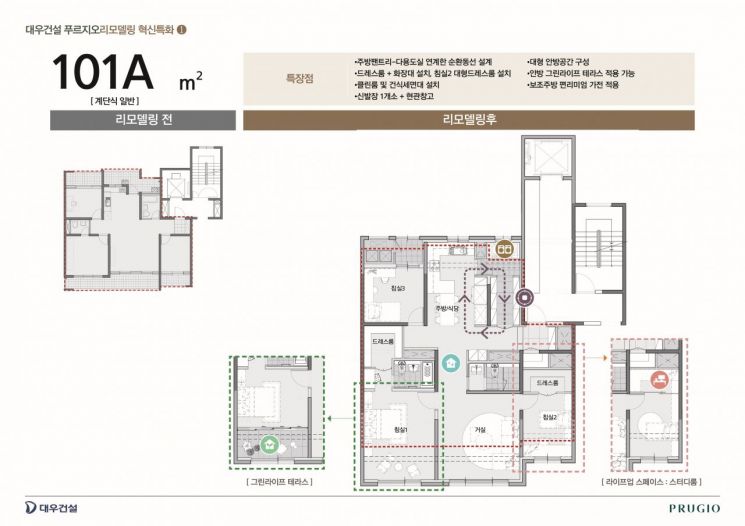
The specialized remodeling floor plan is divided into four types according to the structure of the existing apartment: ▲staircase-through type ▲staircase-standard type ▲corridor 1BAY ▲corridor 2BAY.
The staircase-through type features two unit entrances facing each other based on the stairwell, expanding the front and rear balconies inside the unit to change the existing 2BAY structure to 2.5BAY, and the stairwell space was also enlarged by relocating the elevator.
The other staircase type, the staircase-standard type, has two unit entrances arranged side by side in parallel based on the stairwell. It has an existing 3BAY structure, allowing for efficient space arrangement after expansion.
The corridor 1BAY type is the floor plan with the greatest existing space constraints, where additional bedroom and living room spaces were created through front expansion. The 'Secret System,' which improves storage efficiency using built-in wardrobes, and the active use of built-in appliances enhanced the kitchen space. A floor plan that can be expanded to 2BAY by integrating two units is also prepared for future deregulation of load-bearing wall removal between units.
The corridor 2BAY type secured bedroom and living room spaces through front and rear expansions. Even within limited space, a small residential floor plan was created by configuring a clean room, dressing room, and kitchen space. The common area was designed to change from corridor type to staircase type to ensure privacy for each unit.
In addition to the specialized floor plan, Daewoo E&C established product composition guidelines to break the prejudice that extension-type remodeling complexes have low marketability. A coffered ceiling was applied to all rooms inside the units to prevent ceiling height reduction after remodeling, solving structural issues. Exterior designs including curtain wall looks and sky community facilities were also established with design standards comparable to newly built Prugio complexes.
A Daewoo E&C official said, "Remodeling floor plans are vulnerable to structural stability as the wall demolition ratio increases, and there are many factors that increase construction costs due to repairs and reinforcements, so minimizing the wall demolition ratio in design is key. The specialized floor plan developed this time significantly improved these issues by minimizing the existing wall demolition ratio and incorporated the latest trend design elements to enhance the marketability of remodeled complexes."
© The Asia Business Daily(www.asiae.co.kr). All rights reserved.
![Clutching a Stolen Dior Bag, Saying "I Hate Being Poor but Real"... The Grotesque Con of a "Human Knockoff" [Slate]](https://cwcontent.asiae.co.kr/asiaresize/183/2026021902243444107_1771435474.jpg)

















