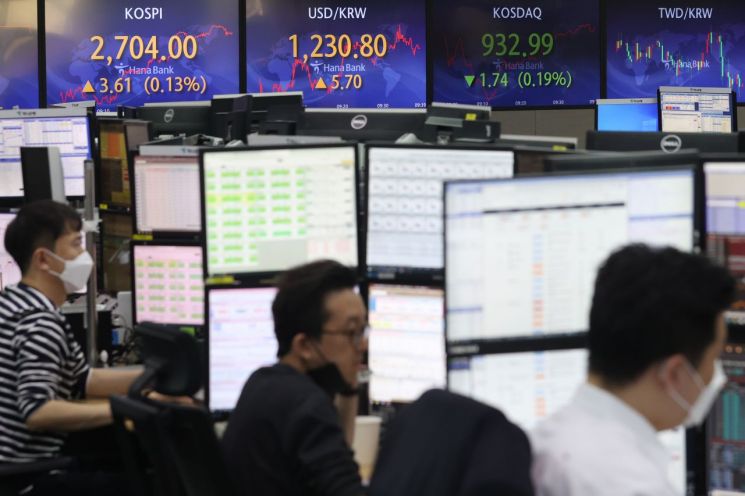
[Asia Economy Reporter Hwang Junho] On the 11th, the KOSPI closed below the 2600 mark.
On that day, the KOSPI closed at 2,693.10, down 7.29 points (0.27%) from the previous trading day. The index started at 2,687.54, down 12.85 points (0.48%) from the previous close, but turned upward early in the session due to net buying by foreigners. However, as the Chinese stock market declined amid inflation concerns, the KOSPI also shifted to a weak trend.
Among all stocks, 438 declined. Among the top market capitalization stocks, the perennial leader Samsung Electronics closed up 0.15% at 67,900 KRW. Other top market cap stocks that showed gains included Hyundai Motor (1.70%) and Kia (3.47%). The rise in Hyundai Motor and Kia appears to be due to expectations for eco-friendly vehicles.
As of this time, Hyundai Motor is up 2.27% at 185,000 KRW. Kia is also up 3.74% at 77,700 KRW. Investor sentiment seems to have improved following news that the proportion of eco-friendly vehicle sales for both companies has surpassed 20% for the first time ever.
According to Hyundai Motor and Kia on the 10th, the proportion of electric and hybrid vehicles among their domestic market sales in the first quarter of this year (273,762 units) was 23.5% (64,417 units). First quarter eco-friendly vehicle sales increased by 44.5% (19,840 units) compared to the same period last year (44,574 units). The share of eco-friendly vehicles in total sales also rose by 9.4 percentage points. First quarter electric vehicle sales reached 22,768 units, a 155% increase from 8,925 units in the same period last year.
The KOSDAQ index closed at 921.83, down 12.90 points (1.38%) from the previous close. The index started at 932.48, down 2.25 points (0.24%) from the previous close, and continued its downward trend, hitting a low of 920.75 during the session. Among all stocks, 913 closed lower. Most of the top market cap stocks ended lower. EcoPro BM, the largest by market cap on the KOSDAQ, fell 2.45%, while Celltrion Healthcare (2.60%) and L&F (6.43%) also recorded declines.
Seo Sang-young, a researcher at Mirae Asset Securities, analyzed, "As the Chinese stock market showed weakness due to expanding inflationary pressures and concerns over economic slowdown caused by continued lockdowns in Shanghai, the Korean stock market also turned downward." He added, "The Hang Seng Index's sharp decline, triggered by the issue of delisting Chinese companies in the U.S., also contributed to the deterioration of investor sentiment."
© The Asia Business Daily(www.asiae.co.kr). All rights reserved.
![Clutching a Stolen Dior Bag, Saying "I Hate Being Poor but Real"... The Grotesque Con of a "Human Knockoff" [Slate]](https://cwcontent.asiae.co.kr/asiaresize/183/2026021902243444107_1771435474.jpg)















