Gungneung Heritage Headquarters Operates Saenggwabang Until June 25
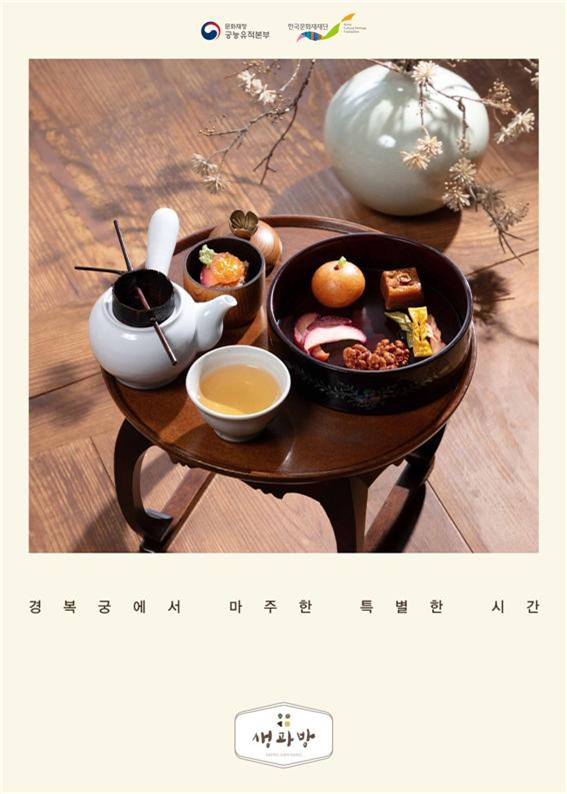
The Cultural Heritage Administration’s Palace and Royal Tombs Headquarters and the Korea Cultural Heritage Foundation will hold a Saenggwabang event at the Sojubang Saengmulbang in Gyeongbokgung Palace from the 20th to June 25th. This program allows visitors to taste and experience royal medicinal teas and court sweets. Saenggwabang refers to the pavilion where special dishes were made in the Joseon royal court.
The Palace and Royal Tombs Headquarters operates the program during the lunch serving hours (10 a.m. to 10 p.m.). Based on records such as the Joseon Wangjo Sillok (Annals of the Joseon Dynasty) and Donguibogam (Principles and Practice of Eastern Medicine), they offer six types of court sweets (Guseonwangdogo, Juak, Hodujeonggwa, Sagwajeonggwa, Yakgwa, Maejakgwa) and six types of royal medicinal teas (Ganggyedaeum, Samgyulda, Gamgukda, Damgangda, Omijacha, Jehocha).
The newly introduced Guseonwangdogo is a rice cake made by harmoniously cooking nine kinds of herbal medicinal ingredients including lotus seed, Poria cocos, Chinese yam, malt, Rehmannia glutinosa, white hyacinth bean, lotus seed plumule, Job’s tears, and sugar. According to Donguibogam, it "helps the spleen and stomach, improves digestion, stimulates appetite, supports kidney energy, boosts vitality, and enhances immune function." The representative royal medicinal tea, Ganggyedaeum, is a decoction of cinnamon, ginger, tangerine peel, and jujube. It is said that King Yeongjo, who lived a long life, drank it regularly for health maintenance and energy replenishment until shortly before his death.
Visitors can order medicinal teas and court sweets at the Hogweso (ordering place) while being served by staff dressed as Joseon court maids and tea attendants in Saenggwabang. Court sweets are priced between 1,000 and 3,000 KRW each, and royal medicinal teas cost between 4,000 and 5,000 KRW. The program runs four times a day except on Tuesdays when Gyeongbokgung Palace is closed. Applications will be accepted on a first-come, first-served basis via Interpark Tickets starting from the 13th. For more details, please refer to the websites of the Palace and Royal Tombs Headquarters or the Korea Cultural Heritage Foundation.
© The Asia Business Daily(www.asiae.co.kr). All rights reserved.
![Clutching a Stolen Dior Bag, Saying "I Hate Being Poor but Real"... The Grotesque Con of a "Human Knockoff" [Slate]](https://cwcontent.asiae.co.kr/asiaresize/183/2026021902243444107_1771435474.jpg)















