[Asia Economy Reporter Ji Yeon-jin] The corporate bond issuance market has contracted more than it did at the beginning of the COVID-19 pandemic. As global tightening, including in the United States, accelerates, volatility in the bond market has increased, and the risk of an economic slowdown in China has caused the popularity of Korean companies to gradually wane. As a result, the proportion of foreign ownership in domestic listed stocks has fallen to its lowest level in 13 years.
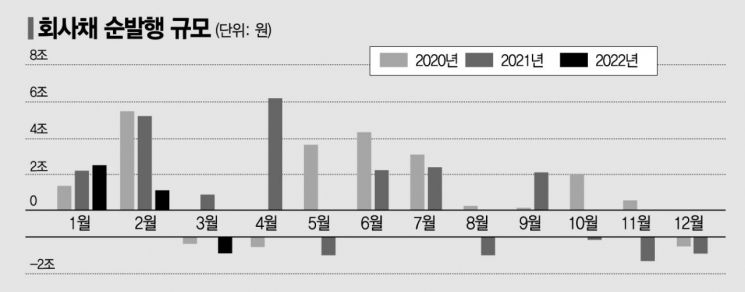
According to the financial investment industry on the 11th, net issuance of corporate bonds excluding hybrid capital securities in the first quarter of this year recorded 2.6664 trillion won. This is a sharp decrease compared to 8.2679 trillion won in the same period last year and even less than the 6.4751 trillion won recorded in the first quarter of 2020, the early stage of the COVID-19 pandemic. In particular, net issuance of corporate bonds last month showed a net redemption of 861.9 billion won. This is lower than the -354.1 billion won recorded in March 2020. During March 2020, when the domestic stock market experienced a major crash due to the COVID-19 pandemic, funding shortages occurred due to fear of the unfamiliar disease, but now raising funds has become even more difficult. This is because countries around the world have started tightening monetary policy, including raising benchmark interest rates, to withdraw the massive liquidity injected to prevent economic recession caused by the pandemic, and the pace of tightening has accelerated this year.
Researcher Lee Kyung-rok of Shin Young Securities explained, "In early 2020, when COVID-19 first appeared, governments responded to the unprecedented event, and the funding shortage in financial markets was quickly resolved. However, the current financial market turmoil is not due to funding shortages but stems from a rapid rise in interest rates beyond expectations and various uncontrollable uncertainties whose limits are difficult to predict."
Commodity prices, which had been rising due to global carbon neutrality policies, have become more volatile due to the Russia-Ukraine conflict. The unexpectedly prolonged war and strengthened sanctions against Russia have further increased uncertainty. Additionally, the U.S. tightening clock has been accelerated due to soaring inflation, and the difficulty in predicting even the peak of inflation is causing investors to become more cautious.
This trend is even more pronounced in the stock market. According to the "March Foreign Securities Investment Trends" announced by the Financial Supervisory Service on the same day, foreigners sold a net 4.866 trillion won of domestic listed stocks last month and made a net investment of 279 billion won in listed bonds, resulting in a total net withdrawal of 4.587 trillion won. Stocks have been sold net for three consecutive months this year, and the market capitalization share has fallen to 27.1%. This is the lowest level in 13 years since it dropped to the 26% range in April 2009, right after the global financial crisis.
In recent years, foreign investors have been reducing their exposure to emerging markets due to concerns about China's economic slowdown. Recently, concerns about an economic slowdown have intensified due to the resurgence of COVID-19 and lockdown measures in Shanghai, fueling foreign investors' sell-off of Korean stocks. Foreigners have sold nearly 10 trillion won (9.8833 trillion won) of domestic stocks on a net basis since the beginning of this year through June 8. Researcher Lee analyzed, "Externally, it is necessary to confirm visibility regarding the war, Russia sanctions, the peak of inflation, and the pace of U.S. tightening, while domestically, some uncertainties such as supplementary budgets and deficit bond issuance issues need to be somewhat alleviated first."
© The Asia Business Daily(www.asiae.co.kr). All rights reserved.
![Clutching a Stolen Dior Bag, Saying "I Hate Being Poor but Real"... The Grotesque Con of a "Human Knockoff" [Slate]](https://cwcontent.asiae.co.kr/asiaresize/183/2026021902243444107_1771435474.jpg)















