Building Trust Through Love and Marriage Stories
Last Year's 'Romance Scam' Damage Exceeds 2 Billion Won
Difficulty Identifying Criminals Due to Overseas IP Tracking Challenges
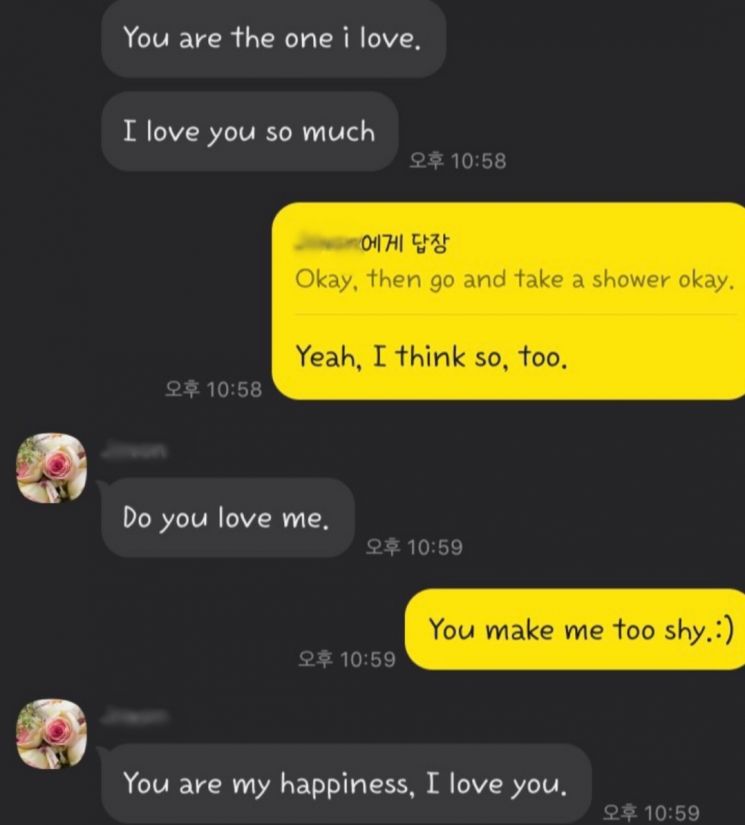
[Asia Economy Reporter Jang Sehee] A woman in her 30s, Ms. A, got to know a man, Mr. B, through Instagram. Mr. B said he had recently arrived from abroad and was under self-quarantine, asking for help to exchange points. After Ms. A transferred 60 million won, Mr. B disappeared.
A woman in her 20s, Ms. C, started communicating with a man, Mr. D, who approached her via Instagram. Ms. C thought she liked Mr. D because he confessed and was kind. Later, Mr. D said he needed to send a package to Korea and asked her to transfer 1 million won. When he requested an additional 4 million won, Ms. C found herself in a difficult situation.
As the number of users of online matchmaking and dating apps increases, a new type of financial fraud called romance scams is on the rise. These scams involve gaining the victim’s affection and then exploiting various reasons to extort money or valuables from them.
Fraudsters approached victims through social networking services (SNS) such as Instagram and Facebook, as well as dating apps. Their method involved stealing photos of attractive people to use as profile pictures and primarily contacting victims via messenger without voice calls. They then built trust by discussing dating or marriage and demanded money under the pretexts of point exchanges, fees, customs charges, and so on. There were also frequent cases of impersonating professionals whose titles start with ‘sa’ in Korean, such as lawyers, accountants, and doctors.
Romance scams fall under Article 347 of the Criminal Act concerning fraud and can be punished. However, since these crimes occur in virtual spaces, it is difficult to identify the perpetrators. According to the National Intelligence Service’s International Crime Information Center, the damage from romance scams last year amounted to 2.07 billion won, a fivefold increase from 370 million won in 2020. Just three to four years ago, the damage was around 900 million won.
Professor Lee Yunho of the Department of Police Science at Korea Cyber University stated, "If the perpetrator is a foreigner residing abroad, extraterritoriality applies (the right of a foreigner to be exempt from the domestic laws of the country they are staying in and to exercise the sovereignty of their own country), making investigation and punishment under Korean law difficult. The anonymity also acts as a shield, making it very hard to identify the criminals."
Professor Seo Junbae of the Korean National Police University said, "From the perspective of blocking criminal means and strengthening policies, legislation should be prepared to crack down on fake SNS accounts and strengthen real-name verification procedures during membership registration to block access to criminal tools."
© The Asia Business Daily(www.asiae.co.kr). All rights reserved.
![Clutching a Stolen Dior Bag, Saying "I Hate Being Poor but Real"... The Grotesque Con of a "Human Knockoff" [Slate]](https://cwcontent.asiae.co.kr/asiaresize/183/2026021902243444107_1771435474.jpg)















