[Seoul District News] Yangcheon-gu, unmanned operation 365 days, 2 books per person, 14-day loan... Gangbuk-gu, cadastral map errors such as boundary overlap, boundary gap, scale change omission, area error, shape overlap to be corrected by 2026 through cadastral surveying and aerial photography for 6,012 parcels... Dobong-gu introduces smartphone large waste easy disposal system ‘Ppaegi’... Gangnam-gu-Hancom Academy, drone expert training... Gangdong-gu recruiting AI data labeling education students... Gangseo-gu ‘2022 Gangseo Cooperation Tongtong Hanmadang’ 1
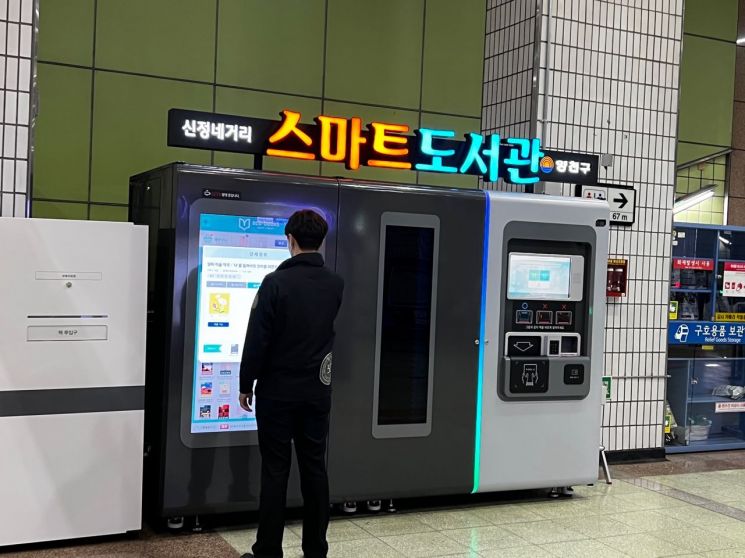
[Asia Economy Reporter Park Jong-il] Yangcheon-gu (Mayor Kim Soo-young) has completed the establishment of a smart library at Sinjeongnegeori Station on Subway Line 2 and will begin full operation from the 11th.
The smart library is a facility where books can be borrowed and returned at subway stations, public places, etc., without visiting a library in person. It operates unmanned and is available 365 days a year, making it very popular among busy office workers and others.
The newly opened Sinjeongnegeori smart library is located next to the ticket gate on the basement level 2 of Sinjeongnegeori Station, allowing immediate borrowing and returning of books stocked in the device. Notably, this smart library also features an unmanned reservation and lending system, enabling users to borrow books from nine public libraries after making a prior reservation.
The smart library is available to all regular members of Yangcheon-gu public libraries. Each person can borrow up to two books for 14 days, with an option to extend for an additional 7 days. However, for reserved book loans, returns can be made either at the unmanned return box inside the smart library or at any public library in the district. If the reserved book is not collected within 3 days, it will be automatically retrieved by the affiliated library.
To enhance the convenience of book lending, the district has previously installed smart libraries and unmanned reservation lending and return machines at Omokgyo Station, Mokdong Station, Yangcheon Central Library, Handu Children's Park, and Mokdong Nuri Children's Park. In the second half of this year, a smart book cafe is planned to be established in Sinwol 3-dong.
For more details about the Sinjeongnegeori smart library, inquiries can be made to the Education Support Division or Yangcheon Central Library.
An official from the Education Support Division said, “To meet the needs of busy office workers who find it difficult to find time to borrow books and the MZ generation who prefer contactless services, we have newly opened a smart library at Sinjeongnegeori Station. We hope many people will use the Sinjeongnegeori smart library, where anyone can easily access books 365 days a year.”
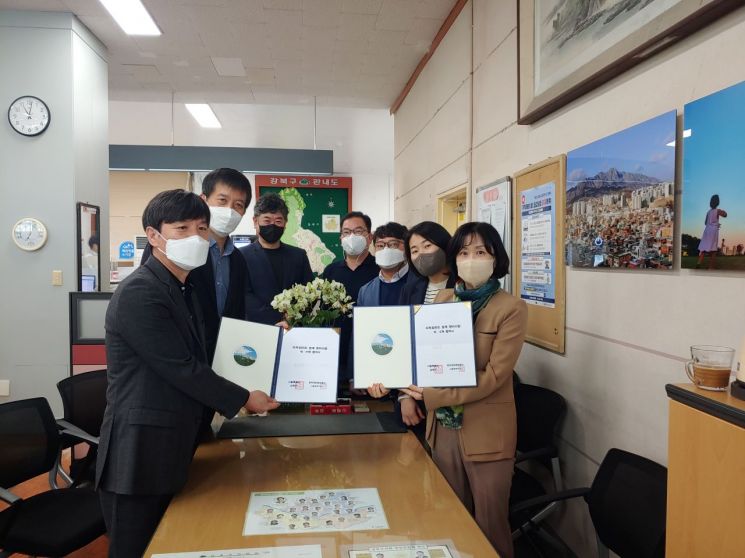 On the 4th, Lee Sang-sim, Director of the Seoul Northern Branch of the Korea Land and Geospatial Informatix Corporation (left), and Kim Kyung-hee, Director of the Real Estate Information Division of Gangbuk-gu (right), are seen signing an agreement.
Gangbuk-gu (Mayor Park Kyum-soo) is launching a ‘Digital Cadastral Boundary Error Correction Project’ to address inaccuracies in cadastral maps.
Cadastral boundary errors refer to issues such as ▲overlapping boundaries ▲boundary gaps ▲omission of scale changes ▲area errors ▲shape overlaps in cadastral (forest) maps. These errors have accumulated since the first cadastral maps were created during the Japanese colonial period in 1910 and have persisted to this day due to lack of error correction during the early 2000s digitization.
These errors cause problems such as time and financial losses for citizens during land surveying, restrictions on property rights due to different scales within the region, and disputes arising from prolonged unauthorized occupation of national and public lands.
Accordingly, on the 4th, the district signed a ‘Cadastral (Forest) Map Boundary Correction Project Entrustment Agreement’ with the Korea Land and Geospatial Informatix Corporation Seoul Northern Branch to correct digital cadastral boundary errors using various methods such as cadastral surveying and unmanned aerial photography.
The district has allocated a budget of approximately 72 million KRW, receiving 50 million KRW support from Seoul City for this project.
The project period is five years until 2026, with plans to correct the maps of 1,700 plots out of 6,012 boundary error plots this year.
Upon completion, the project is expected to shorten surveying times for citizens, impose compensation fees on unauthorized occupants of national and public lands, and secure the accuracy of cadastral maps, thereby aiding citizens in exercising their property rights.
Mayor Park Kyum-soo of Gangbuk-gu said, “Through the cadastral boundary correction project, we will protect citizens’ property rights and smoothly promote various regional development projects. We will also strive to provide accurate cadastral records to enhance trust in district administration.”
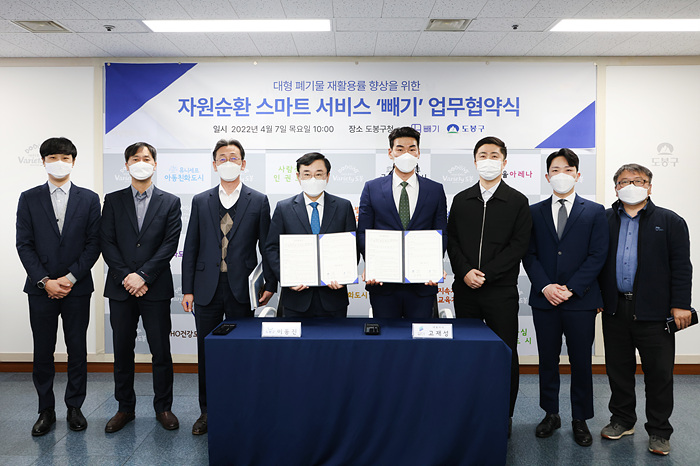
Dobong-gu (Mayor Lee Dong-jin) has selected ‘Gatda Co., Ltd. (CEO Ko Jae-sung)’ as the service platform provider to introduce a large waste easy disposal system and held a business agreement ceremony on the 7th.
The large waste easy disposal system (service name ‘Bbaegi’) is scheduled to be officially launched in June after a two-month trial operation period.
The large waste easy disposal system (service name ‘Bbaegi’) is a non-face-to-face disposal system using a smartphone app. It greatly simplifies the existing face-to-face application procedure at community centers, allowing immediate application at the disposal site. Utilizing various smartphone functions, it is evaluated to be more convenient and accessible than the disposal application method on the district website.
Users can download the ‘Bbaegi’ app for free from the smartphone’s Play Store (Android) or App Store (iOS), or apply through the Bbaegi website. By entering the collection location and uploading photos of the disposal items, the AI object recognition function estimates the cost in advance, allowing payment. At the final step, a disposal number is generated and sent to the collection department, enabling disposal application without a printed collection receipt.
Additionally, the service offers a transportation service called ‘Naeryeodeurim’ for single-person households and elderly people who have difficulty transporting heavy waste, and a lifestyle-oriented recycled secondhand trading service called ‘Junggomaeip’ in collaboration with local small businesses and secondhand dealers, making large waste disposal more convenient.
Ko Jae-sung, CEO of Gatda operating ‘Bbaegi,’ said, “It is meaningful to implement the Bbaegi service in Dobong-gu, which has enacted the nation’s first carbon neutrality basic ordinance and is leading greenhouse gas reduction efforts. We will strive to help Dobong-gu’s stable waste disposal and practical waste reduction.”
Mayor Lee Dong-jin of Dobong-gu said, “With the introduction of this system, residents’ convenience in daily life will improve, and it is expected to have a great effect on spreading a resource circulation culture. We ask for the active use of the service by residents once it is launched in June.”
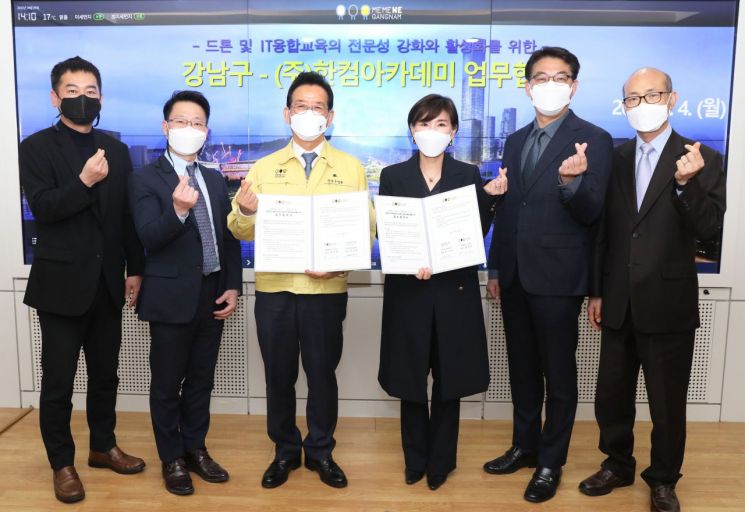
Gangnam-gu (Mayor Jung Soon-gyun) signed a business agreement on the 4th at the district office main building with Hancom Academy, a specialized education center for the 4th industrial revolution, to strengthen the drone and IT convergence expertise of Gangnam residents. Under this agreement, the district and Hancom Academy will establish specialized drone-related education.
Gangnam-gu will open a ‘Drone Pilot License (Class 1) Acquisition Specialized Education’ course for Gangnam residents, recruiting and operating it in May. The course will be conducted over 11 sessions, with the first theoretical session held at the ‘Samsung 2-dong Cultural Center Informatization Classroom’ and the tenth practical session at a drone-exclusive training center located in Gwangju-si, Gyeonggi-do.
The education cost burden for students is about 750,000 KRW, approximately 25% of the total tuition fee. For more details, contact the Gangnam-gu Computer Information Division.
Mayor Jung Soon-gyun of Gangnam-gu said, “During the 7th term of the elected government, Gangnam-gu opened the ‘IT Convergence Education Center,’ a 4th industrial technology experience and education center, in February, proactively responding to the acceleration of digital transformation befitting the ‘Smart Global City Gangnam.’ As major corporations are fostering autonomous vehicles and Urban Air Mobility (UAM), known as flying taxis, as future key industries, Gangnam-gu will continue to provide high-quality drone and IT convergence education and do its best to nurture talents in 4th industrial technologies.”
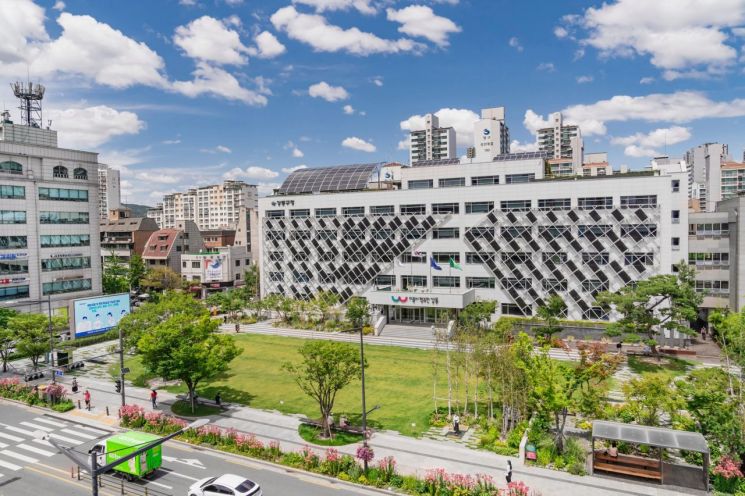
Gangdong-gu (Mayor Lee Jung-hoon) is operating an artificial intelligence (AI) data labeling education course for residents to cultivate personnel in the field of AI learning data construction.
In the era of the 4th industrial revolution, data labeling, which is the foundation for applying AI technology, refers to the data preprocessing work of attaching labels or annotations to data such as images, voice, and videos to build learning data that enables computers to learn autonomously.
The education consists of theoretical education and practice (online) on various types of data labeling for AI learning data construction. After completion, trainees can apply for actual data labeling projects and are expected to generate some income depending on their proficiency.
In fact, last year’s graduates gained new jobs and income opportunities as data labelers at AI specialized institutions and companies such as Seoul National University, Neomodule, and Spearink by participating in data labeling projects.
This year, the data labeling education course for residents will be held four times a year for about 200 people. Registration for the first course, starting on April 26, is available from April 11 to 15 through the Gangdong-gu Office website (‘Online Application’). The number of participants is 50, and the course fee is free.
Mayor Lee Jung-hoon of Gangdong-gu said, “This year, we will double the number of trainees compared to last year to help residents develop data capabilities and gain more job opportunities. Data labeling is a promising new field that anyone can enter with simple training, and it is expected to contribute to job creation for residents such as young people needing short-term side jobs, elderly familiar with computers, and women with career interruptions.”
For more details, contact the Gangdong-gu Smart City Division or check the district website.
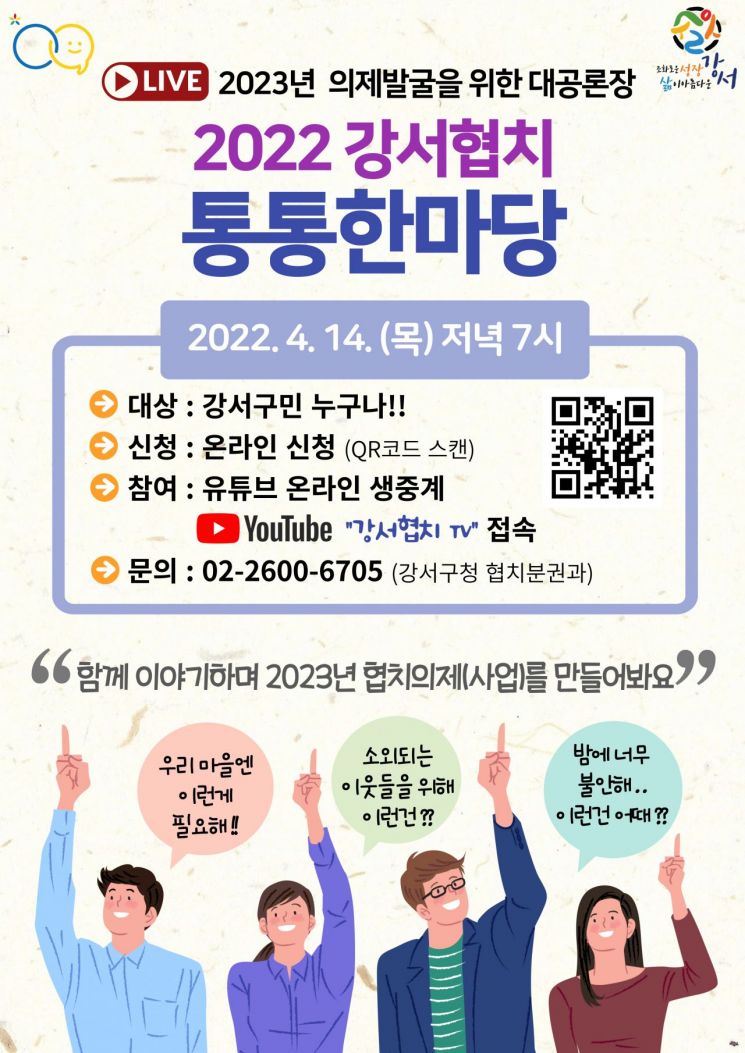
Gangseo-gu (Mayor Roh Hyun-song) is engaging in real-time communication with residents to discover and solve community issues.
The district announced that it will hold the ‘2022 Gangseo Cooperation Tongtong Hanmadang’ via YouTube live broadcast at 7 p.m. on the 14th.
‘Gangseo Cooperation Tongtong Hanmadang’ is a public-private cooperation forum where residents directly discover projects needed in their neighborhood, discuss them, and establish next year’s implementation tasks.
Former KBS announcer Kim Hyun-wook will host the event, with cooperation committee members and local activists participating as panelists to discover cooperative tasks for solving community problems together with residents.
The event will begin by watching a promotional video about Gangseo-gu’s cooperation projects, followed by segments titled ‘Al·Sseul·Hyeop·Jap (Useful Cooperation Trivia) - National Cooperation Pride - Cooperation is What.’
In ‘Al·Sseul·Hyeop·Jap,’ the district’s cooperation coordinator will introduce Gangseo-gu’s cooperation projects and explain how to discover agendas to residents who are still unfamiliar with the term ‘cooperation.’
‘National Cooperation Pride’ will share cooperation agendas discovered so far through agenda discovery subcommittee meetings and proposals from administrative departments to promote next year’s cooperation projects.
In ‘Cooperation is What,’ residents will propose new agendas via real-time comments and engage in on-the-spot discussions with panelists.
The cooperation agendas discovered on the day will undergo several deliberation processes and online resident voting to be finally selected as cooperation projects to be implemented in 2023.
Residents wishing to participate can access the YouTube channel ‘Gangseo Cooperation TV’ 10 minutes before the live broadcast. They can also pre-submit cooperation agendas through advance registration on the Gangseo-gu website by the 13th.
An official from the district said, “This event is an opportunity for residents to directly participate in the policy-making process for regional development and provide diverse opinions. We will continue to actively reflect residents’ valuable opinions in policies through public-private cooperation.”
On the 26th, a deliberative public forum called ‘50+ Cooperation Table,’ where proposers, cooperation committee members, and local activists will discuss the agendas discovered at the ‘Gangseo Cooperation Tongtong Hanmadang’ in depth, is also scheduled to be held.
© The Asia Business Daily(www.asiae.co.kr). All rights reserved.
![Clutching a Stolen Dior Bag, Saying "I Hate Being Poor but Real"... The Grotesque Con of a "Human Knockoff" [Slate]](https://cwcontent.asiae.co.kr/asiaresize/183/2026021902243444107_1771435474.jpg)

















