7th KCCI '2nd Regional Economic Forum'... Gwangju, Jeonnam, Jeonbuk
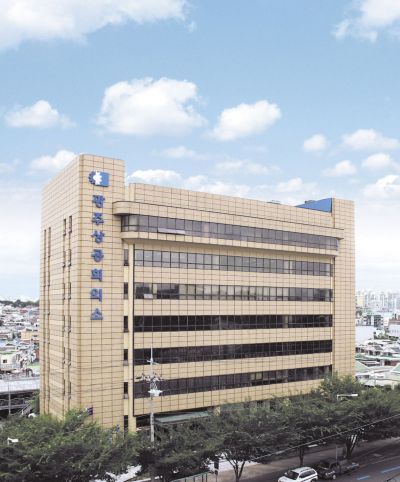 Gwangju Chamber of Commerce and Industry in Nongsung-dong, Seo-gu, Gwangju. (Photo by Asia Economy DB)
[Asia Economy Reporter Moon Chaeseok] The growth potential of the Honam region was found to be below the national average. Economic figures from the Honam area emphasized the need to rapidly advance industrial restructuring through super-regional collaboration, focusing on artificial intelligence (AI), new and renewable energy, and other sectors.
The Korea Chamber of Commerce and Industry (KCCI) announced on the 7th that it held the "2nd Regional Economic Forum" targeting the Gwangju, Jeonnam, and Jeonbuk areas at the Gwangju Chamber of Commerce and Industry in Nongsong-dong, Seo-gu, Gwangju. Attendees included Woo Tae-hee, Executive Vice Chairman of KCCI; Choi Jong-man, Executive Vice Chairman of Gwangju Chamber of Commerce; Hwang Soo-sung, Director of Industrial Innovation Growth at the Ministry of Trade, Industry and Energy; Jo In-cheol, Deputy Mayor for Culture and Economy of Gwangju Metropolitan City; Kim Un-seop, Head of Policy Planning at Gwangju Technopark; Yoo Kyung-min, Head of Industrial Activation at the Korea Carbon Industry Promotion Agency; and Hwang Sang-hyun, Head of the Gwangju-Jeonnam Regional Headquarters of the Korea Industrial Complex Corporation.
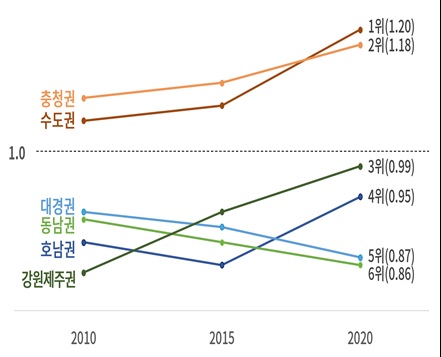
According to the Regional Growth Potential Index (RGPI) for six regions nationwide, the Honam region ranked 4th in 2020. Although it rose two places from the lowest rank in 2015, it still fell short of the national average. The growth potential index recorded 0.95, up 0.09 points from 0.86 in 2015. However, since it remained below 1, which symbolizes the "average," concerns persist about continued stagnation in growth. Looking at the regional gross domestic product (GRDP) data analyzed by the Chamber, Honam's share of the national GRDP dropped from 9.6% in 2010 to 8.9% in 2020, a decline of 0.7 percentage points. Along with the Southeast region and Daegu-Gyeongbuk region, Honam was one of the three areas where GRDP contribution decreased over the past decade. Last year, government research and development (R&D) investment in Gwangju, Jeonnam, and Jeonbuk amounted to 18 trillion won, accounting for only 8% of the total 227 trillion won nationwide. This indicates that investment remained below the region's share of national GRDP.
Kim Young-soo, Senior Research Fellow at the Korea Institute for Industrial Economics and Trade and a presenter at the forum, pointed out, "Recently, key industries such as automobiles, petrochemicals, and steel have experienced growth stagnation, and the Honam region has yet to achieve concrete results in fostering new industries that represent the area, which has contributed to the contraction of regional growth potential." He added, "The stagnation of Honam's growth potential is partly due to insufficient government measures to resolve regional imbalances. To boost regional growth potential, efforts by local economic actors must be accompanied by government support and collaboration."
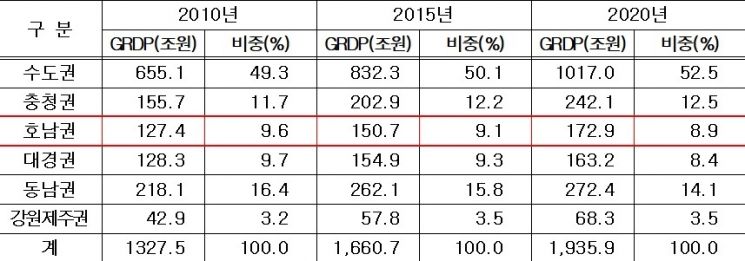 Current Status of Gross Regional Domestic Product (GRDP) by Region. (Source: Korea Chamber of Commerce and Industry)
There was also an opinion that super-regional collaboration is necessary to successfully restructure industries and revitalize the Honam economy. Since traditional heavy industries such as automobiles, shipbuilding, steel, and petrochemicals are undergoing structural decline, the pace of fostering new industries like AI, new and renewable energy, and biohealth must be accelerated.
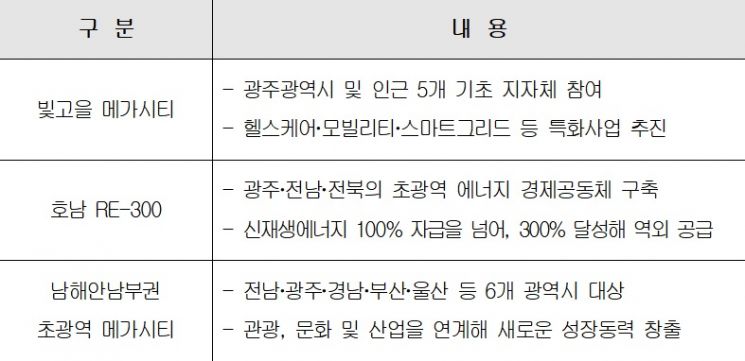
Dr. Oh Byung-ki of the Gwangju-Jeonnam Research Institute emphasized the need to speed up initiatives such as the "Bitgoeul Mega City" plan involving Gwangju and five neighboring cities and counties, the "Super-Regional Energy Community" seeking collaboration among Gwangju, Jeonnam, and Jeonbuk, and the "South Coast Economic Zone Super-Regional Collaboration" extending to Busan and Ulsan. Dr. Oh stated, "To restore balance to the national growth axis, which has been tilted toward the metropolitan area and the Gyeongbu region for over 60 years, it is essential to actively promote various projects that transcend regions and industries through collaboration among Gwangju, Jeonnam, and Jeonbuk. Since it is difficult to achieve this solely through local governments and regional companies, national-level regional R&D and infrastructure investment must be further activated."
There was also a call to change the preliminary feasibility evaluation method used during budget allocation, as the current system does not help reduce the gap between the metropolitan area and other regions. Choi Jong-man, Executive Vice Chairman of the Gwangju Chamber of Commerce, said, "Despite the urgent need for large-scale government support, much time and effort are consumed improving regional infrastructure due to the preliminary feasibility evaluation method that does not reflect local realities," adding, "Institutional reform is urgently needed."
Opinions were also voiced on the need to ease regulations to attract more companies. Professor Jang Seok-in of Korea Polytechnic University said, "Efforts to attract metropolitan area companies, reshoring (return of overseas companies), and foreign direct investment (FDI) are all insufficient. Based on regional characteristics and analysis of existing businesses, bold infrastructure investment and groundbreaking regulatory reforms are necessary to build an innovative ecosystem where companies can thrive locally."
Woo Tae-hee, Executive Vice Chairman of KCCI, also stated, "In the case of the Honam region, the industrial base is relatively weak and the regional economy is shrinking, making it difficult to cultivate new growth engines. Fortunately, the newly established government has expressed a strong commitment to regional balanced development, so I hope they will gather opinions from regions and companies and prepare extraordinary measures that can genuinely revitalize the area."
The 3rd forum is scheduled to be held in early next month in the Daejeon-Chungcheong region.
© The Asia Business Daily(www.asiae.co.kr). All rights reserved.
![Clutching a Stolen Dior Bag, Saying "I Hate Being Poor but Real"... The Grotesque Con of a "Human Knockoff" [Slate]](https://cwcontent.asiae.co.kr/asiaresize/183/2026021902243444107_1771435474.jpg)

















