Russian Imports Account for 75%
Production Possible Until Late May
Urgent Securing of Supplies from Australia, China, Indonesia
[Asia Economy Reporters Kim Jong-hwa, Lee Hyun-woo, Sejong=Reporter Lee Dong-woo] The impact on industries varies if our government joins the sanctions on Russian coal imports. Although the government and industries are seeking alternatives such as diversifying supply sources, supply instability and a sharp price surge are expected as global demand shifts to other countries.
Public power plants under Korea Electric Power Corporation (KEPCO), which use coal as their main energy source, have already begun minimizing imports of Russian thermal coal, so the immediate damage is expected to be limited. In fact, Korea East-West Power has stopped importing Russian coal since February and is closely negotiating import volumes with countries like Australia.
The steel industry, which uses a high proportion of thermal coal in molten iron production, also relies heavily on imports from regions such as Australia and Canada, and holds substantial stockpiles, so it is expected that there will be no immediate supply issues.
The situation in the cement industry is completely different. The domestic cement industry imports about 3.5 million tons of thermal coal annually, with 75% coming from Russia and about 25% from Australia. With prices soaring at the beginning of the year and insufficient stockpiles, if the supply of Russian coal, which accounts for about three-quarters of the total, is cut off, it could immediately lead to production disruptions. A cement industry official said, "If supply is interrupted, construction projects nationwide, including apartment construction sites, could be halted, so urgent countermeasures are needed," adding, "With current thermal coal stockpiles, production is expected to continue until around the end of May."
Diversifying import sources is not as easy as the government suggests. In the case of Australian coal, large-scale floods in eastern Australia last month have made it difficult to immediately increase coal mining. Major coal mines were flooded, ports were closed, and logistics networks such as railways were damaged, so the industry says it will take considerable time to recover smoothly.
The situation is similar for Chinese and Indonesian coal. The Chinese government announced plans last week to increase thermal coal production by 300 million tons, even reopening closed mines, but port shutdowns due to the spread of Omicron have made securing supply difficult. The cement industry states that Indonesian coal is unsuitable for domestic use because of its coal type. It has low efficiency and severe spontaneous combustion issues, causing frequent fires when stored in warehouses.
Prices are as problematic as supply. Meanwhile, the European Union (EU) has hinted at sanctions banning Russian coal imports, causing international coal prices to soar again. According to Bloomberg on the 5th (local time), the Central Appalachian coal price, a major U.S. coal price indicator announced by the U.S. government the previous day, reached $106.15 per ton, the highest since 2008.
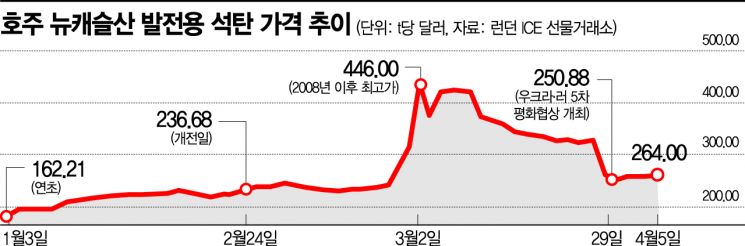
The Australian Newcastle thermal coal futures price, an international coal price indicator, also rose again, increasing 2.03% from the previous session to $264 per ton. This price had surged to $446 on February 2 due to the Russia-Ukraine war but fell to around $250 following the fifth peace talks between Ukraine and Russia.
EU countries, which imported more than 40% of their total coal demand from Russia, are now in an emergency to secure coal. Especially Eastern European countries such as Poland, Romania, and Bulgaria, where coal-fired power generation dependence exceeds 50%, are requesting increased export volumes from major exporters like Australia to secure coal for power generation. A global coal supply war is underway.
An official from the Ministry of Trade, Industry and Energy said, "Just as we quickly responded by forming a resource supply management task force (TF) team following Indonesia's coal export ban earlier this year, we are closely monitoring the international repercussions of the EU's additional sanctions on Russia."
© The Asia Business Daily(www.asiae.co.kr). All rights reserved.
![Clutching a Stolen Dior Bag, Saying "I Hate Being Poor but Real"... The Grotesque Con of a "Human Knockoff" [Slate]](https://cwcontent.asiae.co.kr/asiaresize/183/2026021902243444107_1771435474.jpg)
















