Victim's Side Raises Deletion Suspicion
Police: "Used Without Registration Procedure"
Experts: "Should Be Provided by the State"
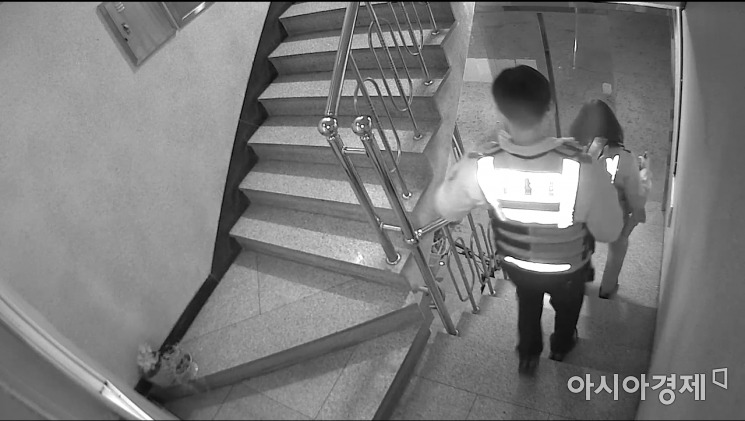 On November 15 last year, at around 5:05 PM, CCTV footage related to the 'Incheon Interfloor Noise Stabbing Incident' that occurred on the 3rd floor of a villa in Namdong-gu, Incheon, was released. The video shows the victim's family going up to the scene, but the police officers who arrived on site did not respond immediately and were seen coming down the building stairs. / Photo by the victim's family representative, video captured
[Asia Economy Reporter Oh Gyumin] As CCTV footage from the ‘Incheon Interfloor Noise Weapon Assault’ incident was released, controversy is growing over the deletion of bodycam footage.
At a press conference on the 5th, the victim’s side claimed the possibility of evidence tampering, while the police denied the deletion suspicion, stating that the footage was not recorded due to storage capacity being exceeded. However, it has been revealed that there are no penalties or sanctions for deleting bodycam footage purchased with police officers’ personal funds.
According to the police on the 6th, bodycams purchased by police officers at local police stations or precincts with their own money can be used without going through procedures such as usage registration, and there are no separate regulations or sanctions regarding recorded footage or storage devices. A Seoul Metropolitan Police Agency official said, "We understand that bodycams are simply used at frontline police stations without separate registration," adding, "It is not our place to regulate something officers use for their own needs." Videos stored on bodycams can be used as evidence to determine whether frontline officers responded initially at the scene and whether their official duties were carried out properly.
Bodycams have become widespread overseas in countries such as the United States and the United Kingdom. However, footage from bodycams purchased with personal funds falls outside regulation, allowing police officers to delete or manipulate videos at their discretion.
The National Police Agency conducted a six-year pilot operation of the bodycam (wearable police cam) system, which attaches cameras to frontline officers’ bodies, starting in November 2015. The operation ended in August last year due to the lack of legal grounds, including concerns over personal information infringement. At that time, the National Police Agency created the ‘Wearable Police Cam System Operation Rules’ to manage bodycam use and related record-keeping. The rules specified obligations such as ‘retaining video records for 30 days,’ but these rules were not applied to the bodycams currently in use. A National Police Agency official stated, "The operation rules applied during the pilot are currently discarded."
In the absence of bodycam usage regulations, related incidents occur frequently. In February last year, a police officer dispatched to the scene in Pyeongtaek, Gyeonggi Province, was sentenced to probation for ‘excessive force’ against a suspect and deleting bodycam footage to destroy evidence. In December last year, a police officer in Cheongju, Chungbuk, was also accused of ‘illegal filming’ for installing a bodycam in a precinct restroom.
Professor Kwak Daekyung of Dongguk University’s Police and Judicial College said that regulating private use of bodycams is difficult but added, "It would be better for the government to officially provide bodycams with budget support and strictly apply management procedure regulations."
© The Asia Business Daily(www.asiae.co.kr). All rights reserved.
![Clutching a Stolen Dior Bag, Saying "I Hate Being Poor but Real"... The Grotesque Con of a "Human Knockoff" [Slate]](https://cwcontent.asiae.co.kr/asiaresize/183/2026021902243444107_1771435474.jpg)















