Public Transit Usage for Commuting and Schooling at 71.6%... Leisure Activities Mainly Indoors, but Outdoor Activities Preferred
Men and Women in Their 20s Have Similar Income of 2 to 2.5 Million Won... Gender Income Gap Observed in 30s
[Asia Economy Reporter Lim Cheol-young] The 2030 generation living in Seoul accounts for 30% of Seoul's population, primarily residing in Gwanak-gu, Gwangjin-gu, and Yeongdeungpo-gu. The regular employment rate is 67%, with an average working time of 41 hours and 26 minutes. Additionally, while the income of men and women in their 20s was similar at 2 to 2.5 million KRW, income disparities widened in their 30s, and the possibility of social class mobility was perceived as average or below.
On the 6th, Seoul City utilized the '2021 Seoul Survey' statistical data containing such information to reconstruct the housing, daily life, workplace, leisure activities, and consciousness of the 2030 generation living in Seoul, analyzing the average life patterns of this generation and announcing the results. This survey focused on ▲the current status of the 2030 generation (population, residence, etc.) ▲daily life (commuting, leisure, sleep, stress, etc.) ▲work and economic status (work life, etc.) ▲consciousness (possibility of social class mobility, views on marriage, perceptions of social minorities and fairness, etc.) to statistically analyze the 2030 generation, Seoul’s future generation.
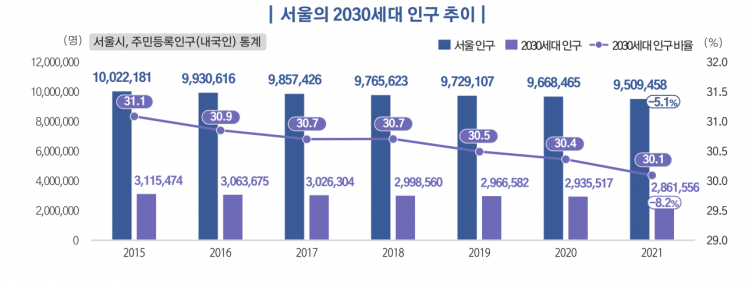
As of last year, the 2030 generation in Seoul consists of 1.4 million men and 1.46 million women, totaling 2.86 million people, accounting for 30.1% of Seoul’s population. Compared to seven years ago, the population of the 2030 generation has been continuously decreasing, with a decline rate (8.2%) higher than the overall population decrease rate of Seoul (5.1%). Seoul City explained, "The main reason for the decrease in the 2030 generation is migration out of Seoul," adding, "Half of the people who moved out of Seoul were from the 2030 generation, and the reasons for moving out were family and job for those in their 20s, and housing and family for those in their 30s."
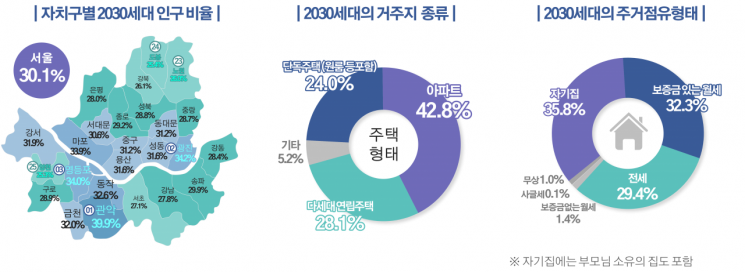
Among Seoul’s autonomous districts, the districts with the highest proportion of the 2030 generation population were Gwanak-gu (39.9%), Gwangjin-gu (34.2%), and Yeongdeungpo-gu (34.0%), while Nowon-gu (26.0%), Dobong-gu (25.4%), and Yangcheon-gu (25.3%) had the lowest proportions. The housing types currently occupied by the 2030 generation in Seoul were apartments (42.8%) and multi-family/row houses (28.1%). The housing occupancy types were self-owned homes including parental homes (35.8%), monthly rent with deposit (32.3%), and jeonse (key money deposit lease) (29.4%).
71% of the 2030 Generation Use Public Transportation for Commuting/Schooling... Sleep 6 Hours 49 Minutes a Day, 46% Feel Stress
The 2030 generation mainly used public transportation (71.5%) for commuting and schooling. This rate was higher than the overall citizen average (57.9%). The main modes of transportation used by the 2030 generation for commuting (schooling) were subway (25.5%), bus + subway (23.4%), and bus (22.6%). Among them, 76.4% of those in their 20s and 66.6% of those in their 30s used public transportation, while the rates of walking and private car use were relatively lower than the overall citizen average.
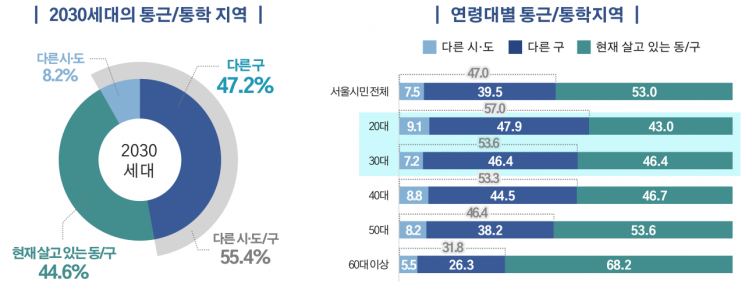
55.4% of the 2030 generation commute (study) to other cities or different districts within Seoul, and only those aged 50 and above experience improved proximity between home and workplace. The leisure activities of the 2030 generation are mainly indoor activities such as watching videos, gaming, and internet searching, whereas their desired leisure activities involve reducing indoor activities like watching videos, gaming, and internet searching, and increasing outdoor activities such as cultural experiences, travel/outdoor excursions, and exercise. Leisure satisfaction was 38.8%, higher than the Seoul citizen average of 34.4%, and leisure companions were mostly friends (37.8%) and alone (33.2%).
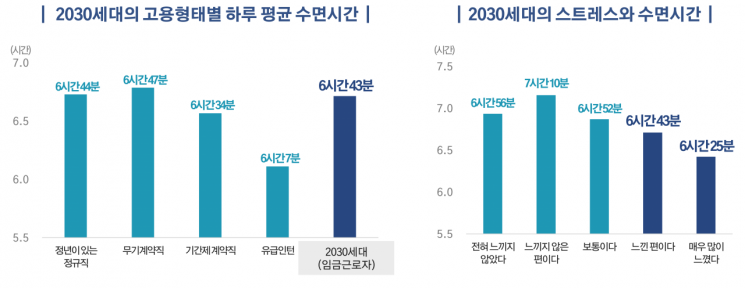
Furthermore, the Seoul 2030 generation slept an average of 6 hours and 49 minutes per day. Sleep duration varied according to employment type, with less stable employment associated with shorter sleep times, and sleep duration was found to be related to stress. Nearly half (46.6%) of the 2030 generation reported feeling stress, with main causes being interpersonal relationships (23.0%), financial status (22.7%), and excessive work or study load (22.2%).
Regular Employment Rate 67%, Average Working Hours 41 Hours 26 Minutes... Gender Income Gap Observed After 30s
The employment types of the 2030 generation were regular employees (67.7%), indefinite contract workers (19.3%), fixed-term contract workers (11.9%), and paid interns (1.0%), with the proportion of regular employees increasing in their 30s. Average working hours by employment type were 41 hours 26 minutes for regular employees, 40 hours 42 minutes for indefinite contract workers, 36 hours 21 minutes for fixed-term contract workers, and 29 hours 12 minutes for paid interns, with regular employees working the longest hours.
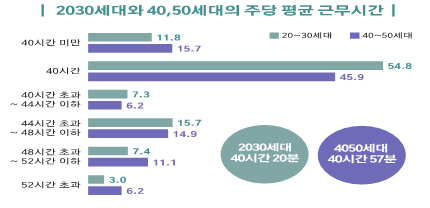
The average weekly working hours for employed 2030 generation members in Seoul was 40 hours 20 minutes, which is 37 minutes shorter than the 40 hours 57 minutes average for the employed 4050 generation. The proportion of the 2030 generation working 40 to 44 hours per week was 62.1%, higher than the 52.1% of the 4050 generation, while the proportion working over 52 hours per week was about half that of the 4050 generation.
In their 30s, the 2030 generation’s earned income increases, but a significant gender income gap emerges. About 50% of those in their 20s earned a monthly average income of 2 to 3 million KRW with little gender difference, but in their 30s, about 40% of men earned 2.5 to 3.5 million KRW, while about 40% of women earned 2 to 3 million KRW, showing a gender income gap.
Additionally, the 2030 generation perceives the possibility of social class mobility for themselves and their children as average or below, but higher than the perception of those aged 40 and above. The 2030 generation’s values regarding marriage showed differences between women and men. Men held somewhat more conservative views than women on marriage, childbirth, and divorce, but were more open-minded about cohabitation.
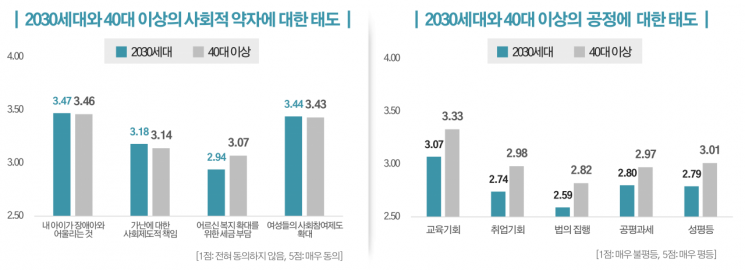
Moreover, there was little generational difference in perceptions regarding interacting with children with disabilities, expanding women’s social participation systems, and social institutional responsibility for poverty, but differences were found among generations aged 40 and above regarding tax burdens for elderly welfare. The 2030 generation’s perceptions of fairness in education opportunities, employment opportunities, law enforcement, fair taxation, and gender equality differed from those of the 40 and above age group.
There was also a perception gap within the 2030 generation regarding women’s social participation. The gender perception gap on policies expanding women’s social participation increased from 0.12 points in 2017 to 0.49 points in 2021, and in terms of fairness perception about gender equality, women thought it was less fair than men did.
Park Jong-su, Director of Smart City Policy, stated, “We confirmed the need to improve proximity between home and workplace for the 2030 generation, activate outdoor leisure activities, and develop policies to improve women’s employment types and compensation systems. We plan to use this as basic data for policy development.”
© The Asia Business Daily(www.asiae.co.kr). All rights reserved.
![Clutching a Stolen Dior Bag, Saying "I Hate Being Poor but Real"... The Grotesque Con of a "Human Knockoff" [Slate]](https://cwcontent.asiae.co.kr/asiaresize/183/2026021902243444107_1771435474.jpg)













