Korea Research Institute of Chemical Technology
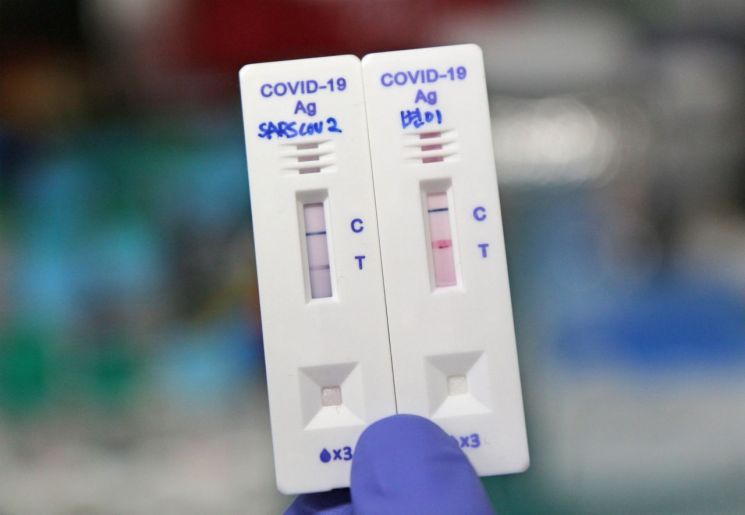
[Asia Economy Reporter Kim Bong-su] Domestic researchers have developed a kit that can diagnose the COVID-19 virus and its sub-variants by distinguishing them like a pregnancy test device.
The Korea Research Institute of Chemical Technology announced on the 4th that the research team of Dr. Kim Hong-gi and Dr. Lee Jong-hwan from the Novel Virus (CEVI) Convergence Research Group developed a diagnostic technology that can detect and distinguish between the normal antigen and variant antigens of the COVID-19 virus by utilizing the difference in binding strength of the ACE2-antibody combination. ACE2 is a receptor substance that the virus uses to penetrate the cell wall when invading human cells.
The COVID-19 virus has various variants such as Alpha, Beta, Delta, and Omicron, and the transmission rate and fatality rate differ depending on the variant, making the detection of variant viruses very important. However, currently, the detection of COVID-19 variant viruses is only possible through gene amplification or sequencing analysis, which require a long time and high costs. Therefore, there is a need to develop diagnostic technology that can rapidly detect variant viruses on-site.
The research team developed a diagnostic device in the form of a ‘pregnancy test kit,’ which is the same as the current COVID-19 antigen rapid test kit. It can rapidly detect not only the normal COVID-19 antigen but also variant antigens on-site and distinguish variant viruses. It can also be used to confirm the formation of neutralizing antibodies against COVID-19 in the body.
The team discovered antibodies with high binding affinity to both the normal and variant antigens of the ‘COVID-19 spike 1 protein,’ labeling them in red, and antibodies with high binding affinity only to the normal antigen, labeling them in blue. These were paired with ACE2 and applied to antigen rapid diagnostic technology. As a result, the normal COVID-19 antigen was detected in purple, and the variant antigen was detected in pink.
This research result is significant for distinguishing variant antigens such as COVID-19 Alpha and Beta, and it is expected that this technology can also rapidly detect and distinguish antigens of variant viruses such as Delta and Omicron on-site.
This research was published in January in the international journal in the field of chemistry and analysis, ‘Biosensors & Bioelectronics’ (Impact factor: 10.618).
© The Asia Business Daily(www.asiae.co.kr). All rights reserved.
![Clutching a Stolen Dior Bag, Saying "I Hate Being Poor but Real"... The Grotesque Con of a "Human Knockoff" [Slate]](https://cwcontent.asiae.co.kr/asiaresize/183/2026021902243444107_1771435474.jpg)















