Russia Blocks Distribution Routes Due to Ukraine Invasion
Seafood Companies' Stocks Rise as Prices Increase
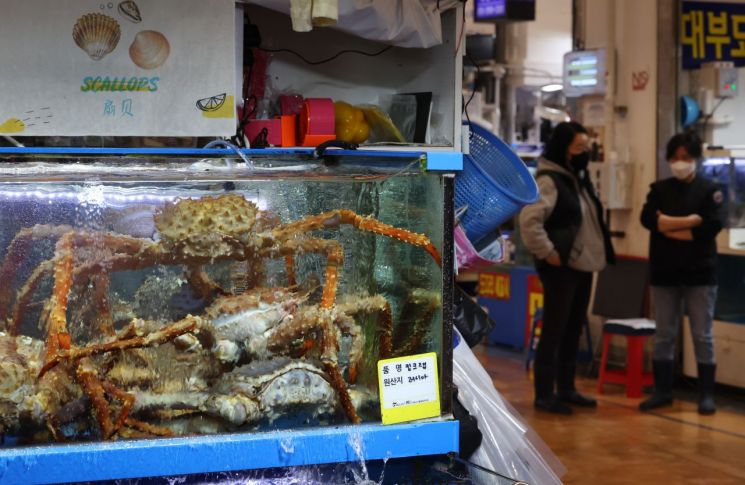
[Asia Economy Reporter Lee Jung-yoon] As the Ukraine crisis disrupts seafood supply and causes prices to rise, seafood stocks are also showing an upward trend.
According to the Korea Exchange on the 4th, Dongwon Fisheries closed at 13,350 KRW in the previous trading session, soaring 35.81% compared to early last month. On the 25th of last month, it recorded a 52-week high of 17,350 KRW. Hansung Enterprise also closed at 9,470 KRW, up 5.11% from the previous day. This represents a 23.15% increase compared to early last month, and notably, it hit the upper limit price (29.90%) on the 2nd of last month.
The reason seafood stocks are rising like this is due to expectations that the increase in seafood prices caused by Russia's invasion of Ukraine will translate into corporate earnings. In fact, flights distributing seafood through Russian airspace have had to use detour routes due to air route blockades, causing prices of salmon and mackerel to surge. According to the weekly seafood market trends at Noryangjin Fisheries Wholesale Market, the average price of salmon per 1 kg from March 21 to 26 this year was 20,600 KRW. This is 1.81 times higher than the average price of 11,400 KRW from March 22 to 27 last year. The average price of mackerel per 1 kg was 4,500 KRW, which is also 1.96 times higher than 2,300 KRW during the same period last year.
Russia accounts for about 5.5% of the world's seafood exports. Domestically, it mainly imports pollock, cod, and snow crab. In particular, it is known that about 80% of pollock imports depend on Russia. Since popular fish species are imported from Russia, prices could surge if supply is blocked.
Experts explain that rising seafood prices do not necessarily translate into corporate earnings. Jo Sang-hoon, a researcher at Shinhan Financial Investment, said, "In the past, seafood stocks also showed an upward trend when supply disruptions occurred due to blocked sea routes, the Japanese nuclear power plant incident, and the boycott of Japanese products," adding, "This is because there is an expectation that companies will raise prices to respond when seafood supply decreases." He continued, "However, since supply reductions have sometimes led to price increases and sometimes not, a cautious approach is necessary when investing."
© The Asia Business Daily(www.asiae.co.kr). All rights reserved.

















