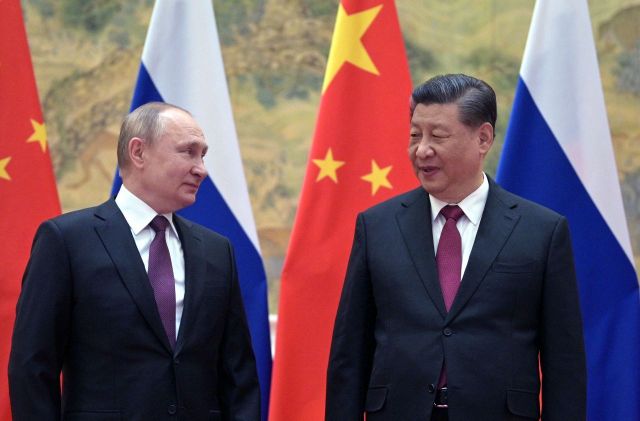
 On February 4th, Russian President Vladimir Putin (left) and Chinese President Xi Jinping pose for a commemorative photo ahead of the summit at the Diaoyutai State Guesthouse in Beijing, China.
 [Photo by Yonhap News]
[Asia Economy Reporter Hwang Sumi] China appears to have tried to divide the United States and Europe, which have united over the Ukraine crisis, but instead confirmed the strong wall of the anti-Russia coalition.
According to China's state-run CCTV on the 1st, Chinese President Xi Jinping, Charles Michel, President of the European Council, and Ursula von der Leyen, President of the European Commission, participated in the 23rd China-European Union (EU) Summit held via video conference on the same day.
The China-EU summit channel is usually a consultative framework attended by Premier Li Keqiang, but this time President Xi Jinping took the forefront.
Although a summit session attended by Premier Li was also held, China's position on the Ukraine crisis was more reflected in President Xi's remarks. Also, state media coverage focused on President Xi's statements. This suggested that China attached considerable significance to this meeting and put much effort into it.
In particular, President Xi's remarks emphasizing Europe's autonomy drew attention. President Xi said, "We hope that the European side will pursue policies based on an independent understanding of China and jointly promote the long-term stabilization of China-Europe relations together with China."
This is analyzed as reflecting China's caution over the strengthened unity between the United States and Europe following the Ukraine crisis. China's true intention is to maintain as harmonious a relationship as possible with Europe, even if conflict with the United States is inevitable.
Earlier last year, due to allegations of repression against the Uyghur ethnic group in Xinjiang and other issues, the ratification of the EU-China Comprehensive Agreement on Investment (CAI), which China had long worked on, was suspended by the European Parliament, causing a rift in relations with Europe.
Subsequently, with the outbreak of the Ukraine crisis, Europe's caution toward China-Russia relations increased. China officially declared a neutral stance but did not criticize Russia's invasion, which violated international law, and opposed sanctions against Russia. The international community interpreted this as China effectively supporting Russia.
Feeling considerable diplomatic pressure, China likely aimed at this summit to ease Europe's caution toward itself and to shift Europe's trajectory, which is strengthening ties with the United States, toward neutrality.
However, the EU's response at this meeting appeared to be far from China's expectations.
According to major foreign media, Ursula von der Leyen, President of the European Commission, stated at a press conference after the summit, "We made it very clear that China must not obstruct our sanctions against Russia."
She also warned China not to support Russia's war efforts or help evade Western sanctions. She added, "This would lead to reputational damage for China in Europe."
China sent a message hoping to strengthen relations with Europe beyond the Ukraine crisis, but Europe is presumed to have chosen containment over cooperation with China. The United States and Europe also issued warning messages about the possibility of China providing a loophole for sanctions against Russia.
Meanwhile, China reaffirmed its opposition to sanctions against Russia. At a regular briefing on the 1st, Chinese Foreign Ministry spokesperson Zhao Lijian, in response to a request for comment on the EU opposing China's support for Russia, said, "Regarding the Ukraine issue, China adheres to an independent and autonomous peaceful diplomatic policy and makes judgments based on right and wrong."
Spokesperson Zhao stated, "Each country has the right to independently decide its foreign policy," and "many countries, including China and developing countries, share the same position on this issue. China has consistently opposed unilateral sanctions."
© The Asia Business Daily(www.asiae.co.kr). All rights reserved.
![Clutching a Stolen Dior Bag, Saying "I Hate Being Poor but Real"... The Grotesque Con of a "Human Knockoff" [Slate]](https://cwcontent.asiae.co.kr/asiaresize/183/2026021902243444107_1771435474.jpg)















