Overcoming the 'Passing' Pain During Moon Administration, Interpreted as 'Code Matching' with New Government
Domestic and International Tourists Expected to Reach 16.7 Million... Tourism Revenue Estimated at 1.8 Trillion KRW Annually
GDP Growth Effect Also Estimated to Range from 1.2 to 3.3 Trillion KRW
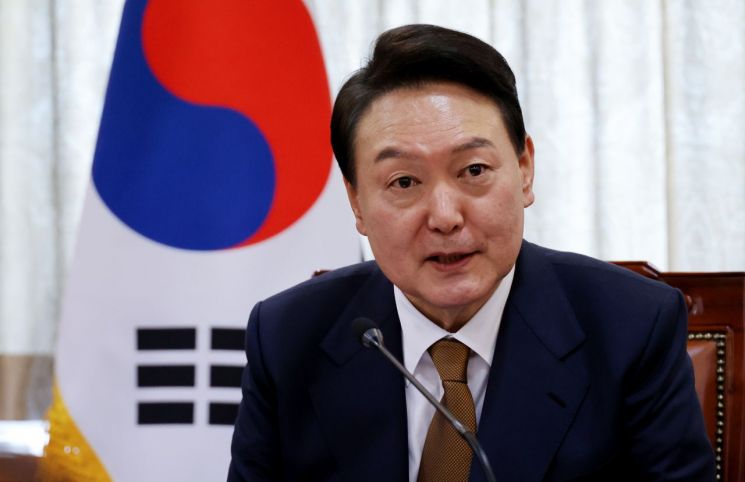 President-elect Yoon Suk-yeol is greeting and meeting with Abdullah Sultan Al Samahi, Charge d'Affaires of the Embassy of the United Arab Emirates in Korea; Zakaria Hamed Hilal Al Sadi, Ambassador of Oman to Korea; Sami Al Sadahan, Ambassador of Saudi Arabia to Korea; Bader Mohamed Al Awadi, Ambassador of Kuwait to Korea; and Mishal Saeed Al Kuwari, Charge d'Affaires of the Embassy of Qatar in Korea, at the transition office in Tongui-dong, Jongno-gu, Seoul, on the afternoon of the 1st.
 Photo by Transition Office Press Corps
[Asia Economy Reporter Jin-ho Kim] The controversy over President-elect Yoon Seok-yeol's plan to relocate the presidential office to Yongsan continues to heat up daily. The political sphere and society at large are grappling with the complex calculations of the pros and cons of moving the Blue House.
Amid this, a recent report released by the Federation of Korean Industries (FKI) has played a role in "adding fuel to the fire." The report anticipates economic benefits 25 times greater than the 200 billion won estimated earlier by the Korea Tourism Research Institute. Analysts suggest that the FKI, which had been thoroughly "passed over" during the Moon Jae-in administration, is actively supporting President-elect Yoon's pledge in an effort to "regain its status."
According to the business community on the 2nd, the Korea Economic Research Institute (KERI) under the FKI recently published a report titled "Economic Effect Analysis of Relocating the Presidential Office to the Yongsan Ministry of National Defense Building." The report was commissioned by KERI to Professor Kim Hyun-seok of Pusan National University.
◆Economic Effect... Over 5 Trillion Won "Should Be Viewed from an Investment Perspective"=The report estimates that if the Blue House is fully opened, tourism revenue alone could reach 1.8 trillion won annually. This assumes that the effect of attracting domestic and international tourists would reach levels comparable to visits after the restoration of Cheonggyecheon in Seoul. The report analyzes that opening the Blue House fully could attract 16.19 million domestic tourists and 510,000 foreign tourists annually.
Of the 1.8 trillion won in tourism revenue, domestic and foreign tourist income are each estimated at around 900 billion won. Professor Kim explained regarding the estimation of tourism revenue effects, "We based it on the annual number of visitors to Cheonggyecheon (17.4 million), subtracting the existing annual visitors to the Blue House (690,000) to estimate the net increase effect from fully opening the Blue House."
Professor Kim particularly valued the Blue House's beautiful scenery and its special significance as the workplace of past presidents. He assessed that fully opening it would also open hiking trails from Gyeongbokgung Palace and the Blue House to Bukaksan Mountain, generating significant tourism demand. He added that if tourism products connecting the Blue House and the Yongsan office were developed, foreign tourists would have high demand as they could visit places where current and former presidents worked all at once.
The report estimates that the economic effect from increased institutional trust among citizens due to the presidential office relocation, which would promote economic actors' activities, would range from 1.2 trillion to 3.3 trillion won based on 2020 GDP.
Social capital is defined as tangible and intangible capital that promotes cooperation within the community, such as trust in national policies and institutions. The report argues that an increase in social capital leads to enhanced government trust, which in turn garners public support for policy implementation, improves policy effectiveness, facilitates information exchange, and contributes to economic growth. Specifically, it analyzes that if the new Yoon Seok-yeol administration relocates the presidential office to Yongsan, expanding communication between the government and the public, it will activate mutual information exchange and create an opportunity to increase institutional trust, thereby improving government policy efficiency.
Professor Kim stated, "The relocation of the presidential office should be viewed not as a cost but from an investment perspective," adding, "I hope it becomes an opportunity to enhance national efficiency and improve public welfare in the long term."
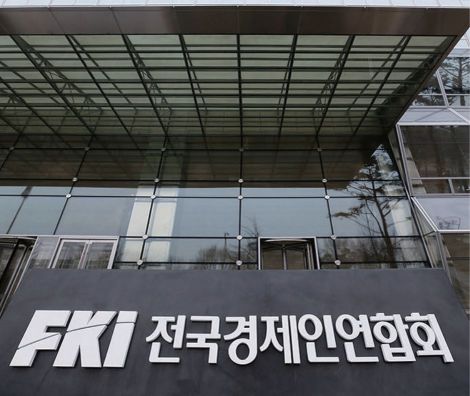
◆Business Community Skeptical... Is FKI Trying to 'Regain Its Status'?=The business community has expressed skepticism about the report. It is considered unusual that the FKI, a gathering of businesspeople, released an analysis on the politically and socially controversial issue of relocating the presidential office.
There is a strong analysis that this was an active "code alignment" effort ahead of the new government's launch. Since the FKI was thoroughly sidelined during the Moon Jae-in administration, the report reflects a determination to restore the organization's fallen status in the new Yoon Seok-yeol administration, which is more business-friendly. Considering the sharply divided public opinion on relocating the presidential office, it is also interpreted as the business community stepping forward to actively support the move on behalf of the industry.
The FKI has been one of the most prestigious economic organizations for decades. However, its status is widely regarded as having declined after four major conglomerates withdrew following the political scandal during the Park Geun-hye administration. The number of employees, once around 200, is reported to have dropped to about 80.
Meanwhile, the FKI is known to have been the fastest among domestic economic organizations to submit economic policy proposals to the Presidential Transition Committee immediately after President-elect Yoon's victory. This, along with releasing a report supporting the presidential office relocation, demonstrates its active efforts to "regain its status."
© The Asia Business Daily(www.asiae.co.kr). All rights reserved.
![Clutching a Stolen Dior Bag, Saying "I Hate Being Poor but Real"... The Grotesque Con of a "Human Knockoff" [Slate]](https://cwcontent.asiae.co.kr/asiaresize/183/2026021902243444107_1771435474.jpg)
















