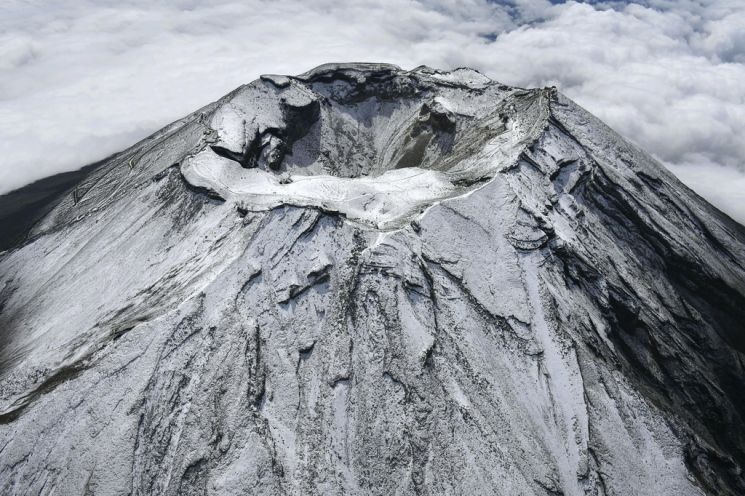
[Asia Economy Reporter Hwang Sumi] Amid ongoing discussions about the potential eruption of Mount Fuji in Japan, a report detailing specific evacuation targets and methods has been released.
Recently, local media such as the Nihon Keizai Shimbun reported that the "Mount Fuji Volcanic Disaster Prevention Council," jointly operated by three prefectures near Mount Fuji (Shizuoka, Yamanashi, and Kanagawa), disclosed an interim report revising the evacuation plan in the event of a Mount Fuji eruption.
According to the report, the council reviewed the existing wide-area evacuation plan based on the latest research and simulations on Mount Fuji eruptions, as well as a revised hazard map (disaster prediction map).
As a result, they estimated that if Mount Fuji erupts, the volume of lava discharge could increase to about twice the previously expected amount. Additionally, the number of residents living in high-risk areas where lava flows could reach within three hours is over 110,000, which is seven times the previous estimate.
The number of municipalities potentially affected by lava flows has also increased from 15 to 27. The population residing in the evacuation target areas was surveyed to be 805,627.
The council also proposed evacuation measures in the event of a Mount Fuji eruption. For residents living in urban areas, it is recommended to evacuate on foot rather than using vehicles. This is because if many residents evacuate by car simultaneously, severe traffic congestion could occur, slowing evacuation speed and potentially causing harm.
However, the use of roads is permitted only for those who have difficulty moving independently, such as the elderly or disabled. Furthermore, about 5,500 residents in eight basic local governments near the crater, where pyroclastic flows (large and small rock fragments released and flowing down due to volcanic eruptions) are expected, should evacuate using vehicles.
The council explained, "Generally, lava flows move slower than walking speed," and added, "It is not necessary to evacuate to distant locations; evacuating in the direction opposite to the lava flow is effective."
Meanwhile, experts have raised their voices, stating that Mount Fuji is already prepared for eruption and that evacuation should occur before an explosion happens.
According to the Japanese weekly magazine Aera in January, Nagao Toshiyasu, a visiting professor at Tokai University Marine Research Institute, said, "Since December last year, seismic activity around Mount Fuji has been increasing," and added, "It would not be surprising if Mount Fuji erupts soon, and the possibility of an eruption this year is not zero."
Another expert expressed concern about a Mount Fuji eruption and recommended residents evacuate. Wada Tamakasa, a disaster crisis management advisor, said, "The Mount Fuji observation system can detect precursors before the volcano erupts," and added, "The actual eruption intensity can only be known after the eruption occurs." He warned, "Waiting for official announcements is foolish. Running away unconditionally is the way to survive."
According to the Japan Meteorological Agency, Mount Fuji has erupted 17 times since the first recorded eruption in 781. The most recent eruption occurred in December 1707, about 300 years ago.
Since then, Mount Fuji had not erupted for a long period and was classified as a "dormant volcano," but after research by the Volcanic Eruption Prediction Liaison Council, which evaluates volcanic activity nationwide in Japan, it was designated as an "active volcano" in 1975.
© The Asia Business Daily(www.asiae.co.kr). All rights reserved.
![Clutching a Stolen Dior Bag, Saying "I Hate Being Poor but Real"... The Grotesque Con of a "Human Knockoff" [Slate]](https://cwcontent.asiae.co.kr/asiaresize/183/2026021902243444107_1771435474.jpg)















