PM2.5 Concentration at 25㎍/㎥
3rd Seasonal Management Plan Focuses on 16 Measures in 4 Sectors Including Transportation and Heating...Estimated Reduction of 130 Tons of PM2.5
Driving Restriction Enforcement Reduces Grade 5 Vehicles by 84%...120,000 Vehicles Inspected for Emissions and Idling
[Asia Economy Reporter Lim Cheol-young] Seoul City announced on the 3rd that it is estimated to have reduced approximately 130 tons of fine particulate matter (PM2.5) and about 2,500 tons of nitrogen oxides (NOx) by implementing the ‘3rd Seasonal Fine Dust Management Plan’ from December last year to the end of March this year.
Over the past four months, Seoul City has intensively promoted 16 reduction measures across four sectors?transportation, heating, workplaces, and others?to reduce fine dust during the winter season. During the seasonal management period, the average concentration of fine particulate matter reached 25㎍/㎥, the lowest since the policy’s implementation. Compared to the same period before the policy (December 2018 to March 2019), the average concentration decreased by 10㎍/㎥ (from 35 to 25㎍/㎥), and the number of ‘Good’ fine dust days (15㎍/㎥ or below) increased more than threefold (from 11 to 38 days).
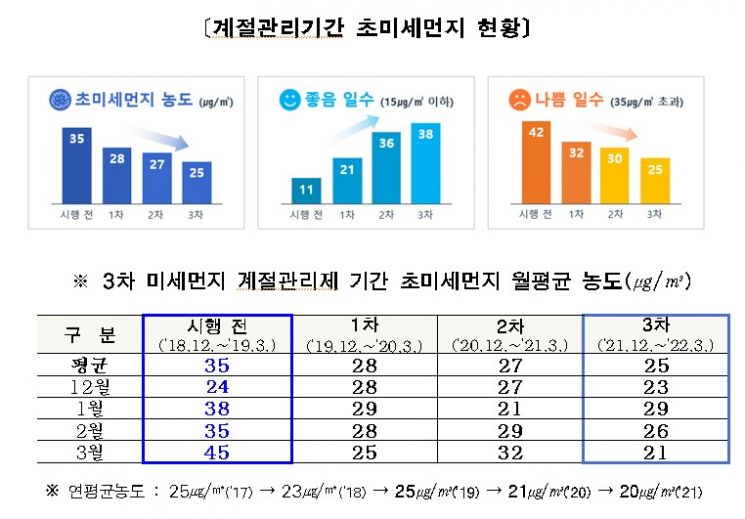
Although PM2.5 concentrations are influenced by a complex combination of meteorological conditions, foreign impacts, and domestic emissions, the city analyzes that the three consecutive years of concentration reduction since the introduction of the seasonal management plan also reflect the policy effect of strengthened emission source management. Regarding meteorological conditions, unfavorable factors such as increased frequency of easterly winds and decreased precipitation compared to the previous year were mixed with favorable factors such as increased rainy days and decreased atmospheric stagnation days. Additionally, the PM2.5 concentration in northeastern China regions including Beijing, Liaodong Peninsula, and Shandong Peninsula improved by 21%, recording 47.8㎍/㎥ compared to 60.3㎍/㎥ during the 2nd seasonal management period.
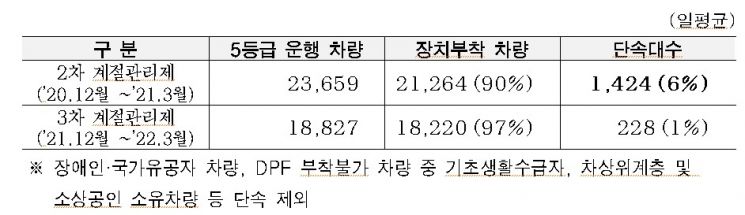
Looking at the major achievements by sector, violations of the operation restriction on Grade 5 vehicles decreased by 84% compared to the previous year, more than 100,000 eco-friendly boilers were distributed, and fine dust emissions were actively suppressed through comprehensive inspections of workplaces. Following the 2nd seasonal management plan, the second enforcement of the Grade 5 vehicle operation restriction resulted in 18,722 violations, an 84% decrease compared to the 2nd plan, indicating that the restriction accelerated the low-emission measures for Grade 5 vehicles. During this period, an average of 18,827 Grade 5 vehicles operated daily in Seoul, of which 18,220 were equipped with Diesel Particulate Filters (DPF), reaching an attachment rate of 97%.
During the seasonal management period, parking fees for Grade 5 vehicles were increased by 50% at 104 city-operated parking lots, resulting in a 35% decrease in the number of parked vehicles compared to November last year before the policy implementation. Subsequently, 112,000 vehicles were inspected for emissions, and 8,300 vehicles for idling; 29 vehicles received improvement orders. Among 666 DPF-equipped vehicles inspected, 91 with poor maintenance were ordered to correct, and 8 cases of intentional DPF damage are currently under prosecution.
Furthermore, Seoul City, together with autonomous districts and the Korea Transportation Safety Authority, conducted special inspections at 57 private vehicle inspection centers, issuing correction orders to 11 centers for defective inspection equipment to prevent poor inspections. During the seasonal management period, 58,747 vehicles participated in the special points program for passenger car mileage. Among them, vehicle owners who drove less than 1,800 km (50% of average mileage) will be evaluated for registration performance and provided with special points worth 10,000 KRW in May.
Additionally, Seoul distributed 102,402 eco-friendly boilers that reduce nitrogen oxide (NOx) emissions to one-eighth compared to general boilers. This is 22% more than the 83,652 units distributed during the 2nd seasonal management plan. 1,211,604 households participated as Eco Mileage members, and after evaluating energy usage over four months, households that succeeded in reducing consumption by 20% or more will receive special points worth 10,000 KRW in September. The city also inspected 285 energy-intensive buildings such as hotels and department stores using over 2,000 TOE annually to ensure compliance with appropriate heating temperatures (below 20℃), issuing guidance to 51 non-compliant buildings to encourage energy saving.
Inspected 3,447 workplaces and construction sites... Operated 390 IoT continuous monitoring systems
Seoul encouraged voluntary reduction of air pollutant emissions from workplaces and conducted inspections. It focused on eradicating unauthorized facilities by inspecting 1,277 sites, resulting in prosecution of 27 unauthorized sites and administrative actions against 5 sites exceeding emission standards. Additionally, 2,170 dust-generating workplaces were fully inspected, identifying 39 violators. The city piloted 23 ‘eco-friendly construction sites’ among large construction projects, strengthening facility standards such as securing dust-cleaning vehicles and installing simple measuring devices.
Seoul connected 390 IoT measurement devices installed at workplaces to build a control system, enhancing enforcement efficiency by linking continuous emission source monitoring with on-site inspections. Some construction sites with detected high fine dust concentrations were inspected on-site, and management was strengthened by expanding water spraying facilities. Furthermore, seven autonomous districts including Gangseo-gu and Seocho-gu, where agricultural waste is generated, operated concentrated waste collection periods and formed monitoring teams to crack down on illegal burning, imposing fines of 3 million KRW for seven illegal burning cases.
Expanded cleaning of priority roads to four times daily... Inspected indoor air quality at 769 multi-use facilities
Seoul designated 56 sections (224.5 km) with heavy traffic and pedestrian flow as priority management roads and increased cleaning frequency more than fourfold compared to the usual once daily. The operational distance of dust-suction street cleaning vehicles also increased by 6%. Subsequently, special inspections were conducted at 769 locations including underground stations, public transportation facilities, academies, and PC rooms frequented by youth, issuing improvement orders to five sites exceeding indoor air quality standards.
The nine fine dust priority management zones implemented more intensive reduction measures than other areas, including inspections of emission workplaces and construction sites, operation of water spraying and dust suction vehicles. To improve air quality in vulnerable underground stations, 1,776 additional air purifiers were installed during the seasonal management period, operating a total of 3,976 units, and air quality management was further strengthened by linking with indoor air quality monitoring systems.
Meanwhile, Seoul encourages large emission workplaces that emit more than 10 tons of air pollutants annually to maximize reduction rates and plans to award commendations to outstanding reduction workplaces in July based on future evaluations. Additionally, analyzing the policy effects of the 3rd seasonal fine dust management plan, the 4th plan to be implemented in December this year will prepare more effective and strengthened measures.
Yoo Yeon-sik, Head of the Climate and Environment Headquarters, said, “Thanks to citizens who actively participated in the seasonal management plan despite inconveniences such as restrictions on Grade 5 vehicle operations, we achieved the lowest concentration ever since the policy’s implementation. We will prepare well for the 4th seasonal management plan starting this December and do our best to create a Seoul free from fine dust concerns.”
© The Asia Business Daily(www.asiae.co.kr). All rights reserved.