Ministry of Justice Mentions Kwon Seong-dong as Example in Transition Committee Report
Proposes Extending Prosecutor General's Term by 4 Years and Independent Budgeting
Passage in Opposition-Controlled National Assembly Faces Difficulties
[Asia Economy Reporter Ki-min Lee] It has been confirmed that the Ministry of Justice presented the “Prosecutors' Office Act Amendment Bill” proposed by Kwon Seong-dong, a member of the People Power Party, as a representative example of measures to ensure prosecutorial neutrality during the Presidential Transition Committee’s work report. There is growing weight to the possibility of pushing for a four-year term for the Prosecutor General and independent budget allocation based on the bill proposed by Kwon, a key figure in Yoon’s inner circle (Yunhaekgwan).
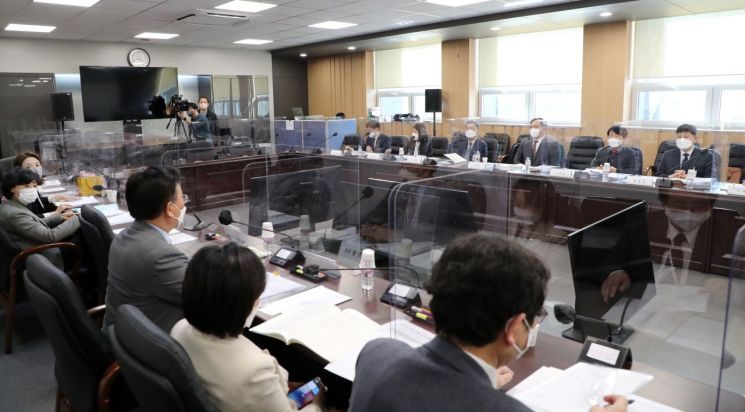
According to the Transition Committee and legal circles on the 1st, the Ministry of Justice reported on Kwon’s Prosecutors' Office Act amendment bill regarding measures to secure prosecutorial neutrality at the Transition Committee meeting room in the Financial Training Institute in Samcheong-dong, Seoul, on the 29th of last month.
The main points of the Prosecutors' Office Act amendment bill, which Kwon proposed as the lead last year, are a four-year term for the Prosecutor General and independent budget allocation. Kwon explained the purpose of the bill by stating, “Prosecutors must serve the entire public and maintain political neutrality as representatives of the public interest when performing their duties. However, under current law, the Minister of Justice can exercise command and supervision over the Prosecutor General, and the Prosecutor General’s term is short, resulting in excessively frequent replacement cycles.”
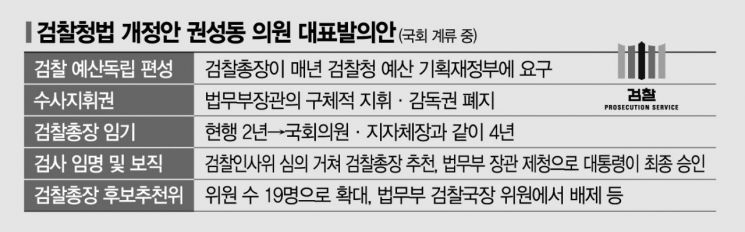
Kwon proposed extending the Prosecutor General’s term from the current two years to four years to secure independence and requiring the Prosecutor General to request the Prosecutors' Office budget from the Ministry of Economy and Finance annually to ensure independent budget allocation. The bill also includes abolishing the Minister of Justice’s specific command and supervision rights, appointing prosecutors and assigning positions through the recommendation of the Prosecutor General and the Minister of Justice’s proposal followed by presidential approval, and excluding the Ministry of Justice’s influence from the Prosecutor General Candidate Recommendation Committee.
Following the Supreme Prosecutors' Office, the Ministry of Justice has also expressed willingness to cooperate in strengthening prosecutorial independence, and with the Transition Committee receiving the bill from Kwon, a key figure in Yoon’s inner circle, there is speculation that legislation may be pursued.
However, even if related discussions intensify in the National Assembly, the passage of the bill cannot be guaranteed. In particular, the Democratic Party, which holds 172 seats in the National Assembly, is concerned about the strengthening of prosecutorial power under the new government and is once again raising the issue of ‘Geomsu Wanbak’ (complete removal of prosecutorial investigation rights). Park Hong-geun, the floor leader of the Democratic Party, said at a party meeting held at the National Assembly the day before, “Investigations under the Moon Jae-in administration are also intensifying. Baseless suspicions about First Lady Kim Jung-sook’s clothing expenses are being raised daily,” adding, “We must gather wisdom to ensure checks and balances. As the opposition and the largest party in the National Assembly, we must unite our efforts to fulfill our role.”
The Transition Committee is also cautious about directly pushing for legislation to secure prosecutorial independence due to practical difficulties. Lee Yong-ho, a member of the People Power Party and secretary of the Political, Judicial, and Administrative Subcommittee of the Transition Committee, acknowledged that the Ministry of Justice cited the bill as an example during the work report but said, “It was explained to mean that there are opinions like that regarding the bill, not that it will necessarily be enacted.”
Right after the Ministry of Justice’s work report, Transition Committee member Yoo Sang-beom said, “The Ministry of Justice expressed agreement that the exercise of the Minister’s investigative command rights has caused some controversy over the infringement of prosecutorial independence,” but added, “However, they did not clearly state their position on specific support and responded that they would actively participate if there is legal revision work under the new government.” The Transition Committee is also considering changing the organizational regulations, which are presidential decrees, rather than legal amendments, to allow independent budget allocation for the Prosecutors' Office.
Meanwhile, regarding President-elect Yoon Seok-yeol’s pledge to reactivate the Blue House Special Inspection Officer system to monitor corruption among the president’s family and others, the Ministry of Justice reported to the Transition Committee that it would cooperate. It also stated that a comprehensive review of the three lease laws is necessary.
© The Asia Business Daily(www.asiae.co.kr). All rights reserved.