Trade Deficit of $4.04 Billion from January to March... Energy Imports Hit Record High
International Oil Prices Continue Soaring... Terms of Trade Also Worsen
Possibility of Prolonged Trade Deficit Trend... Concerns Over 'Twin Deficits'
Government Considering 30% Expansion of Fuel Tax Cut... Announcement on the 5th
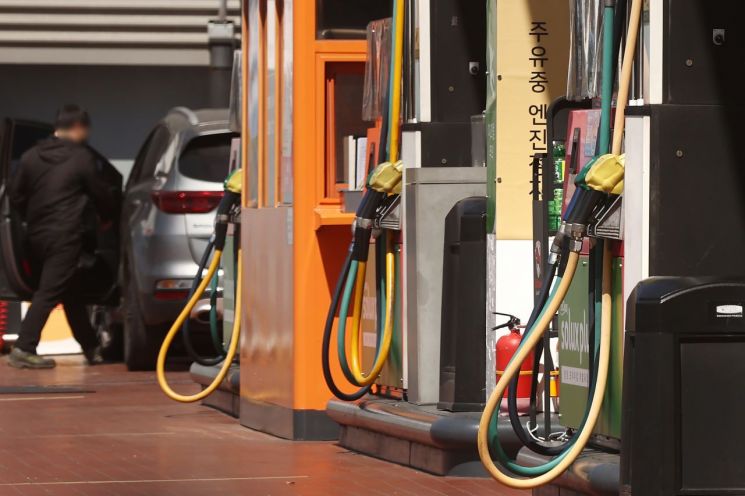 International Energy Prices Soar
(Seoul=Yonhap News) Reporter Jin Yeonsu = As international energy prices continue to soar, they are placing a significant burden on the trade balance and inflation. According to the Korea Customs Service on the 28th, the import value of the three major energy sources (crude oil, gas, coal) from January 1 to March 20 this year reached 38.4966 billion USD, an 85.4% increase compared to the same period last year. Crude oil imports rose by 69.8%, gas imports by 92.0%, and coal imports by 150.6%. The photo shows a gas station in downtown Seoul on the same day. 2022.3.28
jin90@yna.co.kr
(End)
? Yonhap News Agency, unauthorized reproduction and redistribution prohibited
[Asia Economy Sejong=Reporter Lee Jun-hyung] Due to the surge in international energy prices, the trade balance returned to a deficit last month after a month, showing instability in the trade network. Concerns are growing that the longer the high oil price situation triggered by the Ukraine crisis lasts, the more the trade, which is the ‘growth engine’ of the Korean economy, will be directly hit.
According to the Ministry of Trade, Industry and Energy on the 1st, the trade deficit from January to March this year reached 4.04 billion dollars. Although exports have performed well, recording double-digit growth for 13 consecutive months, imports increased at a greater rate due to the rise in international energy prices. In fact, prices of major imported energy such as crude oil (72%), gas (200%), and coal (441%) rose sharply compared to last year. An official from the Ministry of Trade, Industry and Energy explained, "The import value of the three major energy sources is at an all-time high due to the sustained high oil price level of around 110 dollars per barrel," adding, "(Energy import value) had a significant impact on the surge in imports last month."
The problem is that international oil prices continue to soar. International oil prices began to surge in February this year due to geopolitical issues such as the Ukraine crisis and exceeded 100 dollars per barrel last month. At one point, it even approached 140 dollars.
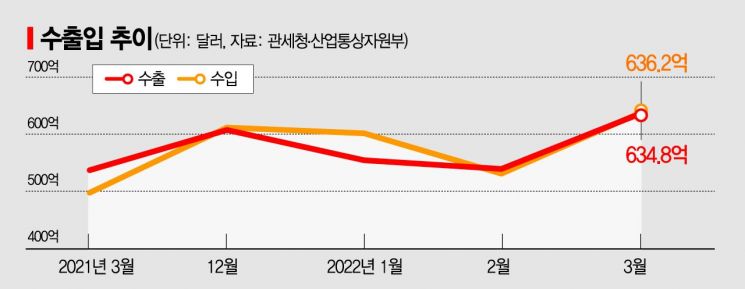
As the impact of high oil prices increases pressure on import price rises, trade terms are worsening. According to the Bank of Korea, the net barter terms of trade index, which shows Korea’s trade terms, fell to 87.69 last month, marking 11 consecutive months of decline. A net barter terms of trade index below 100 means that export goods are not receiving their proper value compared to import goods.
With signs of the Ukraine crisis prolonging, combined with high oil prices and supply chain instability causing raw material price surges, there is analysis that the trade deficit trend may also continue. Professor Sung Tae-yoon of Yonsei University’s Department of Economics said, "External trade conditions are not improving," adding, "Even if the trade balance turns to surplus in the future, it is likely to be a ‘temporary surplus’ like in February this year."
There are also predictions that Korea could fall into a ‘twin deficit’ with both fiscal and current account deficits. The integrated fiscal balance, which subtracts total expenditures from total revenues, has recorded deficits for three consecutive years from 2019 to last year. If both fiscal and current account balances worsen simultaneously, Korea’s external creditworthiness could decline, potentially triggering foreign capital outflows.
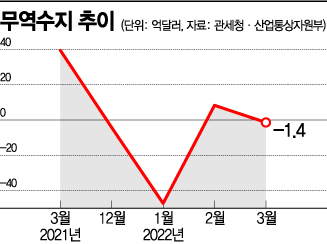
Accordingly, voices demanding government-wide countermeasures are growing louder. The Presidential Transition Committee officially requested the government the day before to expand the fuel tax reduction rate from 20% to 30%.
The government plans to announce whether to expand the fuel tax reduction rate at the Price-Related Ministers’ Meeting scheduled for the 5th. Attention is also focused on additional government measures such as expanding the scope of items subject to tariff quotas.
The Ministry of Trade, Industry and Energy stated that it will prepare support measures such as providing trade finance and expanding logistics voucher targets for export companies. Minister Moon Seung-wook of the Ministry of Trade, Industry and Energy said, "Due to the unprecedented surge in energy prices and the impact of the Ukraine crisis, a slight trade deficit occurred this month," adding, "It is a time when thorough management of trade risks is necessary." Minister Moon also added, "We will closely monitor trends to ensure stable supply and demand of key supply chain items including energy sources such as crude oil and gas, as well as rare gases for semiconductors."
© The Asia Business Daily(www.asiae.co.kr). All rights reserved.