Dollar Hits 125 Yen Amid Yen Weakness Debate... BIS Effective Exchange Rate Already at 1970s Level
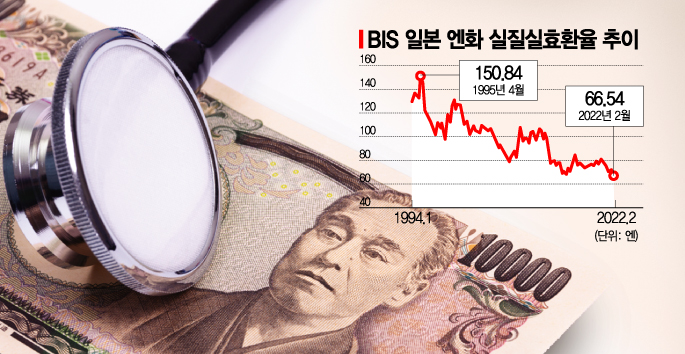
[Asia Economy Reporter Park Byung-hee] The dollar-yen exchange rate hit 125 yen per dollar on the 28th of last month, marking the lowest value of the yen since 2015, intensifying debates over the weak yen in Japan. Haruhiko Kuroda, Governor of the Bank of Japan (BOJ), argues that the weak yen benefits the overall Japanese economy, but companies are increasingly concerned about soaring costs due to rising energy import prices. According to the real effective exchange rate published monthly by the Bank for International Settlements (BIS), the yen has already fallen to levels seen in the 1970s. A decline in the real effective exchange rate is analyzed as a sign of the yen’s weakened purchasing power, which indicates the decline of the Japanese economy.
At the beginning of the year, the yen was trading at 115 yen per dollar, but on the 1st it was at 122 yen per dollar. With growing global economic uncertainties such as the Ukraine war and inflation, the yen has also weakened. In the past, the yen was recognized as a representative safe-haven asset alongside the dollar. It tended to strengthen when global economic uncertainties increased. However, this trend has weakened recently. As Japan’s economic power declines, preference for the yen as a safe-haven asset is also decreasing.
The yen’s decline is well illustrated by the real effective exchange rate published by BIS. Japan’s real effective exchange rate for February, as announced by BIS, was 66.54. This is less than half of the all-time high of 150.84 recorded in April 1995.
The recent yen weakness is due to the BOJ’s monetary policy direction diverging from that of the U.S. Federal Reserve (Fed). While the Fed raised its benchmark interest rate last month for the first time in over three years, signaling a tightening stance, the BOJ continues to maintain its quantitative easing policy. The sharp rise in international oil and natural gas prices has caused Japan’s energy import costs to surge, turning Japan’s current account balance into a deficit since December last year, which is also a cause of the yen’s weakness.
Companies are increasingly worried about the surge in cost burdens due to the weak yen. On the other hand, Governor Kuroda insists that the weak yen still benefits the Japanese economy. In a report released by the BOJ in January, it was analyzed that a 10% depreciation of the yen would increase Japan’s gross domestic product (GDP) by 1 percentage point. Governor Kuroda explained that due to structural changes in the Japanese economy, the economic benefits of a weak yen, which previously appeared as increased exports, now manifest as increased net profits earned by companies overseas. He emphasized that despite changes in Japan’s economic structure, the fact that the weak yen overall benefits the Japanese economy remains unchanged.
However, the offshore expansion of Japanese companies mentioned by Governor Kuroda places a heavy burden on Japan’s domestic economy. As companies leave, jobs decrease, leading to reduced income and sluggish consumption. Among young Japanese, the slang term ‘Oyagacha (親ガチャ)’ has recently become popular. This reflects a dark aspect of the Japanese economy. ‘Oya’ means parents, and ‘gacha’ refers to a toy capsule vending machine. It can be interpreted as ‘parent lottery.’ Just as one needs luck to get a good prize from a vending machine, it means one must be fortunate in the parents they are born to. It is a slang mixing complaints and self-deprecation from young people facing fewer job opportunities and an uncertain future.
© The Asia Business Daily(www.asiae.co.kr). All rights reserved.