Concerns Over Small Business Debt Bomb Exploding at Once
Method to Repay Overdue Loans at Low Interest Rates for Long Periods
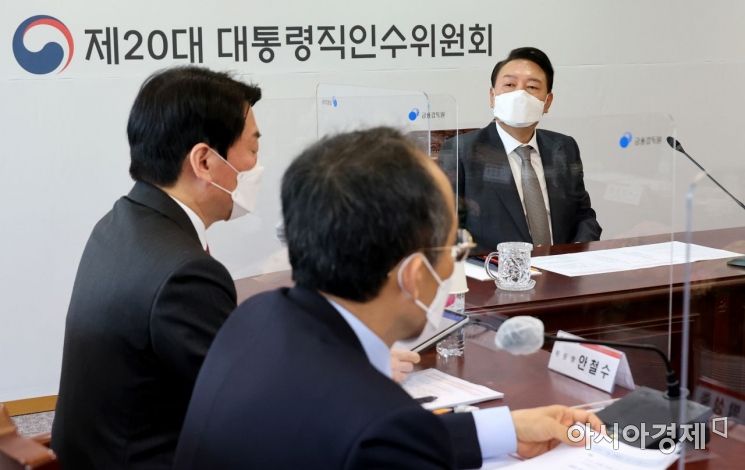 President-elect Yoon Suk-yeol is attending the economic 1st and 2nd subcommittees and the science, technology, and education subcommittee briefing meeting at the Presidential Transition Committee in Tongui-dong, Jongno-gu, Seoul on the 31st, listening attentively to the opening remarks by Transition Committee Chairman Ahn Cheol-soo. Photo by Kim Hyun-min kimhyun81@
[Asia Economy Reporter Sim Nayoung] Can a bad bank rescue small business owners who have been buried in debt since the COVID-19 crisis? On the 31st of last month, Ahn Cheol-soo, chairman of the Presidential Transition Committee, ordered active consideration of a "bad bank," making it a key topic for the new government launching in May. Chairman Ahn said, "Please actively review ways to create a kind of bad bank that allows overdue loans to be repaid over a long period at low interest rates, similar to mortgage loans, through the relevant committees."
Bad Bank That Cleans Up Non-Performing Loans and Restructures Debt
Appears Every Time an Economic Crisis Hits in Past Governments
A bad bank refers to a special fund or bank that cleans up non-performing loans and supports debt restructuring. It has been mentioned as a way to realize President-elect Yoon Seok-yeol's pledge to promote emergency debt restructuring during the foreign exchange crisis. The bad bank first appeared during the 1997 foreign exchange crisis and has been mobilized by successive governments to support vulnerable groups. The Kim Dae-jung administration established the "Non-Performing Loan Resolution Fund" during the foreign exchange crisis and handled 148 trillion won in corporate non-performing loans. The Roh Moo-hyun administration created "Hanmaeum Finance" during the credit card crisis to manage the situation. The Credit Recovery Fund under the Lee Myung-bak administration and the National Happiness Fund under the Park Geun-hye administration were also types of bad banks.
If a bad bank is established, it is likely to be jointly funded by entities related to small business financial support. Chairman Ahn envisions a joint investment method between the Small Enterprise and Market Service and the government. Banks would sell non-performing loans from small business loans to the bad bank, which would assess the debtor's situation, restructure the debt scale, and support a soft landing. The purpose is to prevent a sudden explosion of non-performing loans caused by small business owners who have been barely surviving on debt falling into a state of insolvency.
Banking Sector: "Managing overdue loans according to 30, 60, 90-day schedules is sufficient"
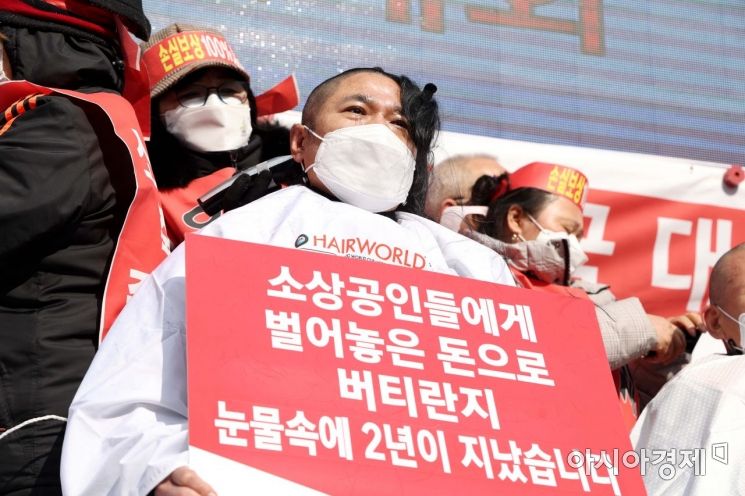 The Corona Victims' Self-Employed Federation (Coja Federation), consisting of 14 self-employed organizations including the Korea Federation of Restaurants, is holding a head-shaving ceremony at the "Government Condemnation Gwanghwamun Rally" held on the 15th at the Gwanghwamun Citizen Open Square in Seoul. They demanded the abolition of business hour restrictions, retroactive application of loss compensation and realization of 100% compensation, inclusion of self-employed persons with sales exceeding 1 billion KRW in the loss compensation target, preparation of separate support plans by Seoul and local governments, and additional application of loss compensation for all businesses opened after the outbreak of COVID-19. Photo by Moon Honam munonam@
At a seminar titled "The Three Major Risks in the Domestic Financial Market and the New Government's Response Strategy," hosted by National Assembly member Yoon Chang-hyun, a planning committee member of the transition team, suggestions related to the "bad bank" were made. Lee Jae-hak, an advisor at Shinhan Bank, proposed, "Considering the needs and interests of small business owners, the government, and financial companies during the COVID-19 situation, I suggest establishing a management organization for small business support loans that can create a win-win structure."
Advisor Lee said, "The management organization can purchase loans with principal overdue by more than 30 days among bank credit loans, manage normalization of existing loans until 60 days overdue, and until 90 days provide customer-specific soft landing consulting and change to customized repayment structures. Loans overdue beyond 90 days can be restructured before being processed as defaults or registered as credit delinquencies."
Since 2020, the government and financial sector have extended the maturity of loans for small business owners and self-employed individuals struggling due to COVID-19 four times in total, postponing repayments until September. As of the end of January this year, the principal and interest of loans with extended maturity or repayment deferral reached 291 trillion won (1,165,000 cases), and the loan balance was 133.4 trillion won (704,000 cases).
Shin Yong-sang, head of the Financial Risk Research Center at the Korea Institute of Finance, said, "Loans to self-employed individuals are large per person and often high-interest loans, with ongoing poor business conditions, making the risk of non-performing loans significantly higher than household debt. To support financial aid, credit recovery, and social fiscal measures, a private joint committee should be established."
© The Asia Business Daily(www.asiae.co.kr). All rights reserved.