Analysis Results of Tap Water Usage Before and After COVID-19 Released
Household Use Up 3.2%... Bath Use Down 40.6%, Public Use Down 18.5%, General Use Down 11.7% All Decreased
[Asia Economy Reporter Lim Cheol-young] The annual tap water usage of Seoul citizens amounted to 1,034.91 million tons, showing an average annual decrease of 2.8% compared to before the COVID-19 outbreak. While usage for general, public, and bathhouse purposes all declined, household usage increased.
On the 31st, the Seoul Metropolitan Waterworks Authority released an analysis of tap water usage data in Seoul before and after COVID-19. The average tap water usage was compared between 2019, before the outbreak, and the two years following it. The analysis covered total annual usage, usage by four sectors (household, general, public, bathhouse), and usage by district.
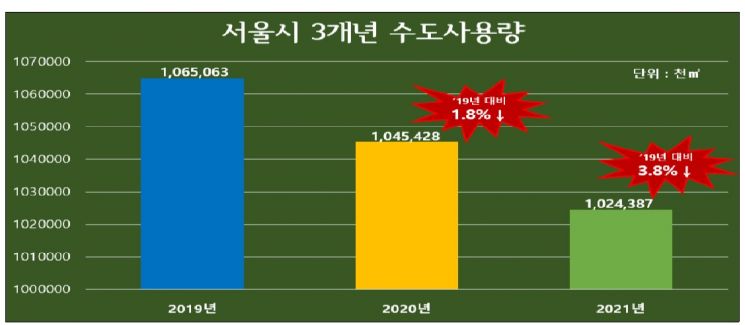
The two-year average tap water usage in Seoul was 1,034.91 million tons, a decrease of 30.15 million tons (2.8%) compared to the 1,065.06 million tons used annually in 2019 before COVID-19. This reduction is equivalent to 4.7 times the freshwater volume of Seokchon Lake (6.36 million tons) and is attributed to social distancing measures such as restrictions on private gatherings and remote work due to the pandemic.
Looking at the yearly figures, the annual usage was 1,065.06 million tons in 2019, 1,045.43 million tons in 2020, and 1,024.39 million tons in 2021. The decrease in usage in 2021 was more than twice that of 2020.
After COVID-19, the increased time spent at home and decreased use of multi-use facilities such as restaurants and cinemas were directly reflected in tap water usage. Household tap water usage increased by about 20 million tons annually (3.2%), while general tap water usage in commercial and business facilities decreased by about 30 million tons annually (11.7%).
Household usage increased during all periods after social distancing measures were fully implemented in March 2020. This is analyzed as a result of increased time spent at home due to reduced outings, remote work, and online classes. The increase averaged 3.2% annually, with a peak increase of 7.3% in May 2020, when a cluster infection linked to the Itaewon clubs occurred, compared to the same period the previous year.
Conversely, general usage decreased during all periods after the COVID-19 outbreak, with an average annual decrease of 11.7%. This is attributed to significant reductions in the use of multi-use facilities such as restaurants, cafes, and sports facilities due to restrictions on private gatherings and business hours. In February last year, just before vaccinations began, usage dropped by as much as 20.1% compared to pre-COVID-19 levels.
Additionally, public tap water usage in facilities such as schools and hospitals decreased by about 10 million tons annually (18.5%), and bathhouse tap water usage decreased by about 8 million tons annually (40.6%). Bathhouse usage showed the largest decrease among the four sectors.
Examining tap water usage by district, almost all areas showed a decrease compared to before COVID-19. Among them, Jung-gu, an office-dense area, had the largest decrease at 17.0%. In contrast, only two districts, Gangdong (4.6% increase) and Eunpyeong (0.4% increase), showed increased usage among the 25 districts.
Meanwhile, tap water usage for the first two months of this year was 164.15 million tons, a 1.1% increase compared to 162.39 million tons during the same period last year. This is interpreted as reflecting the trend of daily life recovery following the government's easing of social distancing guidelines (With COVID-19 policy). The Waterworks Authority expects tap water usage to gradually increase this year as citizens' daily lives continue to recover with the COVID-19 pandemic entering its third year.
Gu Ami, head of the Waterworks Authority, said, “We were able to confirm changes in the daily lives of Seoul citizens due to the prolonged COVID-19 pandemic through this tap water usage analysis. Since tap water usage is expected to recover with the return to normal life this year, we will faithfully carry out the Waterworks Authority’s fundamental role to ensure that citizens can conveniently and safely use tap water anytime and anywhere.”
© The Asia Business Daily(www.asiae.co.kr). All rights reserved.


















