Up to 2 Million KRW Fine for Violations... Increased Labor Cost Burden on Self-Employed
Expected Conflicts with Reluctant Customers... Calls for "Implementation After COVID Calms Down"
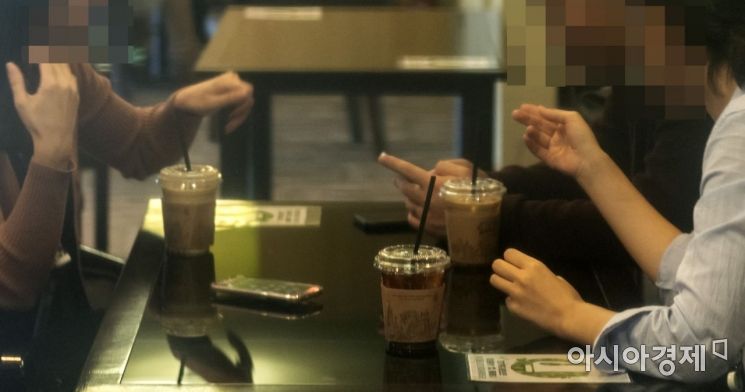 A coffee shop located in a government office building in Seoul is mostly used by public officials, but the use of disposable cups such as plastic cups inside the store remains unchanged. Photo by Yoon Dong-ju doso7@
[Asia Economy Moon Hyewon, Song Seungyun reporters] The use of plastic cups in food service establishments such as cafes, which was temporarily allowed after the outbreak of COVID-19, will be banned again starting from the 1st of next month. Although the purpose is environmental protection, some voices express dissatisfaction, saying that the burden of policy implementation is being shifted onto self-employed business owners. The criticism is that it increases labor costs for self-employed people who are already struggling due to the prolonged COVID-19 pandemic, and that consumers, who are sensitive to hygiene issues at this time, may be reluctant to use cups shared by many rather than disposable ones.
According to the Ministry of Environment and the food service and beverage industry on the 30th, from the 1st of next month, disposable items such as plastic cups will no longer be allowed inside food service establishments. If customers are caught using disposable items in the store, the business owner must pay a fine of up to 2 million KRW depending on the store area and the number of violations.
Large coffee franchises such as Starbucks, Ediya Coffee, and Twosome Place have relatively less burden as they have proactively implemented systems such as free support for mugs and pilot operations of stores without disposable cups from before. In the case of Starbucks, an analysis of 15 years of data from 2007, when the system related to personal reusable cup benefits began to be collected, until October last year, showed that the number of uses was 81.89 million.
However, there are concerns that conflicts may arise between employees who guide customers on the implementation of these systems at each store and consumers, and that the number of complaints from consumers may increase. There is also a concern that the fact that the business is fully responsible for fines or specific operational sanctions such as business suspension when violations are detected is a burden.
The dissatisfaction of relatively small-scale cafe operators is even greater. Kim (43), who operates a small franchise cafe in Gangnam-gu, Seoul, said, "I spent a lot buying 50 mugs, and I am urgently looking for a part-time worker to wash dishes. I am worried about the additional labor costs, but it is also hard to find people."
Lee (38), who runs a personal cafe in Eunpyeong-gu, Seoul, said, "I agree with the purpose of protecting the environment," but added, "If a customer who took a drink in a plastic cup for takeout sits at a table saying 'I'll just sit for a moment' and gets caught in a surprise inspection, the fine is entirely my responsibility. As a shop owner who manages regular customers in the neighborhood, it is not easy to always say unpleasant things to customers, so sometimes I suddenly feel like quitting the business."
The Franchise Association and academic experts unanimously advise that rather than imposing high fines only on business owners when violations are detected at the early stage of policy implementation, the application should be phased in considering the current economic situation.
Kim Jongbaek, head of external cooperation at the Franchise Association, said, "I hope the government approaches regulation by giving incentives or policy benefits to stores that comply well in the early stages through phased implementation," adding, "Most of the store owners under regulation are self-employed, and they complain of fatigue not only from purchasing and washing mugs but also from dealing with customer complaints. Sales have already dropped significantly due to the prolonged COVID-19 pandemic, and increasing this burden only makes things harder for self-employed people."
Professor Lee Eunhee of Inha University’s Department of Consumer Studies said, "Reducing the use of disposable cups is desirable from an environmental protection perspective, but since the minimum wage has increased and self-employed people have laid off employees during the COVID-19 crisis, it is not easy to hire staff again now, so many difficulties are expected," and added, "I hope the government implements the policy flexibly considering the situation on the ground."
As concerns arise that the Ministry of Environment’s recent measure places a burden on self-employed business owners, the Presidential Transition Committee is also supporting delaying the implementation of the system. On the afternoon of the 28th, Ahn Cheolsoo, the head of the transition committee and the COVID-19 Emergency Response Special Committee, said, "I think it is better to postpone the disposable cup regulation until COVID-19 subsides."
The Ministry of Environment, for now, insists that the temporarily postponed system due to COVID-19 cannot be delayed any further. Since the use of disposable items has surged sharply after COVID-19, increasing plastic waste significantly, and since restaurants already use reusable utensils such as spoons and plates with almost no risk of infection, the regulation will be implemented as scheduled on the 1st of next month. However, instead of imposing fines on violating businesses, the ministry is considering ways to stabilize the system through guidance and publicity.
© The Asia Business Daily(www.asiae.co.kr). All rights reserved.
![Clutching a Stolen Dior Bag, Saying "I Hate Being Poor but Real"... The Grotesque Con of a "Human Knockoff" [Slate]](https://cwcontent.asiae.co.kr/asiaresize/183/2026021902243444107_1771435474.jpg)















