Request to Introduce Precision Diagnostic System for Rail and Cable Car Vehicles and Facilities
Establishment of 'Statutory Durability Period' for Major Driving Equipment
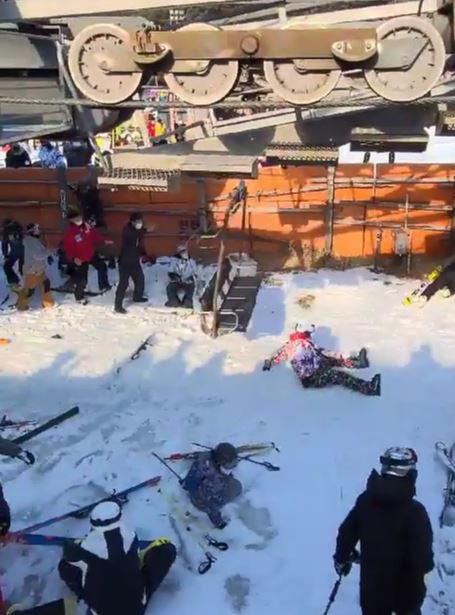
[Asia Economy Reporter La Young-cheol] Gyeonggi Province announced on the 28th that it has proposed improvements to the 'Rail Transport Act' to the Ministry of Land, Infrastructure and Transport, including the introduction of a precision inspection system for rail and cableway facilities, to prevent recurrence of the 'Pocheon Ski Resort Lift Reverse Operation Accident' that occurred last January.
According to Gyeonggi Province, the National Forensic Service investigation revealed that the cause of the accident at Pocheon Bearstown (opened in 1985) was due to the breakage of internal parts of the driving device.
Accordingly, the province proposed introducing the 'precision inspection system,' currently applied only to railroads, to rail and cableway vehicles and facilities to strengthen safety management.
Rail vehicles must undergo precision inspections every five years after 20 years of operation, and rail facilities every 4 to 6 years depending on performance grade after 10 years of operation.
However, until now, rail and cableways have only undergone visual inspections, with no separate regulations for precision inspections.
The proposal also includes establishing a 'statutory durability period' for major driving equipment (such as reducers and wire ropes) of rail and cableways.
Unlike railroads, rail and cableway facilities lack regulations for setting and managing durability periods for parts, so these facilities are often used for extended periods until failure occurs, posing a constant risk of safety accidents, according to the province.
They also requested that standards for reverse operation prevention devices installed on cableway facilities on slopes, such as ski resort lifts, be legally clarified and supplemented.
Under current law, circulating cableways like ski resort lifts are required to install reverse operation prevention or detection devices, but there are no detailed installation standards.
Previously, the Pocheon lift was equipped with a reverse operation prevention device, but it malfunctioned during the accident, causing reverse operation and resulting in casualties.
Therefore, the proposal specifies mandating the installation of reverse operation prevention devices on circulating cableways and detailing installation standards to ensure proper operation under maximum load conditions.
Additionally, it was conveyed that conductors responsible for emergency rescue activities on reciprocating cableways should complete mandatory safety training to prepare for emergencies.
Along with the proposed improvements to the 'Rail Transport Act,' the province plans to strengthen safety inspections in cooperation with central government agencies and related cities and counties to prevent recurrence of rail and cableway accidents.
© The Asia Business Daily(www.asiae.co.kr). All rights reserved.
![Clutching a Stolen Dior Bag, Saying "I Hate Being Poor but Real"... The Grotesque Con of a "Human Knockoff" [Slate]](https://cwcontent.asiae.co.kr/asiaresize/183/2026021902243444107_1771435474.jpg)















