Google and Apple App Store Payments
Up to Twice as Expensive as on PC
Melon and KakaoTalk Prices Vary
Bearing In-App Payment Fees
"Pay via Website Despite Inconvenience"
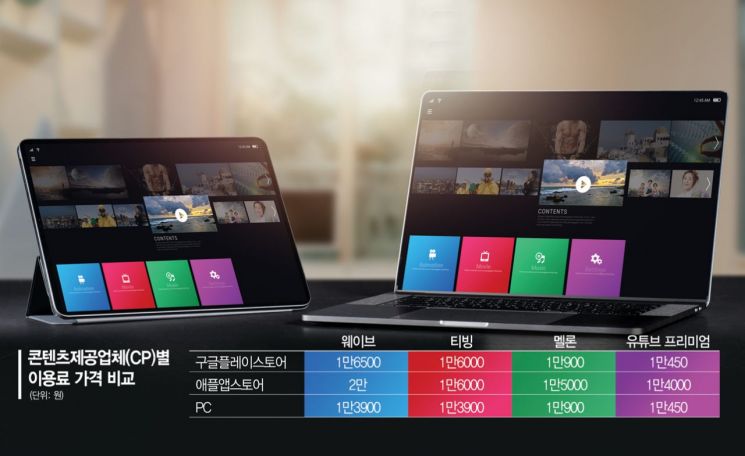
[Asia Economy Reporter Lim Hye-seon] It has been revealed that the usage fees for content providers (CPs) vary greatly depending on the ‘app market toll.’ When making payments on Google (Android) Play Store and Apple (iOS) App Store, content usage fees differ by up to nearly twice as much compared to payments made on PC. As app market operators force content providers to use in-app payments, the burden of commissions ultimately falls on consumers.
Payments on Apps Are Twice as Expensive
According to the IT industry on the 28th, the monthly fee for the OTT service Wavve’s ‘Premium’ product is 13,900 KRW when paid on its website via PC, but it costs 20,000 KRW on the Apple App Store. Starting early next month, the fee will increase to 16,500 KRW when paid through the Google Play Store. This means a single product has three different prices depending on the payment method. This is the result of app market payment commissions being reflected in the price. Apple and Google charge up to 30% commission for payments made within their app markets. For Tving, the monthly fee difference between PC and iPhone Google app payments is as much as 2,100 KRW.
For the music service Melon, the ‘Streaming Plus’ product, which supports unlimited listening and offline playback, costs 15,000 KRW per month when paid via the Apple App Store, but only 10,900 KRW when paid on PC. KakaoTalk emoticons also have different prices: 2,500 KRW on the App Store and 2,000 KRW on PC. For the subscription product ‘Emoticon Plus,’ the price difference between the App Store (6,900 KRW) and PC (3,900 KRW) is nearly double. YouTube’s paid service ‘Premium YouTube’ costs 14,000 KRW per month when paid through the iPhone app, but only 10,450 KRW when paid on PC.
Only Consumers Suffer from Google and Apple Commissions
The price differences by payment method are due to the in-app payment commissions imposed by app market operators. Although the ‘In-App Payment Mandatory Prohibition Act’ (Amendment to the Telecommunications Business Act) came into effect on the 15th, overseas app market operators such as Apple and Google are not complying and continue to force companies to use in-app payments. In-app payment is a method where paid application (app) content must be purchased using an internal payment system developed by Google, Apple, etc. The In-App Payment Mandatory Prohibition Act bans app markets from forcing in-app payments.
In fact, Google announced last November that it would implement ‘third-party payment allowance’ only in Korea, but it is pushing payment policies that contradict the law’s intent. Google is expanding the mandatory in-app payment policy, which was previously applied only to games, to music, webtoons, web novels, and more. It has announced a payment policy that only allows Google Play in-app payments or third-party payments within in-app payments for app developers going forward. Google has notified that if this policy is not followed, it will delete the app from Google Play starting in June. Until now, Google has charged up to 30% commission for using its in-app payment method. Recently, it also allowed third-party payment processing through this system, but the commission in this case is 26%. Considering payment processing fees and card fees, it is actually a loss, so Google is effectively encouraging in-app payments.
An industry insider explained, "Existing users who subscribe through automatic payments or pay via PC will not be subject to the increased fees," adding, "Consumers can reduce their fee burden by enduring the inconvenience and making payments through the website."
© The Asia Business Daily(www.asiae.co.kr). All rights reserved.
![Clutching a Stolen Dior Bag, Saying "I Hate Being Poor but Real"... The Grotesque Con of a "Human Knockoff" [Slate]](https://cwcontent.asiae.co.kr/asiaresize/183/2026021902243444107_1771435474.jpg)















