Controversy Grows Over 'Disabled Mobility Rights' Protest
Seoul Subway Line 3 Used by 23.5 Million Annually
Some Stress 'Excessive Harm' and Demand Tough Response
"Our Indifference Is Shameful," Others Oppose
Experts Say "Korean Society Has Long Excluded Disabled"
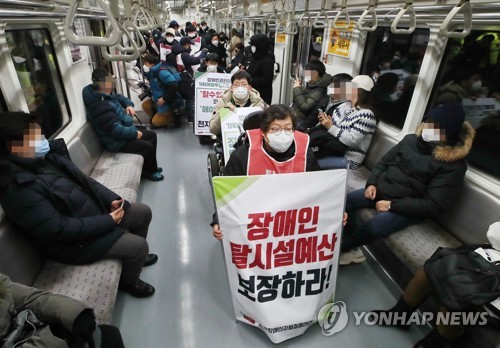 Protests for the Guarantee of Mobility Rights for People with Disabilities, Centered Around Seoul Subway Stations Since the End of Last Year / Photo by Yonhap News
[Asia Economy Reporter Lim Juhyung] "Millions of Seoul subway passengers must not become hostages of a specific group."
This is what Lee Jun-seok, leader of the People Power Party, said regarding the resumption of the 'Disabled Mobility Rights' protests after the 20th presidential election. Lee argued that public authority should be actively deployed against human rights activists and disabled people staging boarding and alighting protests at subway stations during rush hours, sparking controversy.
The controversy is not limited to the political sphere. Citizens who regularly use the Seoul subway are also sharply divided over the protests. While some call for a tough response, arguing that the daily lives of millions of citizens are being disrupted, others counter that the voices of socially vulnerable groups should not be suppressed hastily.
On the 25th, Lee wrote on his Facebook, "No matter how legitimate a claim is, if it excessively infringes on others' rights, it can be negatively evaluated," adding, "The Seoul Metropolitan Police Agency and Seoul Metro Corporation should actively deploy safety personnel. There must be active intervention against the absurdity of the disabled mobility rights struggle holding the mornings of millions of Seoul citizens hostage."
Following Lee's remarks, criticism poured in from the political world. Democratic Party lawmaker Ko Min-jung pointed out on Facebook on the 27th, "The reason Lee's remarks are condemned is the result of his attitude toward socially vulnerable groups such as women and the disabled." Justice Party lawmaker Jang Hye-young also criticized, saying, "The reason disabled people are protesting is because the People Power Party and Lee are ignoring the budget for disabled rights."
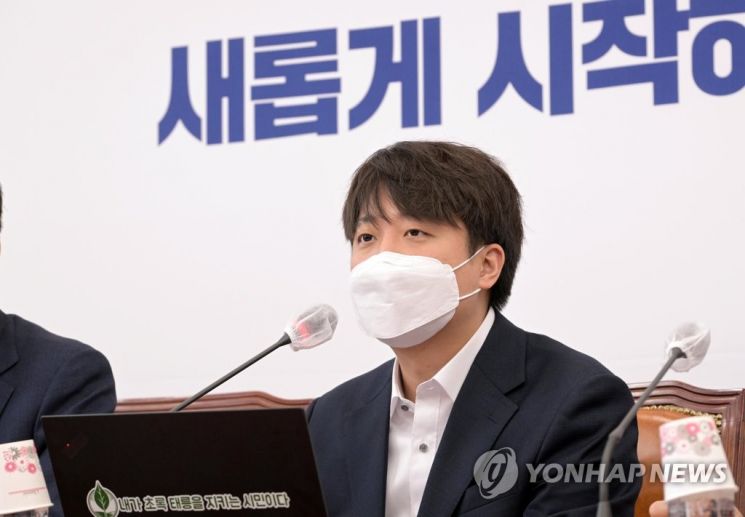
Voices of opposition also emerged within the People Power Party. Kim Ye-ji, a visually impaired lawmaker, criticized Lee in an interview with a media outlet on the same day, saying, "Hasty judgments and language that provoke misunderstanding and hatred are not mature responses." Kim also attended a protest for guaranteeing disabled mobility rights held at Gyeongbokgung Station on Line 3 on the 28th.
◆Annual ridership on Line 3 alone reaches 20 million... "Isn't punishment natural?"
The disabled mobility rights protests have been a 'hot potato' from the start. Activists and disabled people, including the National Solidarity Against Disability Discrimination (Jeonjangyeon), have been staging 'surprise boarding and alighting protests' targeting subway morning commutes since the end of last year. The protests were temporarily suspended during the 20th presidential election campaign but resumed on the 25th.
Jeonjangyeon is pushing forward with these protests as part of their so-called 'propaganda campaign.' They are demanding from the government ▲ national budget responsibility and revision of the Enforcement Decree of the Subsidy Act to guarantee disabled mobility rights ▲ budget allocation for disabled activity assistance ▲ revision of the Enforcement Decree to designate lifelong education facility operating costs for the disabled as a national responsibility. To deliver their message more forcefully, they have blocked the subway during morning commutes.
The protests have sparked significant controversy not only in politics but also in civil society. Some citizens have expressed dissatisfaction, complaining that their morning commutes are disrupted by the disabled protests. Last month, petitions appeared on the Blue House's public petition board calling for strong measures against the disabled groups, such as "Take action against Jeonjangyeon's subway protests" and "Punish the disabled organizations."
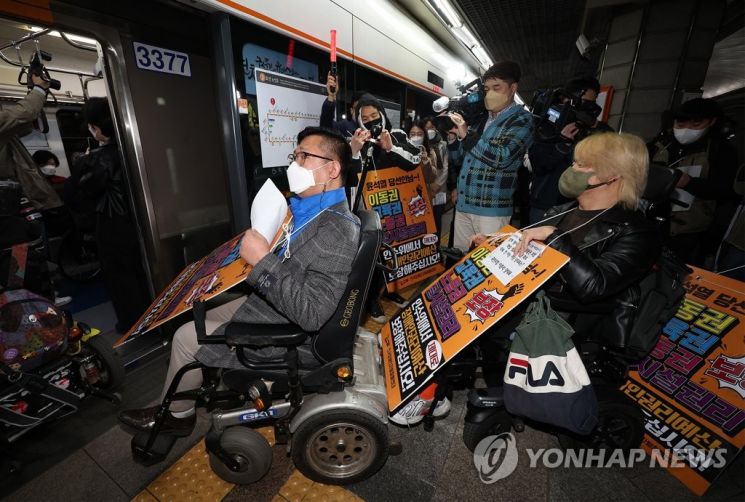 Members of disability organizations, including the National Solidarity for the Elimination of Discrimination against Persons with Disabilities (Jeonjangyeon), are holding a subway protest during the morning rush hour on the 28th at the Line 3 platform of Gyeongbokgung Station in Seoul, demanding the guarantee of mobility rights for persons with disabilities and the inclusion of disability rights budgets. / Photo by Yonhap News
The main issue raised is that the protests cause harm to too many people. According to Seoul city data, as of 2020, the Seoul subway transported 212.7 million passengers annually. Focusing only on Line 3, where protests frequently occur, the ridership reaches 23.5 million. The current Assembly and Demonstration Act allows restrictions if assemblies excessively disrupt traffic in major cities, leading to calls for the same standards to apply to the disabled mobility rights protests.
In fact, Seoul Metro has filed a lawsuit claiming damages against four protest-related figures, including Park Kyung-seok, co-chair of Jeonjangyeon. The police also booked the National Solidarity Against Disability Discrimination on charges of violating the Assembly and Demonstration Act, general traffic obstruction, violation of the Infectious Disease Control and Prevention Act, and general traffic obstruction on the 17th of last month.
◆Over 20 years of 'mobility rights struggle'... "If you curse disabled people 100 times, curse the government at least once"
However, there is also strong opposition to this. Critics argue that suppressing socially vulnerable groups, whose means of voicing their concerns are severely limited, simply because they inconvenience others, is wrong.
A person in their 20s, A, who commutes by subway, said, "I have been late by 20 to 30 minutes for an important appointment because of the protests. But these protests are about people who have never enjoyed freedom of movement demanding the same rights as us," adding, "If they don't raise their voices like this, society's indifference that ignores them should be ashamed, not the disabled."
Another office worker, B (31), said, "I saw posts criticizing disabled protests just because they cause delays in commuting, and it was shocking," adding, "No one seems to think that the society itself, where individual citizens have to bear the inconvenience caused by protests, is wrong. How can all the blame be shifted onto socially vulnerable groups?"
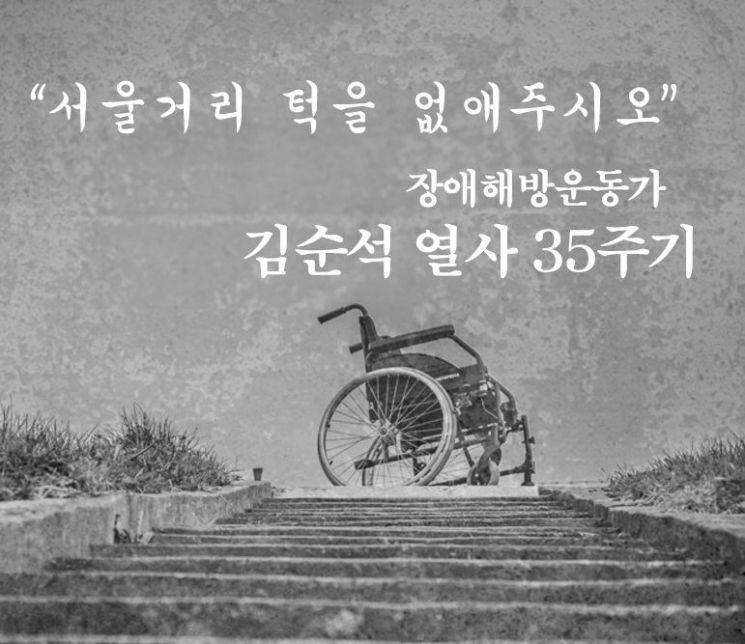 A memorial poster for the 35th anniversary of the late activist Kim Soon-seok, who urged the removal of 'curbs' on Seoul streets that block wheelchair movement / Photo by Disabled Liberation Activists Facebook capture
The struggle for mobility rights by disabled people has been ongoing for decades. The first mobility rights movement began in 1984 with the death of the late Kim Soon-seok, who left five wills to the Seoul mayor demanding the removal of road curbs blocking wheelchairs before passing away.
After lift fall accidents at Oido Station (2001) and Balsan Station (2002), protests demanding accountability and prevention of recurrence intensified. Although the disabled mobility rights protests have continued for over 20 years as of this year, infrastructure improvements for transportation-vulnerable groups, such as installing elevators in subway stations and universalizing low-floor buses, still have a long way to go.
Ultimately, disabled human rights activists, including Jeonjangyeon, escalated their tactics to 'strong measures' by staging boarding and alighting protests at subway stations, beyond marches in Gwanghwamun (2020) and protests at the residence of Deputy Prime Minister and Minister of Economy and Finance Hong Nam-ki (2021). The activists hope that citizens, who experience inconvenience due to the disabled mobility rights protests, will show solidarity with disabled people who have faced lifelong mobility restrictions.
Park Kyung-seok, co-representative of Jeonjangyeon, said at a mobility rights protest held at Chungmuro Station on Line 3 last month, "(Citizens) are naturally angry, but if you curse disabled people 100 times, please curse the government and presidential candidates at least once. We will accept punishment willingly," adding, "The government must also take responsibility for ignoring disabled mobility rights for the past 21 years; isn't that at least fair?"
Experts point out that the problem lies in the fact that social infrastructure has been built while thoroughly excluding disabled people.
Kim Ji-hak, director of the Korea Diversity Research Institute, explained, "Disabled mobility rights protests have continued for decades, and during that time, Korean society has excluded the convenience and safety of disabled people when building transportation-related systems," adding, "These protests are forced to proceed in ways that attract more public attention to highlight such injustice."
He continued, "Citizens may experience inconvenience during the protests, but instead of blaming disabled groups for the cause, it is time to unite and think together to build a world where disabled and non-disabled people can coexist," emphasizing, "When a society considerate of disabled people is created, the benefits will also return to non-disabled people."
© The Asia Business Daily(www.asiae.co.kr). All rights reserved.
![Clutching a Stolen Dior Bag, Saying "I Hate Being Poor but Real"... The Grotesque Con of a "Human Knockoff" [Slate]](https://cwcontent.asiae.co.kr/asiaresize/183/2026021902243444107_1771435474.jpg)













